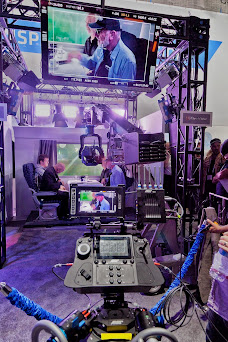
A PREVIEW OF CAMERAS AT NABSHOW 2010

If you're headed out to Las Vegas in a few short weeks, cameras are probably high on your list of gear to check out, whether or not you're a shooter/ cinematographer. NAB 2010 promises a lot of innovation, especially in two areas: HDSLR video and stereoscopic 3D image capture.
Panasonic Corporation will release the world's first
professional fully integrated Full HD 3D camcorder

Panasonic had the flashiest pre-NAB camera announcement out of the major camera manufacturers; I covered its new single-body stereoscopic 3D camera when the company announced details about the $21,000 AG-3DA1 in February. Still, there's a lot more to learn at NAB about the 3DA1, such as literally everything about those two integrated lenses. And, of course, the company will undoubtedly be keeping a few products under wraps until its press conference on the Sunday before the show.

Canon has had quite a week, and it seems to be getting its cinematic ducks in a row well before the NAB 2010. First came the release of its new 2.0.3 firmware for its EOS 5D Mark II HDSLR camera, which added 24p and 29.97 recording as well as manual audio metering. Then came the news that there was a bug in the firmware; audio would not be recorded if the camera lost power while in certain modes, and Canon quickly yanked the firmware update. Finally on Friday, Canon quickly posted firmware update 2.0.4, which fixes the bug. Not done yet, the company also posted its free Apple Final Cut Pro log and transfer utility, EOS MOVIE Plugin-E1 that it had announced in February.
 Canon prototype
Expect to see a lot of HDSLR action in the Canon booth, as well as a prototype of the company's new professional camcorder line that records 4:2:2 video as 50Mbps MPEG-2 (the XF codec). 

Will JVC show successors to its GY-HM100 and GY-HM700 cameras? The company will certainly be bringing new 4K projectors and stereo 3D monitors to the show, but so far it hasn't announced anything in terms of new cameras.
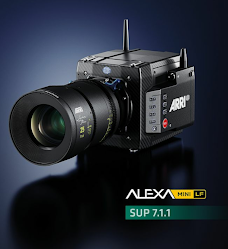
Arri and Red Digital Cinema seem to be headed toward a RAW video face-off; Red's Jim Jannard has offered his competitor some kind words as ARRI introduced its new Alexa prototype in advance of NAB 2010. The digital camera weighs 5.8 kilograms; comparable to a 16mm camera. ARRI claims Alexa's LF3 sensor has a latitude of 13 stops and basic sensitivity of 800 ASA. It's a PL-mount camera, and simplicity is the key; most buttons have a single function only.
Red, of course, recently has introduced its Mysterium-X sensor, which effectively makes the Red One a whole new model. The company is sponsoring a REDucation event in advance of NAB 2010, April 8 through 12.

 Sony 3D camera prototype
Sony hasn't announced anything specific in advance of the show, but the NXCAM line of professional AVCHD cameras that the company announced in November should figure prominently. Sunday's Sony press conference will of course reveal more. Will Sony be showing off its single-lens 3D technology in any form?.

The technology relies on a single "main lens "and a gauntlet of four mirrors, which divert two portions of the single image to two separate "imaging lenses," which are then captured by two separate sensors. This technology, which was introduced in prototype form at CEATEC 2009 in Japan, also comprises high-speed image capture up to 240fps, for super-slow-motion recording.
  For-A VFC-7000
Speaking of high-speed cameras, at NAB 2010 Vision Research will be showing its Phantom HD Gold camera that it introduced last summer. The company has a new camera to show as well, but as of yet there are no details available. For-A will be displaying its new lightweight variable frame rate camera, the VFC-7000, that shoots up to 700fps at 1280x720. Scitech/IDT will be at the show with Redlake high-speed cameras, which have been used in prominent Hollywood productions from the past year.

FAIRBURN 3D CHART

Designed for Precise Setup and Post Processing with a Range of 3D Camera Systems. 
The new  Fairburn 3D Chart was designed by veteran cinematographer B. Sean Fairburn in collaboration with DSC Labs for precise setup and post processing with a range of 3D camera systems. Dimensions of this chart are 24"W x 14.75"H x .125" thickness.


Feature tools include:

* Horizontal and Vertical Alignment (White Cross through middle "Superwhite" and small crosses)
* Focus Fans in corners (Maximum contrast for ease of viewing even in Low light)
* Zoom Ring 10" in diameter (to see zoom disparity between cameras focal length) 5 pixels
* Keystone Correction (colored Balls and White rings in corners)
* Horizontal Scale in cm and Inches (to see exact IO offset at Parallel)
* Mini Gray Scale (Swatch at Bottom #1 White, #6 Middle Gray, #11 Black + "Superblack".08)
* 18% Gray Scale Chips (at top of chart on RT and LT)
* Chroma Du Monde Color Reference in Hexagon Shape (which matches Vector Scope orientation)
* RIGHT and LEFT words on white lines used as orientation detectors
* Arrows Up and Right Also used as Orientation detectors (base of Triangle is 40 Pixels)
* Red R and Blue L to show Color and eye reference (Red Right eye-Blue Left eye)
* RED R show image Flip or Flop orientation
* RGB&YCM have been added at highest printable value
* Focus Fans at the Center are for zoomed in focus Aide
* Scale on far R & L to measure Horiz and rotational offset
* Dead Center Cross

3D Test Chart Procedures:
DURING PREP:
It's best to work with Cameras Individually separately first then mount camera lens pairs to Rig at the same time. Set up the Chart on a C Stand with the Mounting Stand. Use Level and tape or laser to measure height of Center Chart match height of Center Lens. Chart should be flat to the image plane so that distance to sides match and top bottom match. Light Chart so no reflections appear on chart. Mount lens to camera snugly, set backfocus on lens. Lenses must track through zoom. Lens Tracking can ONLY be set properly when on the camera that will be shooting that lens. Bench tracking a lens will not track properly on every sensor. Mount lens to camera widen out. Pan & tilt to center the crosshairs on chart, now zoom in and mark location of crosshairs at telephoto. If it is not centered on the chart to the sensor adjustment in tracking must be done by Lens Tech. Once done this lens and Camera are "Married" and should not be separated. Rods and motors lens brackets should all be Set and Snug then kept together. Color Adjustment can also be done and saved as LUT's or Scene Files (You will do this again once mounted to camera rig with beamsplitter). Right Eye Camera should be marked with RED tape (RED RIGHT) on 2nd Rigg (YELLOW RIGHT). Left Eye Camera should be marked with BLUE tape (BLUE LEFT) on 2nd Rigg (GREEN LEFT).
 3D RIGG SETUP:
Begin 3D Camera Setup by Mechanically zeroing out everything from the Tripod, head, rig mount, and camera mounting plates. Level the head, level & plumb both plates. Mount Cameras (with lenses and motors and rods) to Rig so that they are same distance to reflective surface Mirror. If Side by Side insure they match forward or backward. Insure Focus, Iris, Zoom, match and are set the same. Even the best rigs may have some degree of offset between them therefore having an Alignment chart gives a common critical reference point for the 2 Cameras to be brought into Alignment and to match. Rolling on the chart will also give a tool for Post to continue the work or adjust as needed later. If using a Beam Splitter 50/50 Mirror. Best Viewed on a 50/50 Overlay monitor (One Half dissolved between the 2 images). Drive the IO and C to ZERO called  ZERO Inter-ocular . Goal here is to make the cameras see exactly the same thing the same vector on all objects in the shot. They should match exactly in:

1. Horizontal
2. Vertical
3. Zoom Size
4. Focus Distance
5. Rotation
6. Iris
7. Black/White/Mid/Color
8. Genlock
9. Shutter Sync
10. Equal distant Cables from cameras to Recorders, Switchers and Monitors.
Now the Chart becomes a Reference Tool to see exactly how each camera is aligned and if adjustments need to be made.

 KEY ELEMENT: 
Use a Mini Maglight with the reflector and lens removed to expose just the raw bulb between the chart and the rig as a foreground object. If you see 2 bulbs and 1 chart you are NOT at ZERO IO. If you see 1 bulb and 1 chart you are now at ZERO IO. Final Color Adjustments through the Beamsplitter must also be made to match the color of both cameras with the hexagon CDM on the chart. Save Beamsplitter offset in Lens File or as part of the LUT for Post.

IN THE FIELD:
Measure the distance to the chart and note that distance and focal length. Use the 3-D Chart for morning setup and at the beginning of every scene to give an Alignment and color reference to Post to continue the adjustments if needed. At the head of every Tape or scene. Cover the Left side markings of the chart, Roll the Right Eye only. Cover the Right side markings of the chart, Roll the Left Eye only. Record the chart with both cameras. It would be nice to set convergence to INFINITY first to show your Inter-Ocular distance. Then show the chart converged. Then set the convergence where you want for the scene. Chart distance consistency will be helpful in post when possible. Good habit at the head of a scene first shot. Roll on chart till Speed, then Mark with Sync Slate, begin the Shot. Another good habit is to tail stick every shot as well to look for drift in cameras.

IN POST:
When syncing 2 eyes use the 3-D chart as a reference for H & V, Zoom, Rotation, proper convergence Setting.

The Fairburn 3D Chart is available for purchase at FilmTools in Burbank, CA

ALICE IN WONDERLAND. ONE WILD TEA PARTY

Since this book of fantasy and adventure was first published in 1865, Alice in Wonderland [written by the Reverend Charles Lutwidge Dodgson using the penname Lewis Carroll, with illustrations by John Tenniel] has enchanted generations with a fabulist’s tale that touches deep into the collective dreamscape. Tim Burton, no stranger to creating iconic imagery, observes that “great stories” like Alice “stay around because they tap into things that people aren’t even aware of on a conscious level. There’s definitely something about those images.”

Burton, whose new 3D version arrives in theaters March 5th via Walt Disney Pictures, should know: he lives and works in the London home once owned by Arthur Rackham, the illustrator who created color plates for the book’s 1907 edition. In Burton’s telling (written by The Lion King co-writer Linda Woolverton) Alice is 19 and about to enter into a marriage engagement with a dull, arrogant man. Instead, she follows the White Rabbit down the familiar rabbit hole to Underland (called Wonderland by its inhabitants), a place she visited ten years earlier but does not remember. There, her old friend, the Mad Hatter, convinces her to help overthrow the Red Queen who has taken over Wonderland. In a journey where she grows both large and small, Alice goes on an adventure of self-discovery to save her old friends and the magical place she visited as a child.
 Alice, Bigger Than Life

To realize his version of the often bizarre but familiar images in Alice’s world, Burton chose cinematographer Dariusz Wolski, ASC, who had just finished working with the director on Sweeney Todd, The Demon Barber of Fleet Street. Wolski says the film evolved dramatically from its early production plan. “Originally, it was just Alice as a real person,” he explains. “Then Tim added Johnny [Depp] as the Mad Hatter and Helena [Bonham Carter] as the Red Queen. We had a bunch of amazing actors and decided to shoot them for real, against green screen, and create the sets virtually except for the beginning and the end of the film, which are normal live action.”
 Because the movie would incorporate so much computer-generated imagery, the decision was made to shoot digitally. While Burton was in London, working on the design of the film, Wolski began testing all the available 3D equipment, including Vince Pace’s 3D Fusion Camera system developed for Avatar.

“We were trying to shoot this film in 50 days, since all we were shooting was the actors on green screen, representing only 30 percent of the movie,” Wolski recalls.

But he and Burton later abandoned the idea of shooting in 3D, in part because it would be “prohibitively expensive.” Wolski also pointed out that if they wanted a Technocrane or a camera on a dolly, he’d be dealing with multiple cameras. “Any time I wanted to change the lens, I’d have to recalibrate,” he says. “Knowing Tim’s temperament - he’s very spontaneous - we were afraid the whole thing would slow down our process.”

Burton had already had a positive experience converting the 2D The Nightmare Before Christmas to 3D in post. “After seeing that conversion job, I found no reason to do it any other way,” Burton says. “Shooting it traditionally gave us more freedom to get into the depth, the layers, that we wanted in the time we were dealing with. We were trying to do it faster…and I didn’t see any difference in quality.” [Alice in Wonderland’s 3D conversion was done by Sony Imageworks, which also oversaw VFX, supervised by Ken Ralston. The project underwent two digital intermediates, supervised by Burton and Wolski, at Company 3 in Santa Monica. Colorist Stefan Sonnenfeld graded the 2D version, and then after the 2D-to-3D conversion, colorist Siggy Ferstl did final tweaks to the 3D version.]

Even though he wouldn’t be shooting in 3D, Wolski did take the time to educate himself thoroughly about 3D so that the end result of the 2D-to-3D conversion would work well. “Shooting all those 3D tests taught us a lot,” the cinematographer says. “It taught us about convergence, what lenses to use, how to frame the shot, and at what points 3D is effective and not. We always kept in mind we were shooting a 3D film.”

Wolski recounts studying a National Geographic movie shot in 3D: “There was a lion, shot with a long lens, and it looked really fake,” he begins. “The perspective is compressed. So, to be safe, I felt it was best to shoot [Alice] on the wider side. An understanding of convergence when you’re creating a composition - in other words, keeping in mind what will be in the foreground and the background - really helped.”

Ultimately, Wolski says he chose “fairly standard” lenses. “The 75mm was the longest lens we used, except perhaps for some effects shots, when the White Queen was looking through her binoculars, ” he adds. “Otherwise, it was 50mm, 24mm, 17mm.”

Choosing the camera was trickier. “I was toying between the Sony F23 - because the F35 wasn’t yet available - and the Panavision Genesis,” Wolski continues. “The F23 is a great camera, but I had a problem, because of the size of the chip, where wide shots were not very sharp. Since the actors were always against green screen, I often had the problem of not enough resolution.” He analyzed capture from both cameras more closely at Sony Imageworks, preferring the Genesis in the head-to-head comparison.

But given the desire for “even more resolution,” Wolski also chose the now-defunct 4K-chipped Dalsa Origin for multiple-character scenes where one character either shrinks or expands in size. All the digitally captured material in the film was laid down on Codex Digital disk recorders, which record 10-bit RGB 4:4:4. Wolski notes that he only created one LUT. “What I have found with digital technology is that it’s so overwhelming and there are so many possibilities of tweaking the camera that you can get completely lost,” he describes. “I gave myself one LUT and kept everything simple, not too contrasty, not too flat, and then did everything with lighting. Otherwise, you’re chasing your own tail.”
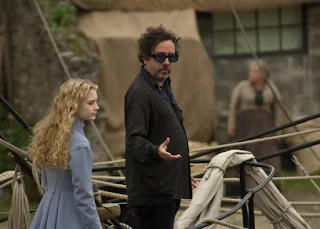
DP Dariusz Wolski, ASC and Director Tim Burton

The cinematographer kept those lighting choices fluid to match the workflow.
“My approach was to be able to move fast and give actors and myself the freedom of changing the mood very quickly,” Wolski continues. The task was to light three 150-by-80-foot green screen stages, differentiated only by topography, such as a castle or hills, which would be transformed into every different indoor and outdoor setting in the film via visual effects. “The most challenging thing was imagining the scene being surrounded by green screen,” he remembers. “You’re dealing with requirements you have to meet to pull the proper mattes and at the same time trying to create a mood.”

The solution was to only have as much green showing as necessary. In addition to a set of black curtains that were repositioned around the stages, Wolski also found light and dark gray fabrics that he placed on the floor to eliminate green spill and also avoid any green bounce. “When you want to put part of the face in shadow, if you’re surrounded by green, the shadow becomes green,” he explains. “Using this gray fabric was one approach we developed that became pretty successful.”

The Alice team (which included A-camera operator Martin Schaer, Steadicam and B-camera operator Scott Sakamoto, additional camera operator Kirby Washington, Libra head operator John Bonnin, D.I.T.’s David Canning and Ryan Nguyen) also used a big silk that doubled as a way for the Sony Imageworks crew to collect data on the relationships of characters to the space.

 “We created tracking marks on the silk that gave them a reference,” Wolski shares. They also placed 20K Fresnels on scissor lifts. “If it was an overcast day, we’d just use the top silk, and for a sunset glow, we shot the 20Ks through different kinds of diffusion. That gave me basically every possibility we’d have if we had shot outside.”

For the scenes when the JubJub, a large bird attacks Alice, the crew built a 16-foot diameter black circle and placed it on the crane. “When the bird attacked Alice or interacted with the actors, we had a big shadow we would drive over the faces,” Wolski says. “We tried to create as much interactive lighting as possible.” But going too far with lighting, which could have negatively impacted the work of the visual effects team, was a danger. “There was a constant dialogue between myself and the VFX supervisor Ken Ralston,” Wolski relates. “How much we would do the shadow, where the monster was coming from, where there would be flames. Problems disappear and new ones arise on the set, and, together, [Ken and I] could always find a solution.”

That fluidity extended to the production design, by Robert Stromberg, and the art direction, supervised by Stefan Dechant. “There was a lot of pre-visualization and rendering,” Wolski adds. “But once you come on stage, hardly any of that is there, so you have the freedom of changing it. [Previs] is a luxury that can also become a trap.”

So does Alice re-imagine the century-old iconic images or create something entirely new? A little of both, according to Wolski, who says, “there were so many references in the movie to the old illustrations and other elements. But it’s Tim Burton’s film and ultimately it’s going to be his interpretation.”

And that means a journey through Alice’s timeless and iconic world reflective of the filmmaker’s unique sensibilities. “Those characters are in our dreams, our tales,” Burton concludes. “[But] what I like about [this version of the story] is that it’s more of a personal journey: the moment where you make that important choice. It’s reconciling within yourself who you are, becoming the person you’re going to be, a human being.”

Courtesy of ICG Magazine /Debra Kaufman

SPIRIT AWARDS 2010

25th Film Independent Spirit Awards Arrivals Show

Roger Deakins, ASC, BSC took home the Best Cinematography Award for his work on Joel and Ethan Coen’s A Serious Man. Deakins is not in the running for the Best Cinematography Oscar this year, though he’s been nominated eight times in the past. The last time was last year, when he and Chris Menges shared an Oscar nomination for Stephen Daldry’s The Reader. A Serious Man and Ethan and Joel Coen took home the prestigious Robert Altman Award.


Click small lower button left to play
Turn off main video window above

Roger Deakins, ASC, BSC and Ethan Coen
(read, Roger Deakins, Keeping an eye on the small things)

 A Serious Man was awarded in the
category of Best Cinematography
and it was the recipient of the prestigious
Robert Altman Award.
T-Bone Burnett and Jeff Bridges, 
Independent Spirit Awards winners
for Crazy Heart.

WHITE RIBBON'S CHRISTIAN BERGER EARNS TOP ASC AWARDS

On Saturday night at the Hyatt Regency in Century City, Austrian born cinematographer Christian Berger ACC, took top honors at the 24th Annual American Society of Cinematographers (ASC) Outstanding Achievement Awards for his masterly neo-realist look in black and white photography on the German language drama "The White Ribbon" (Das Wiese Band) by Palme D'Or 2009 winner director, Michael Haneke. The White Ribbon, Berger and Haneke are also nominated for Best Cinematography and Best Foreign Language Film for the upcoming 82nd Academy Awards.
Christian Berger, ACC  

The White Ribbon
 The award was presented eloquently by British actor Timothy Dalton who introduced the diverse range of films that were nominated for top honors in the feature film category and said "Movies are amazing, You walk into a darkened theater and you are swept up in a story steeped in fact or built on fantasy and everything in-between. You can fall in love with characters or the story can break your heart. 

Dalton also recounted the audacity displayed by many cinematographers and cameraman when "they want to get the shot". In turn, a calmed Christian Bergen accepted the award thanking the American Society of Cinematographers for the highest honor bestowed to cameramen in the United States.

 Timothy Dalton
Bergen has stated in the past about his black and white photography for The White Ribbon in affirmation to Michael Haneke's directorial vision that "the film is about of every type of terrorism, be it of political or religious nature". "Our goal was not to make it in black and white because it is set in 1914 or to evoke some kind of nostalgia or fake something authentic. It was actually to create a strong abstraction...all the lighting was done for black and white". 

Bergen painterly rendition of many critical scenes shoot under daylight conditions brings an emotional connection between the audience, the storyline and the protagonists (children). Interestingly enough, this "gray-scaled" feature was shoot in HD digital video to conform Haneke's Video Look between the tapes and the the real scenes.
 The White Ribbon

"In Haneke’s script, the tension is created in a laconic style of images. In other words it’s the brain of the spectator that creates high tension. Because you see something but you never see it really. It’s never concrete there. It’s only provoked".

The ASC Lifetime Achievement Award was presented to Caleb Deschanel, ASC by his two accomplished daughters Zooey and Emily Deschanel. After an affectionate recounting of memories and stories by Zooey and Emily about the tenacity and good nature of their father-cinematographer, an emotional Caleb accepted the award thanking the ASC and his family for the honor and as a genuine storyteller and master of the craft offered to the audience a candid insight to his experience as cinematographer making the evening memorable.

 Caleb Deschanel , ASC
Caleb Deschanel, ASC, Gigi LeMaster and Daryn Okada, ASC
 Emily and Zooey Deschanel

Tom Stern, ASC presented the Board of Governors Award to Morgan Freeman in recognition of the actor's body of work and contributions to the art of filmmaking. Stern was behind the camera when Freeman earned an Oscar® for his performance in Million Dollar Baby and last year during the production of Invictus. Freeman collected his sixth Oscar nomination this year for his portrayal of Nelson Mandela.


 Morgan Freeman and ASC president Michael Goi

 The Career Achievement in Television Award was presented to John C. Flinn III, ASC by Michael O'Shea, ASC. The presenter recounted moments about their mutual friendship and working relationship, followed by video clips showing the extensive career of John C. Flinn III in many popular and long lived television shows.

 John C. Flinn III, ASC  and Michael O'Shea, ASC
John C. Flinn III, ASC and Anthony Dod Mantle, BSC, DFF

 Alar Kivilo, ASC, earned the television movie/miniseries award for the 2009 Golden Award Winner drama "Taking Chance". When presenting the Television Movie/Miniseries Award to Kivilo, actor Ryan O'Neal noted, "This year's nominees have all soared above the raised bar, crafting powerful images for profound stories that reward the audience's watching". Nominated along with Kivilo were Rene Ohashi, ASC, CSC for Jesse Stone: Thin Ice and Jerzy Zielinski, ASC for The Courageous Heart of Irena Sendler.

Eagle Egilsson
 Amanda Righetti, who plays a featured role in The Mentalist, also commented on the diversity of the films nominated for the cinematography award in the episodic television category during her presentation to Egilsson. "The stories range from undercover cops in Los Angeles to forensic specialists in Las Vegas, a New Yorker struggling to be fashionable to a would-be super hero," she said. "The common denominator is that artful cinematography helped to transport audiences into their worlds." Egilsson earned top accolades in the episodic category for Dark Blue ("Venice Kings").

The other nominees in the Television Episodic Series/Pilot Category were Jeffrey Jur, ASC for FlashForward ("The Gift"), Michael Price for Ugly Betty ("There's No Place Like Mode"), Christian Sebaldt, ASC for CSI: Crime Scene Investigation ("Family Affair"), and Glen Winter, CSC for Smallville ("Savior"). 

The ASC International Award was presented to Chris Menges, ASC, BSC by actor Tim Roth. Menges previous years  of experience as a documentary cameraman in war-torn countries around the world was an essential ingredient to his feature film photography  allowing him to capture emotive and dramatic scenes in a realistic beautiful style. Some of his films are The Mission, The Boxer, The Killing Fields, The Reader,  The Three Burials of Melquiades Estrada, The Pledge and the recently acclaimed The Yellow Handkerchief.

 Chris Menges, ASC, BSC

  Anthony Dod Mantle BSC DFF, Paul Hook ,
Chris Menges, ASC, BSC and Chris Doyle

Tim Roth
Chris Menges, ASC, BSC and David J. Frederick, SOC

The ASC Presidents Award was given to Sol Negrin, ASC by his son Michael Negrin, ASC, in recognition of his accomplishments as a cinematographer, and for his ongoing commitment to preparing the next generation of future filmmaker
 Sol Negrin ASC, Michael Negrin, ASC and guests
 The iconic TV police drama Kojak,  represents a slice
of Sol Negrin's, ASC outstanding body of work

 ASC also recognized the next generation of cinematographers with the presentation of the ASC Richard Moore Student Heritage Award to graduate student Benji Bakshi of the American Film Institute, and undergrad Garrett Shannon from Loyola Marymount University.

Mrs. and Mr. Benji Bakshi, Garret Shannon and Chris Doyle

The ASC was founded during the dawn on the industry in 1919 for the purpose of advancing the evolving art and craft of filmmaking. There are more than 300 members today from countries around the world. ASC also has some 150 associate members from allied sectors of the motion picture and television industries. For more information about the ASC, visit www.theasc.com

For more photos of the ASC Awards 2010 click here

Portion of The White Ribbon, courtesy of Seth Abramovitch

ASC NAMES FEATURE FILM NOMINEES

http://www.theasc.com/index.phpAckroyd, Beebe, Berger, Fiore and Richardson Vie for Outstanding Achievement Award in Cinematography

Los Angeles, January 11, 2010 - The finalists in the feature film category of the 24th Annual American Society of Cinematographers (ASC) Outstanding Achievement Awards competition are Barry Ackroyd, BSC for The Hurt Locker, Dion Beebe, ASC, ACS for Nine, Christian Berger, AAC for The White Ribbon, Mauro Fiore, ASC for Avatar and Robert Richardson, ASC for Inglorious Basterds.
The winner will be announced during the ASC Awards celebration here at the Hyatt Regency Century Plaza Hotel on February 27.

"It is a daunting challenge for our members to narrow a very competitive field down to five films that represent the most artful cinematography we have seen during the past year," says ASC President Michael Goi. "We believe these very different films have set the contemporary standard for compelling visual storytelling."
Barry Ackroyd, BSC for The Hurt Locker

Dion Beebe, ASC, ACS for Nine

Christian Berger, AAC for The White Ribbon

Mauro Fiore, ASC for Avatar

Robert Richardson, ASC for Inglorious Basterds
(pictured with Robert DeNiro)

Beebe previously won the ASC Award for Memoirs of a Geisha in 2006, and earned another nomination for Collateral. This is the ninth nomination for Richardson (Born on the Fourth of July, JFK, A Few Good Men, Heaven & Earth, The Horse Whisperer, Snow Falling on Cedars, The Aviator, The Good Shepherd).

All films eligible for the Academy of Motion Picture Arts and Sciences Oscar® competition were candidates for the ASC Outstanding Achievement Award. Last year's ASC winner in the feature category - Anthony Dod Mantle, BSC, DFF for Slumdog Millionaire - went on to take home the Academy Award®.


Goi notes that art and craft of cinematography is a global language. Fiore was born in Italy, Berger is Austrian, Ackroyd is British, Beebe was born in Australia, and Richardson is a native of the United States. "Our members conceived this annual competition to let our peers know that their colleagues believe they have set the contemporary standard for artful cinematography," says ASC Awards Committee Chairman Richard Crudo. "It requires mastering a complex craft which enables them to help create a sense of time and place while evoking emotions that augment the intentions of everyone involved in the collaborative process."

He adds, "We hope that this celebration also inspires a broad appreciation of the art of cinematography, and inspires the next generation to reach for the stars."
The association previously announced their TV nominees. They are: Alar Kivilo ASC, CSC for Taking Chance, Rene Ohashi, ASC, CSC for Jesse Stone: Thin Ice and Jerzy Zielinski, ASC for The Courageous Heart of Irena Sendler in the television movie/miniseries category. In the episodic/pilot television category, nominees include Eagle Egilsson for Dark Blue, Jeffrey Jur, ASC for FlashForward, Michael Price for Ugly Betty, Christian Sebaldt, ASC for CSI: Crime Scene Investigation, and Glen Winter, CSC for the Smallville.

The ASC was founded in January 1919 by 15 charter members, who were dedicated to advancing the art and craft of filmmaking during the dawn of the industry. There are some 300 active members today, and 150 associates from allied sectors of the motion picture and television industries. For more information about the 24th Annual ASC Outstanding Achievement Awards visit the ASC website www.theasc.com

SOL NEGRIN WILL RECEIVE THE ASC PRESIDENTS AWARD

Sol Negrin, ASC will receive the Presidents Award from the American Society of Cinematographers (ASC) during the 24th Annual ASC Outstanding Achievement Awards. The celebration will be held at the Hyatt Regency Century Plaza Hotel on February 27, 2010. "Sol Negrin has not only made an impact with his six-decade career as a cinematographer," says ASC President Michael Goi, "but his constant efforts to organize industry events and teach the next generation of image makers their craft is selfless and without compare."

Negrin earned five Emmy® nominations, three for episodes of the television serie Kojak (1975, 1976, 1977), one for the television movie The Last Tenant (1978), and one for an episode of the series Baker's Dozen (1982). His artful cinematography in television commercials earned four CLIO Awards, including the iconic American Tourister Bouncing Suitcase campaign during the early 1970s.

Some of Negrin's other television credits as a director of photography include episodes of the classic series McCloud, The Lucie Arnaz Show, The White Shadow, St. Elsewhere, Rhoda, Lime Street, Eischied, and Our Family Honor, as well as the telefilms Best of Friends,Dempsey,And Your Name is Jonah and Women at West Point. His feature film credits include The Concert for Bangladesh, Amazing Grace (1974), Proof of the Man, and Parades. He also contributed additionalcinematography to many feature films which included Crazy Joe, Superman, Coming to America, King Kong (1976), Jaws 2, Elodia (A Forgotten Tune for the Flute) and Robocop.

"Sol's work touched millions of people," says ASC Awards Committee Chairman Richard Crudo. "His peers in ASC are uniquely qualified to recognize and applaud his mastery of the art and craft of cinematography. His dedication to educating the next generation exemplifies the ASC's motto: Loyalty, progress, artistry."

Negrin was born in New York City in 1929 and graduated from the High School of Industrial Arts (now the High School of Art and Design), where he majored in art, photography and photoscience. He studied cinematography at City College Film Institute and took courses at the RCA Institute though the International Photographers Guild. "At first, photography was just a hobby," says Negrin. "I was hoping to be a naval architect, but my math was not up to par."

While in school, Negrin took a part-time job that later became a full-time position with a commercial/industrial film company called Hartley Productions. He worked as an assistant cameraman from 1948 to 1960, often with renowned cinematographers including Torben Johnke, ASC, Jack Priestley, ASC, Lee Garmes, ASC, Joe Biroc, ASC, Leo Tover, ASC, Harry Stradling, Jr., ASC, Hans Koenekamp, ASC, Charles Lang, Jr., ASC, Charles "Buddy" Lawton, ASC, Mario Tosi, ASC, Joseph Brun, ASC, and Boris Kaufman, ASC.

Negrin subsequently stepped up to camera operator on the mainstream television series The Naked City, The Defenders, Car 54, Where are You?, and The Patty Duke Show; and feature films ranging from Frankenstein Meets the Spacemonster to Where's Poppa?, and Across 110th Street.

"I enjoyed collaborating closely with directors to achieve a mutual understanding about lighting and composition in order to make their films as interesting and exciting as possible," says Negrin. "Satisfaction came from knowing I had done my very best."

Conversation with Sol Negrin, ASC

When did you realize you wanted to be a cinematographer?
My father was in the garment business, which I detested. I was going to a New York public school that was a prep high school because I wanted to be a naval architect. I used to build boats and design my own things at home. I wanted to get into the Naval Academy or Webb Institute because those were the two schools that taught naval engineering or architecture. As it turned out, my math skills weren't good enough. I had a grade advisor who asked whether I had an avocation. I told him that I liked photography, and he suggested I pursue that. It was good advice. I took the exam for the High School of Industrial Arts and passed. I showed some of my artwork, and I got in. It was the only school that taught still photography and motion picture filmmaking as well, and I gravitated to the film work. I shot short films for the school, which had a lot of Army surplus equipment, including 16mm Cine Special cameras.

How did your professional career begin?
Negrin: I got a job while I was still in high school, but it was darkroom work and I didn't like it. I stayed there part time for two months, and then started knocking on doors, including Hartley Productions, a company who produced industrial films and commercials for Pan Am Airways, Irish linens, and about a dozen other businesses. Hartley also had produced many training films for the government during the war. They gave me a part-time job. I started off at $5 a week sweeping the floor and doing anything to learn about film production. This was my internship. I gradually moved up, and after a year and a half I was an assistant cameraman. After I graduated high school, I started working full time at Hartley Productions. I got a ground-floor, hands-on experience about everything related to 16mm and 35mm filmmaking. I worked on commercials, documentaries, industrial film and, eventually, feature films and television.

As an assistant, you worked with some of the most renowned ASC cinematographers, some of them from the silent and early sound eras, including Lee Garmes, Charles Lang, Jr. and Hans Koenekamp, to name a few. What did you learn?
Negrin: I worked with cinematographers from the silent and early sound era. The best part about being an assistant is that you get to observe. From Lee Garmes, I learned simplicity. He had an eye for composition and good taste. He knew his diffusion. He was a master in every respect. I worked with Hans Koenekamp on some visual effects shots for Damn Yankees. He really knew his effects, and was a master lighting cameraman as well. With Charles Lang, Jr., we were doing a shoot where Joan Crawford spoke to stockholders of the Pepsi-Cola company, which she had taken over from her late husband. In this company informational film, Charlie photographed her as if it were a feature film using all the diffusion nets and glass as needed. She was always concerned about her neck, and he had a finger net over the key light that cut across her neck so it wasn't so pronounced. Working with Charles Lang, Jr., was an education. Boris Kaufman was from a different generation; he was a master of hard light. Like Harry Stradling, Sr., he knew how to use one large source and make that lamp do the work of many. He had a European sense of composition and depth. Some of what Boris did in On the Waterfront reminds me of Gregg Toland's work on Long Voyage Home.

You were working at MPO and Filmex when the television commercial as we know it today was being invented. What are your memories of that time?
Negrin: MPO was the MGM of commercials. I was an assistant. There was a lot to learn, and the work was steady and paid well. I learned a lot, but it could be exasperating work. I traveled a great deal. Later, after I had become a director of photography, I was on staff for three years at Filmex. Often, I flew to California on Monday and took the red eye home on Friday to be with my family on the weekends.

You have a close friendship with Torben Johnke. How did that come about?
Negrin: I worked with him as an assistant when he first arrived in this country from Denmark, and later I worked for him as a director of photography when he became a producer and director. He was one of my mentors. It was nice that he remembered and hired me. He had his own techniques, and he taught me a lot. We're still friends, and I see him whenever I get to Toronto. I worked with Torben on one of the last Technicolor monopack films. It was at the old Fox Studios on 53rd Street. We had the Bell Telephone Orchestra with about 70 musicians. The film was actually Kodakchrome reversal. When it was processed, they made three strips out of it. It was the forerunner to Eastman color negative monopack film. The exposure index was 10 or 12. There were so many arc lamps that they had to bring in projectionists to operate them because there weren't enough electricians who knew arc lamps. We needed 1,200 footcandles just to get a T2.8 exposure. We were photographing the well-known violinist, Zino Franciscotti. It was a dolly shot into a close-up of the bow and strings of his violin, and because of the heat of the lights, we thought the violin might be damaged. It was a very difficult shot. We had to wait for the dailies because the film had to be sent to California to be processed. We were biting our fingernails, hoping it was in focus. We had been promised a new BNC camera checked out by Technicolor to be sure it met their specs, but the delivery was late, so we had to use an older Mitchell Standard, which had to be put in a blimp that made it very cumbersome. But, we did the picture with it, and I was proud that it went smoothly, with no problems. It was quite an experience.

During the 1970s, you were photographing Kojak, one of the most popular television shows of that era. Your work on that show led to three of your five Emmy nominations. What are some of your memories?
Negrin: While shooting Kojak in New York, I worked with many different directors and often received their praise for a job well done. Part of our task was to capture the flavor of New York City. While working with these directors, I absorbed many of their techniques in order to produce the best visual images. I enjoyed collaborating closely in order to achieve a mutual understanding about the lighting and composition in order to make each story as interesting and exciting as possible. The Emmy nominations were very gratifying, but my greatest satisfaction came from knowing I had done my best.

By the 1980s, you were shooting with modern, fast film stocks and other improved technology. What's your take on the relationship between technology and creativity?
Negrin: The changes have been dramatic, but I don't envy the new people coming into the industry. They have to learn and absorb so much new technical knowledge to make things work in order to capture the vision they are trying to achieve. Because of the camera equipment required or used for film, I find film more user friendly. With digital, each camera is different, and before you realize it, the camera may become obsolete. There's a different workflow for every project. I, personally, am still partial to film. Film has its own distinctive look and is still a different palette. It's more organic. There is a different feel and look to the image itself. Creativity will always be intertwined with any new technology.

What has membership in the ASC meant to you and your career?
Negrin: In 1942, I read my first issue of American Cinematographer, which featured many well known and fine cinematographers of the time. I knew at that moment that I wanted to be an ASC member, and that became my aspiration. The day that I was accepted as a member was one of the most memorable times of my life. The camaraderie of being in the company of such talented individuals is something I never expected. To receive this award from such a distinguished society means so much to me. I'm honored and very happy.

You spend a lot of time and energy teaching tomorrow's filmmakers. What is your advice to them?
Negrin: Learn all you can. Every day is an education. You have to keep up. Absorb it all. It's a very competitive profession. Some of my students are still very much into the film process, and I'm delighted by that. We teach both worlds – film and digital. There is always something new on the horizon, and you have to learn to adapt. That's the way it's always been, from the silent era to the sound era, from black and white to color. What remains the same is that it continues to be and is all about the visual image of storytelling.

About Sol Negrin
Negrin was a member of ADTFC/NABET from 1948 to 1952, when he became a member of Local 644 New York International Photographers Union, IATSE. He has been a loyal member of what is now the International Cinematographers Guild (ICG) for 57 years, and has served that organization in a wide variety of capacities, including president of the New York local. He has been a member of ASC since 1974.

Negrin often shares his wealth of experience and expertise with students and aspiring filmmakers through mentorships, seminars, demonstrations and speaking engagements. For the last decade, he has taught courses on cinematography and the evolution of filmmaking techniques at Five Towns College in Long Island, New York, where he earned an honorary doctorate of fine arts degree in 2002. He is also co-chair of the ICG Educational and Training Committees.

The ASC was chartered in January 1919. There are more than 300 active members of ASC, and 150-plus associate members from sectors of the industry that support the art and craft of filmmaking. Membership and associate membership is by invitation based on contributions that individuals have made to advance the art of visual storytelling.

For more information regarding the 24th ASC Awards, visit www.theasc.com

by Lisa Muldowney