WHITE RIBBON'S CHRISTIAN BERGER EARNS TOP ASC AWARDS

On Saturday night at the Hyatt Regency in Century City, Austrian born cinematographer Christian Berger ACC, took top honors at the 24th Annual American Society of Cinematographers (ASC) Outstanding Achievement Awards for his masterly neo-realist look in black and white photography on the German language drama "The White Ribbon" (Das Wiese Band) by Palme D'Or 2009 winner director, Michael Haneke. The White Ribbon, Berger and Haneke are also nominated for Best Cinematography and Best Foreign Language Film for the upcoming 82nd Academy Awards.
Christian Berger, ACC  

The White Ribbon
 The award was presented eloquently by British actor Timothy Dalton who introduced the diverse range of films that were nominated for top honors in the feature film category and said "Movies are amazing, You walk into a darkened theater and you are swept up in a story steeped in fact or built on fantasy and everything in-between. You can fall in love with characters or the story can break your heart. 

Dalton also recounted the audacity displayed by many cinematographers and cameraman when "they want to get the shot". In turn, a calmed Christian Bergen accepted the award thanking the American Society of Cinematographers for the highest honor bestowed to cameramen in the United States.

 Timothy Dalton
Bergen has stated in the past about his black and white photography for The White Ribbon in affirmation to Michael Haneke's directorial vision that "the film is about of every type of terrorism, be it of political or religious nature". "Our goal was not to make it in black and white because it is set in 1914 or to evoke some kind of nostalgia or fake something authentic. It was actually to create a strong abstraction...all the lighting was done for black and white". 

Bergen painterly rendition of many critical scenes shoot under daylight conditions brings an emotional connection between the audience, the storyline and the protagonists (children). Interestingly enough, this "gray-scaled" feature was shoot in HD digital video to conform Haneke's Video Look between the tapes and the the real scenes.
 The White Ribbon

"In Haneke’s script, the tension is created in a laconic style of images. In other words it’s the brain of the spectator that creates high tension. Because you see something but you never see it really. It’s never concrete there. It’s only provoked".

The ASC Lifetime Achievement Award was presented to Caleb Deschanel, ASC by his two accomplished daughters Zooey and Emily Deschanel. After an affectionate recounting of memories and stories by Zooey and Emily about the tenacity and good nature of their father-cinematographer, an emotional Caleb accepted the award thanking the ASC and his family for the honor and as a genuine storyteller and master of the craft offered to the audience a candid insight to his experience as cinematographer making the evening memorable.

 Caleb Deschanel , ASC
Caleb Deschanel, ASC, Gigi LeMaster and Daryn Okada, ASC
 Emily and Zooey Deschanel

Tom Stern, ASC presented the Board of Governors Award to Morgan Freeman in recognition of the actor's body of work and contributions to the art of filmmaking. Stern was behind the camera when Freeman earned an Oscar® for his performance in Million Dollar Baby and last year during the production of Invictus. Freeman collected his sixth Oscar nomination this year for his portrayal of Nelson Mandela.


 Morgan Freeman and ASC president Michael Goi

 The Career Achievement in Television Award was presented to John C. Flinn III, ASC by Michael O'Shea, ASC. The presenter recounted moments about their mutual friendship and working relationship, followed by video clips showing the extensive career of John C. Flinn III in many popular and long lived television shows.

 John C. Flinn III, ASC  and Michael O'Shea, ASC
John C. Flinn III, ASC and Anthony Dod Mantle, BSC, DFF

 Alar Kivilo, ASC, earned the television movie/miniseries award for the 2009 Golden Award Winner drama "Taking Chance". When presenting the Television Movie/Miniseries Award to Kivilo, actor Ryan O'Neal noted, "This year's nominees have all soared above the raised bar, crafting powerful images for profound stories that reward the audience's watching". Nominated along with Kivilo were Rene Ohashi, ASC, CSC for Jesse Stone: Thin Ice and Jerzy Zielinski, ASC for The Courageous Heart of Irena Sendler.

Eagle Egilsson
 Amanda Righetti, who plays a featured role in The Mentalist, also commented on the diversity of the films nominated for the cinematography award in the episodic television category during her presentation to Egilsson. "The stories range from undercover cops in Los Angeles to forensic specialists in Las Vegas, a New Yorker struggling to be fashionable to a would-be super hero," she said. "The common denominator is that artful cinematography helped to transport audiences into their worlds." Egilsson earned top accolades in the episodic category for Dark Blue ("Venice Kings").

The other nominees in the Television Episodic Series/Pilot Category were Jeffrey Jur, ASC for FlashForward ("The Gift"), Michael Price for Ugly Betty ("There's No Place Like Mode"), Christian Sebaldt, ASC for CSI: Crime Scene Investigation ("Family Affair"), and Glen Winter, CSC for Smallville ("Savior"). 

The ASC International Award was presented to Chris Menges, ASC, BSC by actor Tim Roth. Menges previous years  of experience as a documentary cameraman in war-torn countries around the world was an essential ingredient to his feature film photography  allowing him to capture emotive and dramatic scenes in a realistic beautiful style. Some of his films are The Mission, The Boxer, The Killing Fields, The Reader,  The Three Burials of Melquiades Estrada, The Pledge and the recently acclaimed The Yellow Handkerchief.

 Chris Menges, ASC, BSC

  Anthony Dod Mantle BSC DFF, Paul Hook ,
Chris Menges, ASC, BSC and Chris Doyle

Tim Roth
Chris Menges, ASC, BSC and David J. Frederick, SOC

The ASC Presidents Award was given to Sol Negrin, ASC by his son Michael Negrin, ASC, in recognition of his accomplishments as a cinematographer, and for his ongoing commitment to preparing the next generation of future filmmaker
 Sol Negrin ASC, Michael Negrin, ASC and guests
 The iconic TV police drama Kojak,  represents a slice
of Sol Negrin's, ASC outstanding body of work

 ASC also recognized the next generation of cinematographers with the presentation of the ASC Richard Moore Student Heritage Award to graduate student Benji Bakshi of the American Film Institute, and undergrad Garrett Shannon from Loyola Marymount University.

Mrs. and Mr. Benji Bakshi, Garret Shannon and Chris Doyle

The ASC was founded during the dawn on the industry in 1919 for the purpose of advancing the evolving art and craft of filmmaking. There are more than 300 members today from countries around the world. ASC also has some 150 associate members from allied sectors of the motion picture and television industries. For more information about the ASC, visit www.theasc.com

For more photos of the ASC Awards 2010 click here

Portion of The White Ribbon, courtesy of Seth Abramovitch

ASC NAMES FEATURE FILM NOMINEES

http://www.theasc.com/index.phpAckroyd, Beebe, Berger, Fiore and Richardson Vie for Outstanding Achievement Award in Cinematography

Los Angeles, January 11, 2010 - The finalists in the feature film category of the 24th Annual American Society of Cinematographers (ASC) Outstanding Achievement Awards competition are Barry Ackroyd, BSC for The Hurt Locker, Dion Beebe, ASC, ACS for Nine, Christian Berger, AAC for The White Ribbon, Mauro Fiore, ASC for Avatar and Robert Richardson, ASC for Inglorious Basterds.
The winner will be announced during the ASC Awards celebration here at the Hyatt Regency Century Plaza Hotel on February 27.

"It is a daunting challenge for our members to narrow a very competitive field down to five films that represent the most artful cinematography we have seen during the past year," says ASC President Michael Goi. "We believe these very different films have set the contemporary standard for compelling visual storytelling."
Barry Ackroyd, BSC for The Hurt Locker

Dion Beebe, ASC, ACS for Nine

Christian Berger, AAC for The White Ribbon

Mauro Fiore, ASC for Avatar

Robert Richardson, ASC for Inglorious Basterds
(pictured with Robert DeNiro)

Beebe previously won the ASC Award for Memoirs of a Geisha in 2006, and earned another nomination for Collateral. This is the ninth nomination for Richardson (Born on the Fourth of July, JFK, A Few Good Men, Heaven & Earth, The Horse Whisperer, Snow Falling on Cedars, The Aviator, The Good Shepherd).

All films eligible for the Academy of Motion Picture Arts and Sciences Oscar® competition were candidates for the ASC Outstanding Achievement Award. Last year's ASC winner in the feature category - Anthony Dod Mantle, BSC, DFF for Slumdog Millionaire - went on to take home the Academy Award®.


Goi notes that art and craft of cinematography is a global language. Fiore was born in Italy, Berger is Austrian, Ackroyd is British, Beebe was born in Australia, and Richardson is a native of the United States. "Our members conceived this annual competition to let our peers know that their colleagues believe they have set the contemporary standard for artful cinematography," says ASC Awards Committee Chairman Richard Crudo. "It requires mastering a complex craft which enables them to help create a sense of time and place while evoking emotions that augment the intentions of everyone involved in the collaborative process."

He adds, "We hope that this celebration also inspires a broad appreciation of the art of cinematography, and inspires the next generation to reach for the stars."
The association previously announced their TV nominees. They are: Alar Kivilo ASC, CSC for Taking Chance, Rene Ohashi, ASC, CSC for Jesse Stone: Thin Ice and Jerzy Zielinski, ASC for The Courageous Heart of Irena Sendler in the television movie/miniseries category. In the episodic/pilot television category, nominees include Eagle Egilsson for Dark Blue, Jeffrey Jur, ASC for FlashForward, Michael Price for Ugly Betty, Christian Sebaldt, ASC for CSI: Crime Scene Investigation, and Glen Winter, CSC for the Smallville.

The ASC was founded in January 1919 by 15 charter members, who were dedicated to advancing the art and craft of filmmaking during the dawn of the industry. There are some 300 active members today, and 150 associates from allied sectors of the motion picture and television industries. For more information about the 24th Annual ASC Outstanding Achievement Awards visit the ASC website www.theasc.com

SOL NEGRIN WILL RECEIVE THE ASC PRESIDENTS AWARD

Sol Negrin, ASC will receive the Presidents Award from the American Society of Cinematographers (ASC) during the 24th Annual ASC Outstanding Achievement Awards. The celebration will be held at the Hyatt Regency Century Plaza Hotel on February 27, 2010. "Sol Negrin has not only made an impact with his six-decade career as a cinematographer," says ASC President Michael Goi, "but his constant efforts to organize industry events and teach the next generation of image makers their craft is selfless and without compare."

Negrin earned five Emmy® nominations, three for episodes of the television serie Kojak (1975, 1976, 1977), one for the television movie The Last Tenant (1978), and one for an episode of the series Baker's Dozen (1982). His artful cinematography in television commercials earned four CLIO Awards, including the iconic American Tourister Bouncing Suitcase campaign during the early 1970s.

Some of Negrin's other television credits as a director of photography include episodes of the classic series McCloud, The Lucie Arnaz Show, The White Shadow, St. Elsewhere, Rhoda, Lime Street, Eischied, and Our Family Honor, as well as the telefilms Best of Friends,Dempsey,And Your Name is Jonah and Women at West Point. His feature film credits include The Concert for Bangladesh, Amazing Grace (1974), Proof of the Man, and Parades. He also contributed additionalcinematography to many feature films which included Crazy Joe, Superman, Coming to America, King Kong (1976), Jaws 2, Elodia (A Forgotten Tune for the Flute) and Robocop.

"Sol's work touched millions of people," says ASC Awards Committee Chairman Richard Crudo. "His peers in ASC are uniquely qualified to recognize and applaud his mastery of the art and craft of cinematography. His dedication to educating the next generation exemplifies the ASC's motto: Loyalty, progress, artistry."

Negrin was born in New York City in 1929 and graduated from the High School of Industrial Arts (now the High School of Art and Design), where he majored in art, photography and photoscience. He studied cinematography at City College Film Institute and took courses at the RCA Institute though the International Photographers Guild. "At first, photography was just a hobby," says Negrin. "I was hoping to be a naval architect, but my math was not up to par."

While in school, Negrin took a part-time job that later became a full-time position with a commercial/industrial film company called Hartley Productions. He worked as an assistant cameraman from 1948 to 1960, often with renowned cinematographers including Torben Johnke, ASC, Jack Priestley, ASC, Lee Garmes, ASC, Joe Biroc, ASC, Leo Tover, ASC, Harry Stradling, Jr., ASC, Hans Koenekamp, ASC, Charles Lang, Jr., ASC, Charles "Buddy" Lawton, ASC, Mario Tosi, ASC, Joseph Brun, ASC, and Boris Kaufman, ASC.

Negrin subsequently stepped up to camera operator on the mainstream television series The Naked City, The Defenders, Car 54, Where are You?, and The Patty Duke Show; and feature films ranging from Frankenstein Meets the Spacemonster to Where's Poppa?, and Across 110th Street.

"I enjoyed collaborating closely with directors to achieve a mutual understanding about lighting and composition in order to make their films as interesting and exciting as possible," says Negrin. "Satisfaction came from knowing I had done my very best."

Conversation with Sol Negrin, ASC

When did you realize you wanted to be a cinematographer?
My father was in the garment business, which I detested. I was going to a New York public school that was a prep high school because I wanted to be a naval architect. I used to build boats and design my own things at home. I wanted to get into the Naval Academy or Webb Institute because those were the two schools that taught naval engineering or architecture. As it turned out, my math skills weren't good enough. I had a grade advisor who asked whether I had an avocation. I told him that I liked photography, and he suggested I pursue that. It was good advice. I took the exam for the High School of Industrial Arts and passed. I showed some of my artwork, and I got in. It was the only school that taught still photography and motion picture filmmaking as well, and I gravitated to the film work. I shot short films for the school, which had a lot of Army surplus equipment, including 16mm Cine Special cameras.

How did your professional career begin?
Negrin: I got a job while I was still in high school, but it was darkroom work and I didn't like it. I stayed there part time for two months, and then started knocking on doors, including Hartley Productions, a company who produced industrial films and commercials for Pan Am Airways, Irish linens, and about a dozen other businesses. Hartley also had produced many training films for the government during the war. They gave me a part-time job. I started off at $5 a week sweeping the floor and doing anything to learn about film production. This was my internship. I gradually moved up, and after a year and a half I was an assistant cameraman. After I graduated high school, I started working full time at Hartley Productions. I got a ground-floor, hands-on experience about everything related to 16mm and 35mm filmmaking. I worked on commercials, documentaries, industrial film and, eventually, feature films and television.

As an assistant, you worked with some of the most renowned ASC cinematographers, some of them from the silent and early sound eras, including Lee Garmes, Charles Lang, Jr. and Hans Koenekamp, to name a few. What did you learn?
Negrin: I worked with cinematographers from the silent and early sound era. The best part about being an assistant is that you get to observe. From Lee Garmes, I learned simplicity. He had an eye for composition and good taste. He knew his diffusion. He was a master in every respect. I worked with Hans Koenekamp on some visual effects shots for Damn Yankees. He really knew his effects, and was a master lighting cameraman as well. With Charles Lang, Jr., we were doing a shoot where Joan Crawford spoke to stockholders of the Pepsi-Cola company, which she had taken over from her late husband. In this company informational film, Charlie photographed her as if it were a feature film using all the diffusion nets and glass as needed. She was always concerned about her neck, and he had a finger net over the key light that cut across her neck so it wasn't so pronounced. Working with Charles Lang, Jr., was an education. Boris Kaufman was from a different generation; he was a master of hard light. Like Harry Stradling, Sr., he knew how to use one large source and make that lamp do the work of many. He had a European sense of composition and depth. Some of what Boris did in On the Waterfront reminds me of Gregg Toland's work on Long Voyage Home.

You were working at MPO and Filmex when the television commercial as we know it today was being invented. What are your memories of that time?
Negrin: MPO was the MGM of commercials. I was an assistant. There was a lot to learn, and the work was steady and paid well. I learned a lot, but it could be exasperating work. I traveled a great deal. Later, after I had become a director of photography, I was on staff for three years at Filmex. Often, I flew to California on Monday and took the red eye home on Friday to be with my family on the weekends.

You have a close friendship with Torben Johnke. How did that come about?
Negrin: I worked with him as an assistant when he first arrived in this country from Denmark, and later I worked for him as a director of photography when he became a producer and director. He was one of my mentors. It was nice that he remembered and hired me. He had his own techniques, and he taught me a lot. We're still friends, and I see him whenever I get to Toronto. I worked with Torben on one of the last Technicolor monopack films. It was at the old Fox Studios on 53rd Street. We had the Bell Telephone Orchestra with about 70 musicians. The film was actually Kodakchrome reversal. When it was processed, they made three strips out of it. It was the forerunner to Eastman color negative monopack film. The exposure index was 10 or 12. There were so many arc lamps that they had to bring in projectionists to operate them because there weren't enough electricians who knew arc lamps. We needed 1,200 footcandles just to get a T2.8 exposure. We were photographing the well-known violinist, Zino Franciscotti. It was a dolly shot into a close-up of the bow and strings of his violin, and because of the heat of the lights, we thought the violin might be damaged. It was a very difficult shot. We had to wait for the dailies because the film had to be sent to California to be processed. We were biting our fingernails, hoping it was in focus. We had been promised a new BNC camera checked out by Technicolor to be sure it met their specs, but the delivery was late, so we had to use an older Mitchell Standard, which had to be put in a blimp that made it very cumbersome. But, we did the picture with it, and I was proud that it went smoothly, with no problems. It was quite an experience.

During the 1970s, you were photographing Kojak, one of the most popular television shows of that era. Your work on that show led to three of your five Emmy nominations. What are some of your memories?
Negrin: While shooting Kojak in New York, I worked with many different directors and often received their praise for a job well done. Part of our task was to capture the flavor of New York City. While working with these directors, I absorbed many of their techniques in order to produce the best visual images. I enjoyed collaborating closely in order to achieve a mutual understanding about the lighting and composition in order to make each story as interesting and exciting as possible. The Emmy nominations were very gratifying, but my greatest satisfaction came from knowing I had done my best.

By the 1980s, you were shooting with modern, fast film stocks and other improved technology. What's your take on the relationship between technology and creativity?
Negrin: The changes have been dramatic, but I don't envy the new people coming into the industry. They have to learn and absorb so much new technical knowledge to make things work in order to capture the vision they are trying to achieve. Because of the camera equipment required or used for film, I find film more user friendly. With digital, each camera is different, and before you realize it, the camera may become obsolete. There's a different workflow for every project. I, personally, am still partial to film. Film has its own distinctive look and is still a different palette. It's more organic. There is a different feel and look to the image itself. Creativity will always be intertwined with any new technology.

What has membership in the ASC meant to you and your career?
Negrin: In 1942, I read my first issue of American Cinematographer, which featured many well known and fine cinematographers of the time. I knew at that moment that I wanted to be an ASC member, and that became my aspiration. The day that I was accepted as a member was one of the most memorable times of my life. The camaraderie of being in the company of such talented individuals is something I never expected. To receive this award from such a distinguished society means so much to me. I'm honored and very happy.

You spend a lot of time and energy teaching tomorrow's filmmakers. What is your advice to them?
Negrin: Learn all you can. Every day is an education. You have to keep up. Absorb it all. It's a very competitive profession. Some of my students are still very much into the film process, and I'm delighted by that. We teach both worlds – film and digital. There is always something new on the horizon, and you have to learn to adapt. That's the way it's always been, from the silent era to the sound era, from black and white to color. What remains the same is that it continues to be and is all about the visual image of storytelling.

About Sol Negrin
Negrin was a member of ADTFC/NABET from 1948 to 1952, when he became a member of Local 644 New York International Photographers Union, IATSE. He has been a loyal member of what is now the International Cinematographers Guild (ICG) for 57 years, and has served that organization in a wide variety of capacities, including president of the New York local. He has been a member of ASC since 1974.

Negrin often shares his wealth of experience and expertise with students and aspiring filmmakers through mentorships, seminars, demonstrations and speaking engagements. For the last decade, he has taught courses on cinematography and the evolution of filmmaking techniques at Five Towns College in Long Island, New York, where he earned an honorary doctorate of fine arts degree in 2002. He is also co-chair of the ICG Educational and Training Committees.

The ASC was chartered in January 1919. There are more than 300 active members of ASC, and 150-plus associate members from sectors of the industry that support the art and craft of filmmaking. Membership and associate membership is by invitation based on contributions that individuals have made to advance the art of visual storytelling.

For more information regarding the 24th ASC Awards, visit www.theasc.com

by Lisa Muldowney


OSCARS® DESIGNER CHALLENGE 2010

On Tuesday, nine fashion designers competed for the chance to have their creation worn on stage by one of the Awards escorts during the 82nd. Academy Awards on Sunday March 7.
Oscar Fashion coordinator Patty Fox and a advisory committee selected the designers and paired them with Los Angeles-based models, one of whom will wear the public's favorite gown as she brings Oscar statuettes onto the stage of the Kodak Theatre in Oscar Night®.
 The designers participating in in the Oscars Designers Challenger 2010 are Fernanda Carneiro with a black chiffon mermaid gown with lace insets; Elda De La Rosa with a blue-and-gold iridescent silk taffeta gown with hand pleated folds; Ivy Higa with a Apricot silk chiffon asymmetrical pleated Grecian gown; Phong Hong, with a gold silk charmeuse hand braided asymmetrical goddess gown; Raina Salibi with a black laser cut leather gown with bubble drape skirt;  Oday Shakar with a metallic french lace one shoulder gown with Swarosky crystals; Ari Sheumelian with a black ombre tulle strapples twisters gown; Oliver Tolentino with an Ivory pineapple and abaca fiber mermaid gown with freshwater pearl detai and Kelsy Zimba with a silver-blue duchess satin gown with pleated bodice.

Which dress will be the one worn at Oscar Night?  Which dress is the best?  Cast you vote and decide what fashion designer will have the chance to have their creation worn on stage by one of the Awards escorts during the 82nd. Academy Awards on Sunday March 7.

Public voting for "Oscars Designers Challenge 2010" began Tuesday at 5pm PT at Oscar.com, the official website of the Academy Awards.
 

KODAK RELEASES FILM CALCULATOR APP FOR iPHONE

HOLLYWOOD, February 17, 2010  --- Kodak has released the KODAK Film Calculator Glossary application and , the first of several Kodak Cinema Tools to be released, as a free download from the iTunes App Store. The tool determines the running time for any length of film in any format, or how much film is needed for a specific duration, making complex mathematical calculations quickly and conveniently.

"This is the first Kodak Cinema Tool to be made available as an application for mobile device users," says Nicole Phillips, Kodak's director of web marketing for the Entertainment Imaging Division. "We plan to release additional applications in the near future, with the goal of helping filmmakers bring their visions to the screen. This Film Calculator app provides quick, on-the-spot answers to questions wherever and whenever they arise. As we begin our foray into mobile tools, we look forward to offering new ways to connect our customers to information they need, effortlessly."

 When using the KODAK Film Calculator app, information can be entered into fields where data is known: format, length, run time and frame rate. The app then calculates and supplies the other variables. Film length can be measured in feet or meters for all formats, including Super 8, 16 mm, 35 mm, three-perf 35 mm, and 65 mm film. The intuitive user interface includes a "reset" button that makes recalculating data easy, and the "film format" drop down menu allows switching and comparing formats at the touch of a finger.
 The application also includes KODAK's Glossary, which provides instant definitions for hundreds of filmmaking terms. The glossary is designed to help filmmakers and their collaborators communicate clearly and accurately.

"Our customers are accessing information online and through social media networks, and we plan to continue to focus our efforts in these areas, supporting their needs and making information even more readily accessible at the touch of a button," adds Phillips.

Kodak's Entertainment Imaging Division is the world-class leader in providing film, digital and hybrid motion imaging products, services, and technology for the professional motion picture and exhibition industries. For more information, visit www.kodak.com/go/motion.

Join Kodak on Facebook at http://www.facebook.com/KodakMotionPictureFilm.

Contact Info
Media:
Lisa Muldowney / Sally Christgau
760-438-5250

CODE NAME: ALEXA

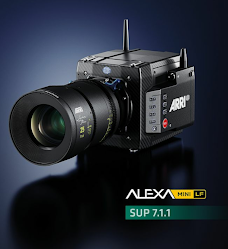
The Digital Cinema Society (DCS) hosted an exclusive preview of the latest ARRI technology including the next generation of ARRI digital cameras with a hands-on demonstration of the prototype code named ALEXA and their innovative post-production software, Relativity and new lighting fixtures such as the redesigned lens-less daylight 1.8K/1.2K watt HMI and the cooler and output efficient Ceramic 3200K 250 watts studio spotlight.

Cinematographer James Mathers, co-founder of DCS
introducing the event

Mike Jones, ARRI Lighting Division, Bill Russell, ARRI V.P
Western Operations, James Mathers,

The evening event called "Everything ARRI" was held on the campus of California State University Northridge and it was initiated with the introduction of the ARRI representatives by James Mathers, co-founder of the Digital Cinema Society and host of the event.

Mike Jones describing the features of an ARRI lighting fixture

Showing above, the ARRI LoCaster LED fixture (left) features an easy to use onboard controller with a choice of six color temperature settings, continuous dimming and ON/OFF switch. Weighing 2 lbs it is an ideal companion for mobile applications. To the right shown, is the Studio Ceramic 250. User benefits include lamp performance equal to a 1kW halogen lamp, cooler housing temperatures, low power consumption, long lamp life, hot restrike, integrated ballast, 3200K color temperature and a Color Rendering Index >90.

The first presentation of the evening was by Mike Jones, Lighting Division Representative, who introduced some of the TrueBlue line of studio fresnels, the new Broadcaster and Lowcaster handy LED fixtures, the 1.8/1.2K watt daylight HMI with a redesigned lens-less reflector and housing, capable of being plugged into a 20Amp household circuit and the ARRI Studio Ceramic 250 Spotlight, to a mixed and eager audience of cinematographers, camera operators, producers, directors and film school students.

Robert Primes, ASC and Bill Russell, Bill Russell, ARRI V.P
Western Operations

Cinematographers Rudy Harbon & Ronald Vidor, SOC

Three cinematographers framed in an animated conversation,
John Newby ASC, Bonnie Blake, SOC & Dianne Farrington, SOC

One of the highlights of the exclusive preview was a the show-reel projection of the images captured with the ALEV III CMOS 4:3 sensor, a 35 mm format single sensor with a spectacular base sensitivity of 800+ EI and equivalent wide exposure latitude. The video presented was shot mostly in low ambient light situations and presented no apparent signal-to-noise ratio and a very accurate color reproduction. The AlevIII sensor footage was plain amazing.

The Alexa prototype is designed around the AlevIII CMOS sensor, offering an unsurpassed sensitivity and dynamic range at 800 ASA plus offering more tha n two stops faster than its popular predecessor, the reliable D-21 used by top cinematographers as their feature film camera set-up of choice.

The Alexa comes in three camera models with an estimated price range of $69.510 to $180.700 depending of the models. The two entry level models (A-EV/A-EV Plus) utilize a 16:9 area from the sensor and are complemented by the ARRI EVF, the most advanced electronic viewfinder on the market. The high-end model (A-OV-Plus) offers a 4:3 sensor and a rotating mirror shutter linked to an optical viewfinder, ready to support anamorphic PL mount lenses.

The ARRI Alexa
At the heart of the three models is the AlevIII sensor with a Bayer color filter array and optical low pass filter with a 800+ Exposure Index and a full 35mm frame size with a maximum usable area to support 4:3 anamorphic PL mount lenses or 16:9 aspect ratio with a 3.5K pixel count to provide optimum oversampling for HD Video and 2K DI. The frame rate of the three models runs from 1-60 fps.
The ARRI Alexa
I had a hand-held test run with the Alexa on my shoulders, the camera was fitted with a prime lens, a follow focus and a matte box. The still crude ergonomic but balanced weight design of the prototype felt comfortable as an ENG news gathering camera or a hand-held feature film camera. The viewfinder is a large state-of-the-art F-LCOS array with auto-calibrating LED illumination and a sharp and clear 1280 x 720 display.

Alexa also features several output signals and methods, including T-Link certified on-board recording options, including multiple live HD and Data Mode Stream to ARRIRAW files output supported by ARRIRAW Converter, Digital Vision Nucoda, DVS Clipster, Filmlight Baselight, Glue Tools, Iridas, Avid, and other participants to the ARRIRAW Partner Program. The ARRIRAW workflow is Windows and MacOS platform compatible, allowing the users to choose the best workflow to fit their post-production needs.

Richard Antley, Director of Digital Imaging
describing features of ARRI Relativity software

Attendees to the event "Everything ARRI"

ARRI Relativity software, showing Texture Control


Another component of the ARRI workflow package is the ARRI Relativity software, a powerful suite of post-production tools that offer versatile control to your workflow. Using sophisticated motion estimation and spatial-temporal image filtering, ARRI Relativity software offers Texture Control, (such as adding or subtracting grain), Film Simulation, and Space Time Converter (spatial resampling and frame rate conversion). ARRI Relativity™ software is powered by Pixel Strings™, developed and licensed from Cinnafilm. Arri Relativity allows users to alter images in ways that appear as though they were achieved in-camera. Digital images can take the look of film while film images can be selectively degrained; scenes filmed at particular frame rate can be expanded or contracted to other frame rates, giving to cinematographers a broader range of flexibility while in post-production.

For more information about events and workshops held by the DCS click here.
For more information about ARRI products click here.
Read here the past posting ARRIFLEX unveils Alexa.
Watch New Digital ARRI-ALEXA-IBC 2009 video ON-DEMAND Playlist above.

SLAMDANCE ANNOUNCES DISTRIBUTION AGREEMENT WITH MICROSOFT

Four Slamdance films to launch new video Rental and download to own program on Zune and Xbox platforms. Slamdance today announced a worldwide video content collaboration with Microsoft on both Zune and Xbox platforms. The initiative will launch during the Slamdance Film Festival on January 27, 2010 with a four film, 7-day program providing video rental throughout North America. Zune video Marketplace will make the selected films available on video-on-demand across North America on both Zune and Xbox platforms. During this 7-day period movie fans have the opportunity to rent some of the same films being screened at the Slamdance Film Festival on their computers or through Xbox LIVE.

Price per film rentals during the festivals will range from 600 to 880 Microsoft Points*. Thereafter, the video content from Slamdance will expand worldwide through the Zune Marketplace with year-round programs featuring download to own and rental videos to the more than 20 million Zune and Xbox LIVE members. The first films in the collaboration include two documentaries and two narratives, showcasing Slamdance’s range of emerging diverse and independent voices.
Additional Slamdance films will be added to the program throughout the coming enabling Slamdance to give an international audience the Slamdance programming experience without being in Park City. “We’re very excited to be the exclusive digital presenter of the Slamdance Film Festival and bring its unique festival experience to our millions of marketplace users,” said Paul Davidson, manager of Global Video Content for Zune Video Marketplace. We share their passion for nurturing and supporting new talent and by offering the films in the marketplace; we hope to do just that.”

Slamdance President and Co-Founder Peter Baxter says, “Slamdance has a true independent identity and proven track record of unearthing great films. It’s time now to be progressive and unleash our film programs outside of the festival and directly help filmmakers find popular, worldwide audiences. The standard of Slamdance films deserve this much and we believe the audience will respond.”

Films selected for Zune and Xbox distribution are:

Making its US premiere, American Jihadist, directed by Mark Claywell examines the life and times of Isa Abdullah Ali, and African-American Muslim from the ghettos of Washington, DC, labeled a “known terrorist” by the U.S. Defense Department though he’s never been charged with any crime. Ali fought for six years in Lebanon and Bosnia and was shot multiple times for his religion. What makes a person willing to pick up a gun for their religion? Are the underlying causes purely religious? Or might religious militancy be a means of addressing chronic social, economic and political issues? And what do the answers mean for the wider Islamic World? These questions underlie American Jihadist.

Adam Barker directs the documentary Mind of the Demon: The Larry Linkogle Story, a brutally honest look into the life and mind of one of the most out-spoken, forward-thinking, visionaries ever to come out of the motor-sports industry. Larry Linkogle is a world-record holding dirt-bike legend whose off-the-cuff antics and aggressive "never sell out" attitude was the spark that kick-started the entire freestyle motocross revolution. But as the new sport took off beyond expectations, so did Larry’s battles with his inner demons. A heart-wrenching account of the demise of the sport's most infamous legend, Mind of the Demon's timeline is told through incredible archival footage, and interviews with every top industry name. Past and present storylines intertwine to drive the film toward one of only two possible conclusions: the most unlikely inspirational comeback story of all time or a nosedive into a black hole of self-destruction. Narrated by Lemmy Kilmister of Motorheard, the film features interviews with sport talents including Carey Hart, Christian Fletcher, Mike Metzger, Seth Enslow and Jeff Emig among others.

The Scenesters is an innovative and quirky murder mystery that both honors and deconstructs the conventions of the classic 'who-done-it?' film noir. A dark comedy that uses the 'found footage' approach to storytelling, the film compiles supposed 'real' clips from a variety of sources - courtroom transcripts, crime scene videography, news reports, etc - all detailing how a group of Los Angeles twentysomethings got mixed up in a deadly game of cat-and-mouse with a prolific serial killer. The film's soundtrack (and plot) features indie-rock favorites The Airborne Toxic Event, The Cribs, The Sonics, Wallpaper, Le Switch, and many many more. A film by Todd Berger, the film also stars Sherilyn Fenn, Suzanne May, Blaise Miller and Jeff Grace.

Making its world premiere, a modern medieval saga The Wild Hunt tells the story of Erik Magnusson, a young man who decides to follow his estranged girlfriend Evelyn into a medieval re-enactment game when he discovers that she has been seduced by one of the players. As the down-to-earth Erik treks deeper into the game in search of his love, he inadvertently disrupts the delicate balance of the make believe fantasy-land. Passions are unleashed. Rules are broken. Reality and fantasy collide. The good-hearted game turns into a tragedy of mythic proportion. Directed by Alexandre Franchi, the film’s cast includes Kaniehtiio Horn, Mark Anthony Krupa, and Ricky Mabe.

A LOOK TO THE OSCAR® RACE

9 FOREIGN LANGUAGE FILMS ADVANCE IN OSCAR® RACE AND 7 FEATURES CONTINUE IN VFX OSCAR® RACE

Nine films will advance to the next round of voting in the Foreign Language Film category for the 82nd Academy Awards®. Sixty-five films had originally qualified in the category.and seven films remain in the running in the Visual Effects category for the 82nd Academy Awards®.

Foreign Language films, listed in alphabetical order by country, are:
Argentina, “El Secreto de Sus Ojos,” Juan Jose Campanella, director;
Australia, “Samson & Delilah,” Warwick Thornton, director;
Bulgaria, “The World Is Big and Salvation Lurks around the Corner,” Stephan Komandarev, director;
France, “Un Prophète,” Jacques Audiard, director;
Germany, “The White Ribbon,” Michael Haneke, director;
Israel, “Ajami,” Scandar Copti and Yaron Shani, directors;
Kazakhstan, “Kelin,” Ermek Tursunov, director;
The Netherlands, “Winter in Wartime,” Martin Koolhoven, director;
Peru, “The Milk of Sorrow,” Claudia Llosa, director.

Visual Effects category films are listed below in alphabetical order:
“Avatar”
“District 9”
“Harry Potter and the Half-Blood Prince”
“Star Trek”
“Terminator Salvation”
“Transformers: Revenge of the Fallen”
“2012”

Foreign Language Film nominations for 2009 are again being determined in two phases.
The Phase I committee, consisting of several hundred Los Angeles-based members, screened the 65 eligible films between mid-October and January 16. The group’s top six choices, augmented by three additional selections voted by the Academy’s Foreign Language Film Award Executive Committee, constitute the shortlist.
The shortlist will be winnowed down to the five nominees by specially invited committees in New York and Los Angeles. They will spend Friday, January 29, through Sunday, January 31, viewing three films each day and then casting their ballots.
The 82nd Academy Awards nominations will be announced on Tuesday, February 2, 2010, at 5:30 a.m. PT in the Academy’s Samuel Goldwyn Theater. Academy Awards for outstanding film achievements of 2009 will be presented on Sunday, March 7, 2010, at the Kodak Theatre at Hollywood & Highland Center®, and televised live by the ABC Television Network. The Oscar presentation also will be televised live in more than 200 countries worldwide.

KODAK AT SUNDANCE AND SLAMDANCE 2010:

Kodak Puts Filmmakers in the Spotlight at Slamdance and Sundance;Company Hosts Filmmaking on a Budget Panel; Presents Product Grants

Kodak
will once again give its full support to the independent filmmaking community at the Slamdance and Sundance Film Festivals, which run concurrently in Park City, Utah, beginning January 21.

Kodak will host a Fireside Chat panel at Slamdance featuring independent filmmakers discussing their budgetary and aesthetic reasons for shooting on film. Producer Vanessa Hope (Imperialists Are Still Alive), director-cinematographer Josh Safdie (Daddy Longlegs), and cinematographer Gavin Kelly (The Dry Land) will share their experiences working in the Super 16 mm format. All three of the panelists' movies are screening at the Sundance Film Festival. The panel takes place on January 22, at 1 p.m. at the Treasure Mountain Inn and is free to festival attendees

PANASONIC UNVEILS HD3D CAMCORDER

Panasonic Corporation will release the world’s first* professional, fully-integrated Full HD 3D camcorder in Fall 2010. The company will begin taking orders in April.

This Full HD 3D camcorder will offer the following core benefits:

Easier to Use
Current 3D systems are large-scale setups in which two cameras are fitted to a rig in parallel, or vertically intersect across a half-mirror. Separate recorders are also required. In Panasonic’s new Full HD 3D camcorder, the lenses, camera head, and a dual Memory Card recorder are integrated into a single, lightweight body. The camcorder also incorporates stereoscopic adjustment controls making it easier to use and operate.

The twin-lens system adopted in the camcorder’s optical section allows the convergence point** to be adjusted. Functions for automatically correcting horizontal and vertical displacement are also provided. Conventional 3D camera systems require these adjustments to be made by means of a PC or an external video processor. This new camcorder, however, will automatically recalibrate without any need for external equipment, allowing immediate 3D image capture.

More Flexible
The solid-state memory file-based recording system offers greater flexibility to produce Full HD 3D videos in more challenging shooting environments. The camcorder is lighter weight and smaller than current 3D rigs, while providing the flexibility of handheld-style shooting. Setup and transportation is simplified, making it ideal for sports, documentary and filmmaking projects.

Solid-State Reliability and Workflow
Right and left Full HD video streams of the twin-lens 3D camcorder can be recorded as files on SDHC/SD Memory Cards, ensuring higher reliability than on other tape, optical disc, HDD or other mechanical-based recording systems. This solid-state, no-moving-parts design will help significantly reduce maintenance costs, and the 3D camcorder will be better able to perform in extreme environments and be more resistant to temperature extremes, shock, and vibration.

And users will enjoy a fast, highly-productive file-based workflow, with instant, random access to recorded content; easy plug-in to both Mac and PC-based platforms; and longer recording capacity.

More Affordable
Using a standardized, fully integrated design, the Full HD 3D camcorder will be offered at a much lower price than traditional 3D rigs. Transportation expenses for this handheld unit will be less and faster setup times reduce labor costs. Using standard, re-recordable SDHC/SD Memory Cards available already everywhere, media costs become almost insignificant.

In addition to a camcorder, Panasonic also plans to offer a professional-quality 3D Full HD LCD monitor for field use as well as a professional HD digital AV mixer for live event production. Panasonic will offer professional production equipment to allow video professionals to efficiently create 3D content, so consumers can enjoy 3D video using Panasonic 3D home theater systems.

Major Specifications (tentative)
• Product Name: Twin-lens Full HD 3D camcorder (made-to-order)
• Suggested Retail Price for Main Unit: $21,000
• Available: Fall 2010 (made to order)
• Power Consumption: Under 19 W (main unit only)
• Weight: Under 3 kg (main unit only)
• Recording Media: SDHC/SD Memory Card

* As an integrated twin-lens Full HD 3D camcorder capable of recording Full HD 3D video to Memory Cards. As of January 2010 (based on our investigation)
** The point at which the left and right-camera lenses’ optical axes converge

Development Background
Movie companies and content producers are eager to produce more 3D content. 3D video is set to become a mainstream motion picture technology. In response to the resurgence of 3D movies, in September 2009, Panasonic proposed the world’s first 3D home theater systems, based around 3D-enabled Blu-ray Disc players and Plasma TVs (announced and exhibited at CEATEC 2008). In February 2009, the company established the Advanced Authoring Center (within Panasonic Hollywood Laboratory) – at which 3D movies are authored for replication on 3D Blu-ray Discs (announced at CES 2009). Currently, producing 3D movies is a painstaking process. Panasonic intends to promote the production of high-quality 3D video content by accelerating the development of 3D video production systems designed to boost production speed and efficiency.