NAB 2010 AT A GLANCE Part 1

The National Association of Broadcasters Show in Las Vegas is certainly the most important "global industry destination" if you want keep yourself abreast and informed of new broadcast technology, including education and services, and this year was no different. The registration to the NAB Show 2010 soared to over 88.000 plus registered attendees making a very crowded convention floor. This year, I met new manufacturing vendors offering  the latest technology in equipment in all levels of the industry from production to post.
Las Vegas Convention Center at dusk

 Gordon Smith, new President/CEO of NAB and two term Senator from Oregon opened the show on Monday addressing attendees and presenting the NAB Service Distinguished Award to Michael J. Fox for his commitment to raising awareness and money for Parkinson's disease research through the Michael J. Fox Foundation for Parkinson's Research.
  Gordon Smith

 Michael J. Fox  receiving the NAB Service Distinguished Award 
NAB from NAB president/CEO Gordon Smith

 The Keynote speaker was Hiroshi Yoshioka, executive deputy president of Sony Corp. and president of Sony Consumer Products & Devices Group. Yoshioka's address focused on global and U.S. consumer demand for 3D technology and its mainstream adoption.

 Hiroshi Yoshioka, executive deputy president of Sony Corp.

3D technologies are stronger and redefined this year. Mostly every digital video camera manufacturer is showcasing a 3D camera, such as Panasonic or have partnered with others manufacturers to offer 3D acquisition and workflow. In the second year of  the popular 3D Pavilion, many of the vendors showcased digital 3D cinema products, consumer eye wear and 2D-to-3D conversion technologies.

  Sony cameras coupled in a Element Technica 3D rig
(D.Malhmann photo)

Panasonic AG-3DA1 is the world’s 
first professional quality, fully-integrated Full HD 3D 
camcorder that records to SD card media.
(D.Malhmann photo)
3D was the topic at Sunday’s Panasonic press conference, which included a screening of material captured with the AG-3DA1 HD 3D camcorder and projected on a 152-inch Panasonic plasma display. Joe Taylor, chairman and CEO of Panasonic Corp. of North America, reviewed the range of products designed to bring 3D assets “from the camera to the couch.” The 3D Pavilion has doubled in size since its introduction last year. Also the attendees were  able to see the latest developments on 3D production and content development from Hollywood at the Content Theatre.  The Discovery Channel and ESPN presented Super Sessions such as Wednesday's "The Business and Technology of Sports Broadcasting: From Mobile Devices to 3D," sponsored by Level 3 Communications.

 3D presentation at  the Content Theater

Among new camera prototypes to be release in a future date is Sony's MPE-200 3D Processor, which provides a variety of digital adjustments to the stereo imaging HD cameras, allowing a similar control experience to mechanical servos. The MPE-200 digitally simulates several of the adjustments that are currently performed mechanically on higher-end rigs.  The 3D Processor provides stereographic engineers a means to manage camera and rig parameters in order to deliver high-quality 3D images. MPE-controlled systems can also augment higher-end rigs in complicated 3D-live productions. Also purpose-designed for 3D production is the company's new HDC-P1 full HD compact multipurpose camera, which combines 2/3-inch CCD technology and a two-disc filter servo in a small and lightweight design. 

 The MPE-200  Sony 3D camera

  
Silicon Imaging unveiled the SI-3D camera at the NABShow . The new SI-3D stereo camera utilizes dual SI-2K Mini heads integrated with a single processor, which mixes and synchs the left- and right-eye images into a single 3D QuickTime file. These can be recorded with the new SI-3D Minideck Recorder, or fed into the new SI-3D Live system for stereoscopic SMPTE HD-SDI broadcast or 2K Cinema playback and projection.

SI-3D camera
Silicon Imaging unveiled the SI-3D camera at the NABShow . The new SI-3D stereo camera utilizes dual SI-2K Mini heads integrated with a single processor, which mixes and synchs the left- and right-eye images into a single 3D QuickTime file. These can be recorded with the new SI-3D Minideck Recorder, or fed into the new SI-3D Live system for stereoscopic SMPTE HD-SDI broadcast or 2K Cinema playback and projection.

The SI-3D offers filmmakers built-in tools for checking and adjusting camera alignment and parallax shift between the two views. All of the controls are accessible through a simple touch-screen interface. The stereo data is processed in one system, eliminating the need for a separate stereo processor to mix the two signals for a stereo display.

Currently, 3D content is captured from two independent left and right cameras, each with its own settings, color controls, record start, timecode, content management and monitoring outputs. A variety of complex “workarounds” are used to synchronize the recordings or combine the outputs for viewing. Other systems use a fixed optical system with highly compressed H.264 or J2K codecs to record, which either limit 3D depth for close-ups or large scenic views “When you shoot with two separate cameras, you have to do everything twice, and you need all these other boxes to mix the signal together,” said Ari Presler, CEO of Silicon Imaging. “With the SI-3D, all you do is point the camera, shoot, edit, and then do your 3D grading. This camera makes it all one streamlined process.”


A road attraction for the consumer crowd at the NABShow floor are the manufacturers of support equipment for the new digital VDSRL-HD cameras such as Red Rock Micro and Zacuto, both companies producing rods, matte boxes, follow focus, support brackets, and lens converters for consumer HD video cameras. The increment of use by filmmakers of the Canon D5/D7, Nikon D90/300 and the Panasonic Lumix have made these aftermarket products a must to have if you want to operate your digital VDSRL-HD and achieve maximum performance
Canon EOS with Matte Box and Follow Focus
(D.Malhmann photo) 

Lighting changes or updates come to market in a slow pace but Mole Richardson, one of the oldest lighting company’s has stepped into the LED world this year at NAB with the announcement of their latest fixture, the MoleLED. Mole Richardson is a trusted name in the motion picture industry.
New LED fixture, the MoleLED
(D.Malhmann photo) 

 Mole worked with OSRAM Sylvania to develop the MoleLED using the OSRAM Sylvania proprietary Phosphor Dome Technology to offer a Tungsten and Daylight LED fixture. The MoleLED fixture consists of 12 OSRAM KREIOS LED circuit board, each containing 20 high output LEDs for a total of 240 individual LEDs, each topped with a remote phosphor dome. The phosphor domes are an OSRAM proprietary design, which are blue light activated to produce light in two exact color temperatures, Tungsten and Daylight. Measuring in at 15″ high by 3.5″ deep and just 18.25″ wide and a total weight of only 13 lbs with the yoke, the MoleLED is perfect for location lighting were lightweight and small compact design is required. There is local or DMX controlled dimming from 100% to 10% with auto sensing power supply from 100-240 volts and uses just 0.6 amps max draw on a 110 volt AC power input.
 
Twenty-First Century Camera Crew Panel
From Left to Right: Lewis Rothenberg, TNS Productions, Inc.;
Andy Romanoff, Panavision; Steven Poster, Int. Cinematographers
Guild;  Jason Clark, Ways & Means Productions; Rodney Charters

 Transvideo CineMonitor HD 3D View 12"
The first HD SDI monitor in the world for 3D D-Cinema field use. 
The CineMonitorHD 3D View includes several mode to help
the operator to correlate cameras and to preview the
image in anaglyph mode.  (D.Malhmann photo)

A view of the NABshow floor. JL Fisher
Manufacturer of motion picture and television 
equipment. Dollies, pedestals and heads.
Jib Arms and Cross arms.
Audio Booms and Bases.
(D.Malhmann photo)


NewTek, manufacturer of industry-leading video and 3D animation products, today has launched TriCaster™ model TCXD850, the latest addition to the TriCaster line of high definition (HD) portable live production systems. This new TriCaster offers a 22-channel switcher, with eight HD or standard definition (SD) digital or analog inputs, two DDRs, titles, stills, two network inputs and eight virtual/mix channels.

TriCaster TCXD850 takes the TriCaster product line to a new level of performance, introducing a rack mount system with significant new capabilities, at all levels of production,” said Andrew Cross, executive vice president, engineering, NewTek. “This latest TriCaster continues to change expectations about what is possible in HD live production, enabling producers to deliver compelling live events, successfully engage their audience and create new revenue streams.
more to come, part 2
 George Leon

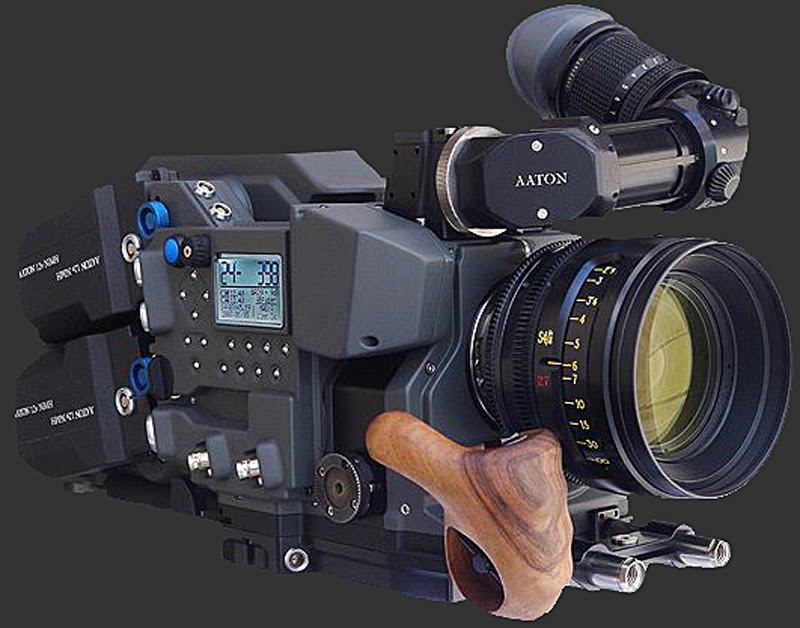
AATON PENELOPE DELTA AT NABSHOW 2010: C'EST MAGNIFIQUE

Among the many new or improved digital cinematography cameras showcased at the NABShow 2010 in Las Vegas, I have to bring your attention to the Aaton Penelope Delta, a 35mm film camera and a RAW uncompressed  DPX/compressed DNxHD digital cinematography camera all rolled into one camera body. (The only camera in the motion picture industry switchable from Super35mm/2-3 perfs to DPX recording digiback in less than half an hour).
The camera was announced earlier this year by veteran camera maker and Aaton's founder Jean Beuviala at the AFC Micro Salon 2010 in Paris and since then I was waiting to see the camera up close and personal and I have to say that Aaton has done it again (Aaton die-hards agreed with me).

Aaton has created with the Penelope Delta, the first digital cinematography  camera with the best ergonomic design for hand held operation to date. In the past, I have chose to work with Aaton cameras, from the original LTR/Origin C  to the 35III, due in part to the same reason, ergonomics and much more, such as overall easiness of operation, specially for an one-man-band documentary camera crew. 

With more of 40 years of groundbreaking camera making, since the implementation of coaxial magazines in the Eclair NPR and ACL, Beuviala and his team have combined the best features of an already superb 35mm film camera to develop a top of the line digital cinematography camera without sacrificing the sleek original design, Aaton cameras are known for. It is not a boxy awkward looking camera with hard edges, and it new digital untethered features are rather imperceptible to the untrained eye. 
 The slide-in lightweight (360 gr) 2.5" SSD Aaton DeltaPack®  (compressed dailies -on SD cards- are simultaneously recorded) and electronic innards are housed in the "digital coaxial magazine" and it is capable to  ingest uncompressed RAW DPX files of 4K+(plus) at up to 800MB/sec.(actual resolution of the image is not yet disclosed).  The DNxHD format  (10 bit hi rez)compressed dailies are a work-flow time saver, ready for edit, just import the files to your Avid or Premiere CS4 (with Adobe Media Encoder) system.

In the gate of the body of the camera sits the Aaton specific, Dalsa® CCD sensor with 13 stops dynamic range. One interesting feature is the that the 800 ISO basic sensitivity can be reduced to 100 ISO to virtually eliminate the use of ND filters (obscuring picture in the viewfinder)  with close to 100% pixel-fill allowing for lenses with short exit-pupil distance, complemented with the original large and bright optical viewfinder from the Penelope camera.

Other features are, 4second boot time from zero power to REC-ready with three to six hour autonomy from 2 on-board  Li-Ion batteries. Main selector accessible from both Operator’s and Assistant’s side for simple access to digiback commands, without sub-menus. The Assistant’s side screen displays essential shooting parameters: timecode, ISO, battery voltage, fps and remaining ‘footage’ (also visible on Operator’s side). 19dBA noise level in REC and PAUSE thanks to low power electronics and low speed air flow through large vents. HD422 (with view outside frame), and power socket for on-board HDSDI monitors. 19dBA noise level in REC and PAUSE thanks to low power electronics and low speed air flow through large vents located in the "coaxial digital magazine". Two outputs: HD422 (1.5GHz), HD444 (3GHz). One input: sync for 3D twins.
It is an Aaton switchable 2/3 perf. 35mm Penelope
or an Aaton Delta? The new design and digital features are
so integrated into the camera body that are almost imperceptible
to see from this angle.Answer: It is a 35mm Penelope

In conclusion and a at first look, the Aaton Penelope Delta gives the impression to be as good as the French gastronomic cuisine... C'est Magnifique!. But let's wait for the development and follow through of all its features into the production model to market to test it in a real environment and to compete with the existent HD digital cinematography cameras out there.  

The camera will be available next summer at a competitive industry price. For more info, visit Aaton or Abel CineTech. Also, learn more by watching  Mitch Gross from Abel Cine Tech giving you the run down at NABShow 2010 of the Aaton Penelope Delta in our VOD video window. Click in our playlist and choose Penelope Delta.
 by George Leon

MEETING ALEXA IN HOLLYWOOD

 By George Leon

On Tuesday April 6, I was invited to the DGA theater complex  in Hollywood for the ARRI pre-NAB Showcase featuring the newest addition to their digital camera line, the anticipated ALEXA. Following their motto "it's not just another digital camera, it's an ARRI",  Volk Banehmann, CEO of ARRI USA presented the camera to an sold-out audience,  emphasizing the technological advances integrated into the camera and gave warm thanks to the audience after announcing he is steeping down as CEO of ARRI USA and CSC and passing the torch to Glen Kennel who holds the post of Chief Technology Officer.

  James Mather, Volk Bahnemann, Jon Fauer, ASC

 As a highlight of the evening Fujinon also announced the introduction of two news lenses made specially for the ALEXA camera, the Arri-Fujinon Alura Zooms, a 18-80 T2.6 and a 45-250 T2.6. The evening went along with a presentation of the ALEXA specs and several video clips shot in different lighting conditions demonstrating ALEXA's  picture perfect quality and extended latitude range. 

David Darby, ASC, Bill Bennett, ASC and Chauncy Cummings,
FotoKem. Bill used the ALEXA camera and ARRI
lenses to shot a comparison test in an actual Honda TV spot
shoot.The clip was shot  downtown Los Angeles and it was of
superb quality and excellent color reproduction.

ALEXA's Super 35 format CMOS Bayer sensor exhibits a cinematic, shallow depth of field with a base sensitivity of EI 800, low noise and an unsurpassed dynamic range of 13.5 stops and allows the use of all 35mm PL mount lenses. The sensor's 3.5K pixel count delivers an optimum in image sharpness, sensitivity and latitude for HD (1920 X 1080) and 2K DI workflows.

 The ALEXA camera with the 45-50 T 2.6 ARRI Fujinon Alura lens

 The camera touted as " the most advanced digital camera system with the highest dynamic range and sensitivy on the market" can simultaneously record Apple QuickTime/ProRes files, output uncompressed HD video and uncompressed ARRIRAW data onto on-board SxS memory cards.  Also,  ALEXA  internal recorder encodes ProRes 422 (HQ) or ProRes 444 images, along with audio, metadata and Final Cut Pro (FCP) XML files. These files load directly into FCP for editing, coloring and finishing work. 

 An advantage to other systems is ALEXA' s easy upgrade to the module that holds the memory cards, which  is removable and  the camera electronics module which comprise the whole right side of the camera and  can also be removed and replaced by upgraded electronics with advanced features. 

 The public milling around around the ALEXA and
discussing it's features

 Although the camera weights 15 lbs. with bracket and
viewfinder - excluding the lens, it felt balanced and
comfortable on my shoulder.

Chuck Lee, Fujinon Inc, Technology Manager

Bill Russel, ARRI V.P Camera Products.

 Nancy Schreiber ASC, George Leon SOC, Douglas Knapp, SOC
Alexa 3D rig

 For more information about ALEXA,  read these past postings in FILMCASTLive! or experience the camera and other ARRI products at the NABShow in Las Vegas or visit the ARRI website.

A PREVIEW OF CAMERAS AT NABSHOW 2010

If you're headed out to Las Vegas in a few short weeks, cameras are probably high on your list of gear to check out, whether or not you're a shooter/ cinematographer. NAB 2010 promises a lot of innovation, especially in two areas: HDSLR video and stereoscopic 3D image capture.
Panasonic Corporation will release the world's first
professional fully integrated Full HD 3D camcorder

Panasonic had the flashiest pre-NAB camera announcement out of the major camera manufacturers; I covered its new single-body stereoscopic 3D camera when the company announced details about the $21,000 AG-3DA1 in February. Still, there's a lot more to learn at NAB about the 3DA1, such as literally everything about those two integrated lenses. And, of course, the company will undoubtedly be keeping a few products under wraps until its press conference on the Sunday before the show.

Canon has had quite a week, and it seems to be getting its cinematic ducks in a row well before the NAB 2010. First came the release of its new 2.0.3 firmware for its EOS 5D Mark II HDSLR camera, which added 24p and 29.97 recording as well as manual audio metering. Then came the news that there was a bug in the firmware; audio would not be recorded if the camera lost power while in certain modes, and Canon quickly yanked the firmware update. Finally on Friday, Canon quickly posted firmware update 2.0.4, which fixes the bug. Not done yet, the company also posted its free Apple Final Cut Pro log and transfer utility, EOS MOVIE Plugin-E1 that it had announced in February.
 Canon prototype
Expect to see a lot of HDSLR action in the Canon booth, as well as a prototype of the company's new professional camcorder line that records 4:2:2 video as 50Mbps MPEG-2 (the XF codec). 

Will JVC show successors to its GY-HM100 and GY-HM700 cameras? The company will certainly be bringing new 4K projectors and stereo 3D monitors to the show, but so far it hasn't announced anything in terms of new cameras.
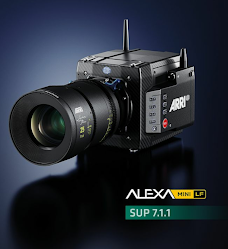
Arri and Red Digital Cinema seem to be headed toward a RAW video face-off; Red's Jim Jannard has offered his competitor some kind words as ARRI introduced its new Alexa prototype in advance of NAB 2010. The digital camera weighs 5.8 kilograms; comparable to a 16mm camera. ARRI claims Alexa's LF3 sensor has a latitude of 13 stops and basic sensitivity of 800 ASA. It's a PL-mount camera, and simplicity is the key; most buttons have a single function only.
Red, of course, recently has introduced its Mysterium-X sensor, which effectively makes the Red One a whole new model. The company is sponsoring a REDucation event in advance of NAB 2010, April 8 through 12.

 Sony 3D camera prototype
Sony hasn't announced anything specific in advance of the show, but the NXCAM line of professional AVCHD cameras that the company announced in November should figure prominently. Sunday's Sony press conference will of course reveal more. Will Sony be showing off its single-lens 3D technology in any form?.

The technology relies on a single "main lens "and a gauntlet of four mirrors, which divert two portions of the single image to two separate "imaging lenses," which are then captured by two separate sensors. This technology, which was introduced in prototype form at CEATEC 2009 in Japan, also comprises high-speed image capture up to 240fps, for super-slow-motion recording.
  For-A VFC-7000
Speaking of high-speed cameras, at NAB 2010 Vision Research will be showing its Phantom HD Gold camera that it introduced last summer. The company has a new camera to show as well, but as of yet there are no details available. For-A will be displaying its new lightweight variable frame rate camera, the VFC-7000, that shoots up to 700fps at 1280x720. Scitech/IDT will be at the show with Redlake high-speed cameras, which have been used in prominent Hollywood productions from the past year.

FAIRBURN 3D CHART

Designed for Precise Setup and Post Processing with a Range of 3D Camera Systems. 
The new  Fairburn 3D Chart was designed by veteran cinematographer B. Sean Fairburn in collaboration with DSC Labs for precise setup and post processing with a range of 3D camera systems. Dimensions of this chart are 24"W x 14.75"H x .125" thickness.


Feature tools include:

* Horizontal and Vertical Alignment (White Cross through middle "Superwhite" and small crosses)
* Focus Fans in corners (Maximum contrast for ease of viewing even in Low light)
* Zoom Ring 10" in diameter (to see zoom disparity between cameras focal length) 5 pixels
* Keystone Correction (colored Balls and White rings in corners)
* Horizontal Scale in cm and Inches (to see exact IO offset at Parallel)
* Mini Gray Scale (Swatch at Bottom #1 White, #6 Middle Gray, #11 Black + "Superblack".08)
* 18% Gray Scale Chips (at top of chart on RT and LT)
* Chroma Du Monde Color Reference in Hexagon Shape (which matches Vector Scope orientation)
* RIGHT and LEFT words on white lines used as orientation detectors
* Arrows Up and Right Also used as Orientation detectors (base of Triangle is 40 Pixels)
* Red R and Blue L to show Color and eye reference (Red Right eye-Blue Left eye)
* RED R show image Flip or Flop orientation
* RGB&YCM have been added at highest printable value
* Focus Fans at the Center are for zoomed in focus Aide
* Scale on far R & L to measure Horiz and rotational offset
* Dead Center Cross

3D Test Chart Procedures:
DURING PREP:
It's best to work with Cameras Individually separately first then mount camera lens pairs to Rig at the same time. Set up the Chart on a C Stand with the Mounting Stand. Use Level and tape or laser to measure height of Center Chart match height of Center Lens. Chart should be flat to the image plane so that distance to sides match and top bottom match. Light Chart so no reflections appear on chart. Mount lens to camera snugly, set backfocus on lens. Lenses must track through zoom. Lens Tracking can ONLY be set properly when on the camera that will be shooting that lens. Bench tracking a lens will not track properly on every sensor. Mount lens to camera widen out. Pan & tilt to center the crosshairs on chart, now zoom in and mark location of crosshairs at telephoto. If it is not centered on the chart to the sensor adjustment in tracking must be done by Lens Tech. Once done this lens and Camera are "Married" and should not be separated. Rods and motors lens brackets should all be Set and Snug then kept together. Color Adjustment can also be done and saved as LUT's or Scene Files (You will do this again once mounted to camera rig with beamsplitter). Right Eye Camera should be marked with RED tape (RED RIGHT) on 2nd Rigg (YELLOW RIGHT). Left Eye Camera should be marked with BLUE tape (BLUE LEFT) on 2nd Rigg (GREEN LEFT).
 3D RIGG SETUP:
Begin 3D Camera Setup by Mechanically zeroing out everything from the Tripod, head, rig mount, and camera mounting plates. Level the head, level & plumb both plates. Mount Cameras (with lenses and motors and rods) to Rig so that they are same distance to reflective surface Mirror. If Side by Side insure they match forward or backward. Insure Focus, Iris, Zoom, match and are set the same. Even the best rigs may have some degree of offset between them therefore having an Alignment chart gives a common critical reference point for the 2 Cameras to be brought into Alignment and to match. Rolling on the chart will also give a tool for Post to continue the work or adjust as needed later. If using a Beam Splitter 50/50 Mirror. Best Viewed on a 50/50 Overlay monitor (One Half dissolved between the 2 images). Drive the IO and C to ZERO called  ZERO Inter-ocular . Goal here is to make the cameras see exactly the same thing the same vector on all objects in the shot. They should match exactly in:

1. Horizontal
2. Vertical
3. Zoom Size
4. Focus Distance
5. Rotation
6. Iris
7. Black/White/Mid/Color
8. Genlock
9. Shutter Sync
10. Equal distant Cables from cameras to Recorders, Switchers and Monitors.
Now the Chart becomes a Reference Tool to see exactly how each camera is aligned and if adjustments need to be made.

 KEY ELEMENT: 
Use a Mini Maglight with the reflector and lens removed to expose just the raw bulb between the chart and the rig as a foreground object. If you see 2 bulbs and 1 chart you are NOT at ZERO IO. If you see 1 bulb and 1 chart you are now at ZERO IO. Final Color Adjustments through the Beamsplitter must also be made to match the color of both cameras with the hexagon CDM on the chart. Save Beamsplitter offset in Lens File or as part of the LUT for Post.

IN THE FIELD:
Measure the distance to the chart and note that distance and focal length. Use the 3-D Chart for morning setup and at the beginning of every scene to give an Alignment and color reference to Post to continue the adjustments if needed. At the head of every Tape or scene. Cover the Left side markings of the chart, Roll the Right Eye only. Cover the Right side markings of the chart, Roll the Left Eye only. Record the chart with both cameras. It would be nice to set convergence to INFINITY first to show your Inter-Ocular distance. Then show the chart converged. Then set the convergence where you want for the scene. Chart distance consistency will be helpful in post when possible. Good habit at the head of a scene first shot. Roll on chart till Speed, then Mark with Sync Slate, begin the Shot. Another good habit is to tail stick every shot as well to look for drift in cameras.

IN POST:
When syncing 2 eyes use the 3-D chart as a reference for H & V, Zoom, Rotation, proper convergence Setting.

The Fairburn 3D Chart is available for purchase at FilmTools in Burbank, CA

ALICE IN WONDERLAND. ONE WILD TEA PARTY

Since this book of fantasy and adventure was first published in 1865, Alice in Wonderland [written by the Reverend Charles Lutwidge Dodgson using the penname Lewis Carroll, with illustrations by John Tenniel] has enchanted generations with a fabulist’s tale that touches deep into the collective dreamscape. Tim Burton, no stranger to creating iconic imagery, observes that “great stories” like Alice “stay around because they tap into things that people aren’t even aware of on a conscious level. There’s definitely something about those images.”

Burton, whose new 3D version arrives in theaters March 5th via Walt Disney Pictures, should know: he lives and works in the London home once owned by Arthur Rackham, the illustrator who created color plates for the book’s 1907 edition. In Burton’s telling (written by The Lion King co-writer Linda Woolverton) Alice is 19 and about to enter into a marriage engagement with a dull, arrogant man. Instead, she follows the White Rabbit down the familiar rabbit hole to Underland (called Wonderland by its inhabitants), a place she visited ten years earlier but does not remember. There, her old friend, the Mad Hatter, convinces her to help overthrow the Red Queen who has taken over Wonderland. In a journey where she grows both large and small, Alice goes on an adventure of self-discovery to save her old friends and the magical place she visited as a child.
 Alice, Bigger Than Life

To realize his version of the often bizarre but familiar images in Alice’s world, Burton chose cinematographer Dariusz Wolski, ASC, who had just finished working with the director on Sweeney Todd, The Demon Barber of Fleet Street. Wolski says the film evolved dramatically from its early production plan. “Originally, it was just Alice as a real person,” he explains. “Then Tim added Johnny [Depp] as the Mad Hatter and Helena [Bonham Carter] as the Red Queen. We had a bunch of amazing actors and decided to shoot them for real, against green screen, and create the sets virtually except for the beginning and the end of the film, which are normal live action.”
 Because the movie would incorporate so much computer-generated imagery, the decision was made to shoot digitally. While Burton was in London, working on the design of the film, Wolski began testing all the available 3D equipment, including Vince Pace’s 3D Fusion Camera system developed for Avatar.

“We were trying to shoot this film in 50 days, since all we were shooting was the actors on green screen, representing only 30 percent of the movie,” Wolski recalls.

But he and Burton later abandoned the idea of shooting in 3D, in part because it would be “prohibitively expensive.” Wolski also pointed out that if they wanted a Technocrane or a camera on a dolly, he’d be dealing with multiple cameras. “Any time I wanted to change the lens, I’d have to recalibrate,” he says. “Knowing Tim’s temperament - he’s very spontaneous - we were afraid the whole thing would slow down our process.”

Burton had already had a positive experience converting the 2D The Nightmare Before Christmas to 3D in post. “After seeing that conversion job, I found no reason to do it any other way,” Burton says. “Shooting it traditionally gave us more freedom to get into the depth, the layers, that we wanted in the time we were dealing with. We were trying to do it faster…and I didn’t see any difference in quality.” [Alice in Wonderland’s 3D conversion was done by Sony Imageworks, which also oversaw VFX, supervised by Ken Ralston. The project underwent two digital intermediates, supervised by Burton and Wolski, at Company 3 in Santa Monica. Colorist Stefan Sonnenfeld graded the 2D version, and then after the 2D-to-3D conversion, colorist Siggy Ferstl did final tweaks to the 3D version.]

Even though he wouldn’t be shooting in 3D, Wolski did take the time to educate himself thoroughly about 3D so that the end result of the 2D-to-3D conversion would work well. “Shooting all those 3D tests taught us a lot,” the cinematographer says. “It taught us about convergence, what lenses to use, how to frame the shot, and at what points 3D is effective and not. We always kept in mind we were shooting a 3D film.”

Wolski recounts studying a National Geographic movie shot in 3D: “There was a lion, shot with a long lens, and it looked really fake,” he begins. “The perspective is compressed. So, to be safe, I felt it was best to shoot [Alice] on the wider side. An understanding of convergence when you’re creating a composition - in other words, keeping in mind what will be in the foreground and the background - really helped.”

Ultimately, Wolski says he chose “fairly standard” lenses. “The 75mm was the longest lens we used, except perhaps for some effects shots, when the White Queen was looking through her binoculars, ” he adds. “Otherwise, it was 50mm, 24mm, 17mm.”

Choosing the camera was trickier. “I was toying between the Sony F23 - because the F35 wasn’t yet available - and the Panavision Genesis,” Wolski continues. “The F23 is a great camera, but I had a problem, because of the size of the chip, where wide shots were not very sharp. Since the actors were always against green screen, I often had the problem of not enough resolution.” He analyzed capture from both cameras more closely at Sony Imageworks, preferring the Genesis in the head-to-head comparison.

But given the desire for “even more resolution,” Wolski also chose the now-defunct 4K-chipped Dalsa Origin for multiple-character scenes where one character either shrinks or expands in size. All the digitally captured material in the film was laid down on Codex Digital disk recorders, which record 10-bit RGB 4:4:4. Wolski notes that he only created one LUT. “What I have found with digital technology is that it’s so overwhelming and there are so many possibilities of tweaking the camera that you can get completely lost,” he describes. “I gave myself one LUT and kept everything simple, not too contrasty, not too flat, and then did everything with lighting. Otherwise, you’re chasing your own tail.”
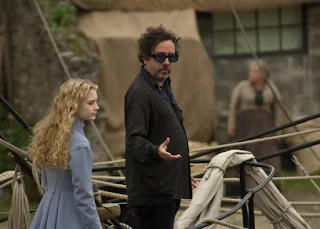
DP Dariusz Wolski, ASC and Director Tim Burton

The cinematographer kept those lighting choices fluid to match the workflow.
“My approach was to be able to move fast and give actors and myself the freedom of changing the mood very quickly,” Wolski continues. The task was to light three 150-by-80-foot green screen stages, differentiated only by topography, such as a castle or hills, which would be transformed into every different indoor and outdoor setting in the film via visual effects. “The most challenging thing was imagining the scene being surrounded by green screen,” he remembers. “You’re dealing with requirements you have to meet to pull the proper mattes and at the same time trying to create a mood.”

The solution was to only have as much green showing as necessary. In addition to a set of black curtains that were repositioned around the stages, Wolski also found light and dark gray fabrics that he placed on the floor to eliminate green spill and also avoid any green bounce. “When you want to put part of the face in shadow, if you’re surrounded by green, the shadow becomes green,” he explains. “Using this gray fabric was one approach we developed that became pretty successful.”

The Alice team (which included A-camera operator Martin Schaer, Steadicam and B-camera operator Scott Sakamoto, additional camera operator Kirby Washington, Libra head operator John Bonnin, D.I.T.’s David Canning and Ryan Nguyen) also used a big silk that doubled as a way for the Sony Imageworks crew to collect data on the relationships of characters to the space.

 “We created tracking marks on the silk that gave them a reference,” Wolski shares. They also placed 20K Fresnels on scissor lifts. “If it was an overcast day, we’d just use the top silk, and for a sunset glow, we shot the 20Ks through different kinds of diffusion. That gave me basically every possibility we’d have if we had shot outside.”

For the scenes when the JubJub, a large bird attacks Alice, the crew built a 16-foot diameter black circle and placed it on the crane. “When the bird attacked Alice or interacted with the actors, we had a big shadow we would drive over the faces,” Wolski says. “We tried to create as much interactive lighting as possible.” But going too far with lighting, which could have negatively impacted the work of the visual effects team, was a danger. “There was a constant dialogue between myself and the VFX supervisor Ken Ralston,” Wolski relates. “How much we would do the shadow, where the monster was coming from, where there would be flames. Problems disappear and new ones arise on the set, and, together, [Ken and I] could always find a solution.”


That fluidity extended to the production design, by Robert Stromberg, and the art direction, supervised by Stefan Dechant. “There was a lot of pre-visualization and rendering,” Wolski adds. “But once you come on stage, hardly any of that is there, so you have the freedom of changing it. [Previs] is a luxury that can also become a trap.”

So does Alice re-imagine the century-old iconic images or create something entirely new? A little of both, according to Wolski, who says, “there were so many references in the movie to the old illustrations and other elements. But it’s Tim Burton’s film and ultimately it’s going to be his interpretation.”

And that means a journey through Alice’s timeless and iconic world reflective of the filmmaker’s unique sensibilities. “Those characters are in our dreams, our tales,” Burton concludes. “[But] what I like about [this version of the story] is that it’s more of a personal journey: the moment where you make that important choice. It’s reconciling within yourself who you are, becoming the person you’re going to be, a human being.”

Courtesy of ICG Magazine /Debra Kaufman

SPIRIT AWARDS 2010

25th Film Independent Spirit Awards Arrivals Show

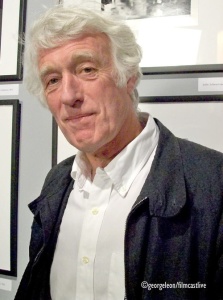
Roger Deakins, ASC, BSC took home the Best Cinematography Award for his work on Joel and Ethan Coen’s A Serious Man. Deakins is not in the running for the Best Cinematography Oscar this year, though he’s been nominated eight times in the past. The last time was last year, when he and Chris Menges shared an Oscar nomination for Stephen Daldry’s The Reader. A Serious Man and Ethan and Joel Coen took home the prestigious Robert Altman Award.


Click small lower button left to play
Turn off main video window above

Roger Deakins, ASC, BSC and Ethan Coen
(read, Roger Deakins, Keeping an eye on the small things)

 A Serious Man was awarded in the
category of Best Cinematography
and it was the recipient of the prestigious
Robert Altman Award.
T-Bone Burnett and Jeff Bridges, 
Independent Spirit Awards winners
for Crazy Heart.