REST IN PEACE, POLAROID FILM 1928-2009

By George Leon
Another of my favorite products has passed away to the annals of photographic history this month. Polaroid, the instant camera outfit with the ubiquitous instant self-developing film packaged in a blue box or a rainbow wrapped box, lost the battle against the gratifying immediacy of digital photography. The company which stopped making instant cameras for consumers a year ago and for commercial use a year before that, said that as soon as it had enough instant film manufactured to last it through 2009, it would stop making that, too. Three plants that make large-format instant film will close by the end of the quarter, and two that make consumer film packets will be shut by the end of the year.

Polaroid® (a trademark of the Polaroid Corporation) is the name of a type of synthetic plastic sheet which is used to polarize light. The original material, patented in 1929 and further developed in 1932 by Edwin H. Land, consists of many microscopic crystals of iodoquinine - sulphate herapathite embedded in a transparent nitrocellulose polymer film. The needle-like crystals are aligned during manufacture of the film by stretching or by applying electric or magnetic fields. With the crystals aligned, the sheet tends to absorb light, which is polarized parallel to the direction of the crystal alignment, but transmits light, which is polarized perpendicularly to it. This allows the material to be used as a light polarizer. Its crystalline structure also blocks the transmission of non-perpendicular light. Not only did Polaroid’s techniques work in film, but they also work in sunglasses, window coatings, liquid crystal displays and microscopes.

Limited edition of 4x5 Alpenhause Polaroid with a 127mm,
f/4.7, 4-element Rodenstock Ysarex and double-window
viewfinder/rangefinder on top of the camera and
automatic parallax compensation


Polaroid Land 180 with a 114mm, f/3.8 4-element
Tominon lens. Separate-window range/viewfinder
assembly. Built-in mechanical development timer

Among other photographic products of my choice that had come to a rather inglorious end is the Agfa-Gevaert XT series of motion picture camera negative stock, an emulsion that rendered beautiful subtle pastels and warm earthy tones and a first choice of many cinematographers around the world. I was fortunate enough to shoot many cans of Afga XTR250 and XTS400 and also compare its characteristics against Kodak and Fujifilm stocks in different workshops and presentations held in a short-lived cine club for professional cinematographers underwritten by Carol Dean of now defunct Studio Film and Tape and members of the old IATSE local 644 in New York City. Until not long ago, I had in my possession 1,200 feet (6 cans) of AgfaXT320 in my fridge.

But the saddest of all losses, is the retirement of the 35mm Eastman Kodak Kodachrome transparency film, with its durable polyester base and the sharpest dye couplers emulsion of the any era. Kodachrome was processed exclusively using its proprietary K-14, a predecessor of the common slide E-6 process, yielding a unique look, deep contrast and rich vibrant lasting colors. I was also lucky to shoot hundred of rolls of Kodachrome 25 ASA, 64ASA or 200ASA film, my favorite emulsion for corporate portraiture and fashion shoots. It was always a hit, if printed in Cibachrome. Fantastic looking prints! For more information about cibachrome prints, visit the website of a master printer and friend of mine at http://www.cloneachrome.com/

Kodachrome 64

In 1947, with World War II over and government contracts drying up, Edwin H. Land rushed his instant camera into production, with spectacular success. Consumers bought millions of Polaroid cameras and hundreds of millions of Polaroid film packs, establishing the company as one of Massachusetts' biggest manufacturers, with as many as 15,000 employees, and revenue that peaked at $2.31 billion in 1994.

According to the Photo Marketing Association, Americans bought 4.2 million instant cameras in 2000, nearly all of them Polaroid. However, they bought 4.5 million digital cameras that same year. It was a harbinger of hard times for Polaroid; digital cameras steadily got cheaper and better, and users became accustomed to sharing snapshots over the Internet. Last year, Americans bought 28.2 million digital cameras, and just 240,000 instant cameras.

But also, Polaroid had other problems: Its successful fight against a hostile takeover bid in the late 1980s left the company swamped with debt. It filed for bankruptcy protection in 2001, and is now owned by privately-held Petters Group Worldwide, of Minnetonka, Minn. “We’re trying to reinvent Polaroid so it lives on for the next thirty to forty years,” said Tom Beaudin, Polaroid’s President, COO and CFO in an interview to the Boston Globe. Petters changed its direction from instant cameras and instant film to digital cameras, flat-panel TV sets, DVD players and computer monitors under the Polaroid brand.

Polaroid’s decision to halt film production of their cameras and instant film distressed photo professionals and photo amateurs around the globe. Polaroid pack or sheet film is a very important tool for the non-digital professional, commercial and art photographer, allowing us to evaluate lighting, exposure and composition prior shooting our chosen emulsion in 35mm 120, 4x5, 5x7 or 8x10 formats. Every medium and large format camera maker offered a Polaroid back or facilitated the way for other aftermarket companies to adjust a Polaroid back in their cameras.

Prior every still shooting I did, regardless of the format, (except 35mm) and client, from corporate, to fashion to tabletop (2 1/4x 2 1/4 Hasselblad, 6x7 Mamiya or 4x5 Linhof/ Sinar) at my New York City/Hoboken studio or anywhere on location, I always used Polaroid pack or sheet film to evaluate lighting, exposure and composition. It was beautiful. It created a sense of anticipation, crew-client collaboration and sometimes worked as currency to pay agency “go-see” models, makeup artists or lunch. It was the proof of proofs of a successful shoot.

Polaroid 669 film is balanced for average
daylight (5500K) at 1/125 of a second,
as well as for electronic flash units

Polaroid 57 4 x 5 Black and White Sheet
film is a high speed, panchromatic general
purpose black and white print film.
Ultra high-speed Medium contrast,
medium grain

The ritual to time the processing of a Polaroid sheet or pack film coming out the rollers of a Polaroid back was sometimes a comical or a dramatic event among professional photographers. Usually, only assistants that had gained enough trust from the photographer could peel apart the Polaroid film. Timing and correct peeling apart of the film was key to offer a perfect proof to the client. The pungent smell of the gooey chemical left in my fingers after every peeling apart is a smell I will never forget.

A Polaroid 4x5 sheet holder, standard
for every 4x5 view camera

A Polaroid holder for pack film 6x 7 RZ Mamiya

The beauty of the subtle image etched into the negative of the Polaroid film is an object of admiration and manipulation by creative photographers and artists. A favored Polaroid camera by many artists, law enforcement, insurance companies and Polaroid aficionados was the high-end SX-70 because it’s many features as a reflex camera using integral print film.

Polaroid SX-70 the first foldable "reflex" instant
camera with integral film and coated 4-element
116mm f/8 coated glass lens and electronic shutter.
The SX-70 film was the favorite of artists for
creative manipulation (read more)

Time is changing everything rapidly; a new camera or new photographic technology could become obsolete faster than ever. Film and analog video is being replaced by HD video. High-speed film cinematography is being replaced by super high-speed video. 2D imagery acquisition is being fiercely courted by 3D acquisition, postproduction and distribution. (see Avatar, James Cameron's new movie)

An example in how fast a new technology becomes obsolete faster than ever, dwells in two little wonder cameras of early 2000, the Cannon XL and the Panasonic DVX100A/B, now dwarfed to say the least, by their HDV updated versions. It is technology-eating technology. The gratifying immediacy of a beautiful and grain less high-definition image is the incentive, is the Holy Grail, is the raison d’être.

As many other people, I will miss the different cheap Polaroid cameras I have owned through the years, spitting integral film with a toying sound and seeing the ethereal images forming in front of my eyes. Also, will miss a retrofitted 185 Land with a Copal leaf shutter I sold not too long ago and the screw-ups that happened every time I pulled wrongly the protective tab of a 669 or a 667-pack film. But overall, what I will miss the most is the wonderment offered by a technology that lasted over eighty years. A longevity record now days, that’s for sure.

VIDEO ASSIST PREDATES JERRY LEWIS "PATENT"

by George Leon
It is said that necessity is the mother of invention and Jerry Lewis, the director and actor of The Bellboy (1960) said these words about his invention of the "Video Assist " in a conversation in 2008
with Peter Bogdanovich


Peter: Well, it is incredible. I don't know how the hell you did it. That was your first movie as a director for a commercial release. And then you made five or six pictures right one after the other...

Jerry: Yep.

Jerry: Is that when you invented the video assist?

Jerry: 1956. I had already invented the video assist.

Jerry: The video assist is a closed-circuit monitor that enables you to see while you're shooting—it enables you to see what you're shooting on a TV monitor. Jerry invented that and for years was the only person using it. Now everybody in the industry uses it on every picture.

Peter: How did you come...how did that happen?

Jerry: Because nobody was doing it. I just thought, if I was going to direct a film of myself, I'm going to have to have that information. I'm not going to direct a film and say to someone, "Bernie, how was it?" "It was funny!" "Print it!" No way, no, sorry. So before I would take the directorial reins, knowing what that meant, I figured I'm going to have a tool that's going to help me that I could trust. I went to see Mr. Morita of Sony. I flew to Japan about 35 times in the next four years and I was working with Hideo, his son, who helped me tremendously in getting the beam splitter, getting the electronic code and making what I had to have to do what I wanted to do. So I put it together, made it work, and the first time I had a chance to work with it was on The Bellboy.

Jerry: So you can see yourself.

Peter: Yeah. Of course.

Peter: Amazing.

Jerry: I used only video monitors. I‘d use 30 or 35 of them on the set. Everywhere I was, I could see where we were when I was shooting and I would either make the entrance or cut it. If it was fine, I'd continue. I'd have all that information wherever I looked. No one could understand how I would know what that meant. Well, you work it out.

My interest into the matter is that grew up admiring and laughing at the nutty slapstick screwball comedy of Jerry Lewis and I still remember seen him directing Smorgasbord back in 1982 on location. Also, I have many years of experience using video assist or video taps as they are commonly known. I used them for music videos and television commercials. But, I never was a fan of the gizmo. It was blessed curse. It was the choice of directors or producers , but not necessarily mine as a cinematographer or camera operator for many obvious reasons.

In light of the conversation between Jerry and Peter and other claims of such technical achievement, Peter Glaskowsky, writer of Speeds and Feeds and technology analyst of CNET News decided to investigate the movie star patent registration.

A few weeks ago, he wrote about Jerry Lewis' role in the development of "video assist" technology, the use of video technology to support film making (see "Jerry Lewis and the elusive Video Assist patent"). Lewis was credited as the inventor of video assist during the Academy Awards telecast in February, and more specifically, was said to hold a patent on the technology. He looked for this patent because he thought it would be interesting to write about it here, but didn't find it. After he contacted the U.S. Patent and Trademark Office for help with the story, it looked too. The bottom line is that there is no such patent.


This illustration from an article written
by Jim Songer for American Cinematographer
magazine, shows a Panavision camera with the
video assist subsystem integrated into the loading door.
(Credit: Jim Songer and Video West)

It turns out that video assist goes back to well before 1956, when Lewis claims to have invented it--as he did in a 2008 interview with Peter Bogdanovich. Thanks to a commenter on my original post, plus some long discussions with Jim Songer, an engineer who made substantial contributions to video assist in the 1960s, I have tracked down what may be the earliest patents on video-assist technology. But before I get into those patents, let me describe the elements of video assist technology in a little more detail. First, video assist relates primarily to motion picture production. As the name suggests, the purpose of the video is to assist the production by allowing the director, actors, and other crew members to review what's being filmed. This can be done live, or if video recording is used, the video can be reviewed after the shot.

The ultimate implementation of video assist requires simultaneous film and video recording of the same scene with the greatest possible quality and convenience. Accordingly, both film and video recording should be accomplished with what amounts to one camera, which should meet all the other requirements for motion-picture principal photography, use the same viewfinder and all of the same controls, and work with the same lenses and lighting. There can still be considerable value to a system that doesn't meet all these requirements. Indeed, the earliest video-assist systems were very simple. US Patent 2,420,197 by Adolph H. Rosenthal, issued in 1947 with a 1944 filing date, describes combining film and video cameras on a common chassis. Each camera used its own lens, which means they couldn't record exactly the same view (a condition known as parallax). Parallax can be a problem, especially for a tightly framed shot. Sometimes it isn't a problem. Lewis, for example, used video assist to help set up the timing of his scenes, so precise framing wasn't essential. From what I've been able to learn, Lewis' original video-assist system used separate video and film cameras, possibly mechanically attached for convenience, and so may have been unpatentable in light of the the 1947 patent.

Jerry Lewis Video Assist console with a scope,
monitor and reel-to- reel tape playback

The next major step was to combine the two optical systems to eliminate the parallax error. This combination was described in U.S. Patent 2,698,356 by Paul Roos, issued 1954 with a 1951 filing date, which describes the combination of a movie camera with a TV camera recording the image through the same lens using a beamsplitter. It appears that the Roos adapted an existing camera design that used the beamsplitter to provide an optical viewfinder; Roos realized he could put a video camera in the viewfinder path. This development earned Roos a 1988 Technical Achievement Award from the Academy of Motion Picture Arts and Sciences (AMPAS) "for the invention of a method known as Video Assist."

A 1955 patent filed in 1953 by Arthur E. Reeves and Robert Gordon Nichols (U.S. 2,709,391) goes one more essential step by adding a second beamsplitter so that both an optical viewfinder and a video camera could be used simultaneously. Songer explained to me a limitation of the Reeves/Nichols design: the three optical paths in this system, each with a different length, would cause undesirable variations in image size. For one lens, the film might see a wider view than the video camera; for another, the image on the film might be larger and thus have a narrower view. Solving this problem would require making significant adjustments to the camera when changing lenses.

Also, since the video camera is so far from the lens, with so many optical elements in between, it would not receive very much light. The video cameras of those days were not extremely sensitive, so to make them work, more light had to be diverted from the film. There are a couple of patents from 1960 and 1965 describing the attachment of a 16mm film camera to a studio-style TV camera, but as far as I can tell, there were no further advances in video assist technology for motion-picture use until Jim Songer integrated a video camera into a Panavision film camera and solved these problems. Songer was hired by Gordon Sawyer of Samuel Goldwyn Studios in 1962 to work on video-assist technology, which he called "Instant Replay" at the time. Over the next several years the path of his developments echoed that of previous efforts, solving each problem in turn. Along the way,

Songer's project was spun out to create a company called "Video West," and Songer was kind enough to send me copies of articles from American Cinematographer magazine describing the "Video West Instant Replay System." Ultimately, Songer designed his own video camera using a high-resolution Saticon tube in which the video image was scanned from only a small portion of the tube face. This made it possible to divert a smaller portion of the light away from the film, so the combined camera system could work with standard studio lighting.

Songer's design made the video camera work as an almost invisible element in the film camera, eliminating the need for adjustments when changing lenses and minimizing the light loss so the camera would still work in typical studio conditions. Songer's design was also more practical for use in the fast-paced motion picture industry than previous systems. It eliminated the need for adjustments when changing lenses, and was built into the loading door for a standard Panavision camera so that it could be moved from one camera to another.

Previous systems, including a competing design from the Mitchell Camera Company, were built into the camera chassis, but Hollywood producers found it more convenient to rent standard cameras and install the video-assist module only when needed. With just two of these video-assist systems, Video West supported the production of a large number of motion pictures starting with Blake Edwards' "The Party." Songer also made his system wireless: the video signal was transmitted by radio to the video-tape recorder and multiple video monitors, including battery-operated portable monitors that could be brought onto the set for review by actors.

Songer received his own Technical Achievement Award from AMPAS for 2002. The research report prepared by AMPAS to support the award states: "...it can be concluded that the development of Video Assist by Jim Songer has had one of the most significant impacts of any technical development in the history of the fim industry." Referring to the various technical requirements for video assist as part of principal cinematography, the report concludes: "Since Jim Songer's Video Assist system was built inside the first sound reflex camera to be accepted by the motion picture industry for a camera in the 'A' position, it would make it chronologically impossible for anyone else to have achieved video assist any earlier."

(Songer didn't apply for patents on this work, which would have belonged to Video West in any event. But later in his career, he earned 17 US patents between 1976 and 2003, plus many more international patents. Some were very significant. One anticipated the Macrovision copy-protection technology for video-cassette recorders, for example. Others related to 3D video display and high-definition TV.) All of this information seems to put an end to Lewis' claims. He was undoubtedly a pioneer in the application of video assist, but others made more significant contributions to the development of this important technology.
Read On the Set with Video Assist by Michael Frediani, SOC

PANAVISION'S FUTURE IS IN NEED OF FOCUS

By Richard Verrier

When producer John Wells was preparing to shoot his crime drama "Southland," he chose a digital camera that few had heard of a few years ago. The Red One was inexpensive, easy to use and enthusiastically endorsed by his friend and director Steven Soderbergh, who used it to film his two-part movie last year about Che Guevara. Wells was so taken with the Red camera that he even used it to film the final six episodes of "ER." That was a blow to Panavision Inc., the movie camera rental company whose roots go back more than half a century in Hollywood and which had provided cameras for hundreds of episodes during the hospital drama's 15-year run.

Panavision was completely in shock," recalled Arthur Albert, cinematographer for "ER." "It was like a slap in the face." Panavision's movie camera, with the director squinting into the eyepiece behind it to line up the shot, has been a ubiquitous presence on film sets. But now the company, beset by cheaper rivals moving into its turf, a sharp drop in film production and huge debt acquired in a 1998 takeover by investor Ronald O. Perelman, is struggling to hold on to its reputation as the industry's leading supplier of cameras and lenses.

Once known for its stable management, Panavision in recent years has more resembled the revolving executive suite door of a Hollywood studio, with four chief executives in the last six years. The most recent, William M. Campbell, lasted less than three months on the job. "Anybody who uses Panavision equipment has to be concerned," said Richard Crudo, past president of the American Society of Cinematographers. "Our biggest concern is that something disastrous might happen and suddenly they're not with us any longer. That would be a major blow to the industry."

Some of Panavision's problems parallel those facing other companies in the production industry. The company has been hit hard by the steep downturn that began last year during the Hollywood writers strike and the subsequent standoff between the major studios and the Screen Actors Guild. The economic recession also led studios to make fewer movies and advertisers to cut back on making commercials, further weakening demand for filmmaking equipment.

Panavision is a unit of Perelman's privately owned holding company, MacAndrews & Forbes Holdings Inc., which doesn't release the company's financial results. But people close to Panavision say camera and lens orders for feature films, which account for most of the company's revenue, are down 15% to 20% this year.

The company generated about $250 million in revenue in 2008, slightly below that of 2007. The company would not provide an estimate for total revenue in 2009. In response to the slowdown, Panavision laid off about 200 employees, reducing its total workforce to 1,200. It plans to consolidate offices, currently split between Woodland Hills and Hollywood, into a location in Burbank this year. The close-knit cinematography community first sensed things may not have been going well at Panavision in April, when Perelman ousted Bob Beitcher, who had been CEO since 2003, after the two sparred over how to turn the business around. The news surprised many in the industry, where Beitcher was respected for his efforts to improve Panavision's service and upgrade its products.

Beitcher declined to discuss his exit, but said, "Panavision is dealing with many of the same issues as all the other service providers in the industry are." Beitcher was succeeded by Campbell, a former president of Discovery Networks USA who also had been an executive at ABC, CBS and Warner Bros. Television. But Campbell barely had a chance to unpack his boxes before Perelman asked him to step aside in June, after other executives complained that Campbell lacked an understanding of the business and was not sufficiently engaged in the day-to-day affairs of the company, according to people familiar with the situation.

But one person close to Campbell disputed that account and said he stepped down because Perelman didn't share his strategy to rejuvenate the company, which included beefing up the company's website and more aggressively taking on rivals like Red Digital Cinema, the Lake Forest maker of the Red One camera. Campbell, who will continue to work for the company as a consultant, declined to comment for this article.

He was succeeded by William C. Bevins, a longtime Perelman associate who had worked as a top executive at the billionaire investor's other Hollywood companies, New World Communications Group Inc. and Marvel Entertainment Inc. Bevins declined to discuss the management upheaval but said that "the most important thing right now is to make sure that we manage through this recovery and that as the economy improves we have equipped ourselves to provide not just the service, but the gear that will allow us to maintain and possibly even improve our market share." Despite the drop in business, Panavision still generates an operating profit and has cash flow of about $70 million, said people familiar with the company. But much of that goes toward servicing its debt, which is held by a consortium of banks headed by Credit Suisse.

"We can very effectively manage the debt level that we have," Bevins said. "But if at any point in time we have capital needs that go beyond that, we can always look to our shareholder [Perelman], and he's been supportive of us." Aside from a production slowdown, Panavision is grappling with a more fundamental shift: Its business was built around manufacturing and leasing costly, high-end film cameras. It was a model that worked well for decades, when its cameras and lenses became a fixture in Hollywood and had little competition.

But demand for film cameras has steadily declined in recent years. Although filmmakers still debate the merits of shooting on 35-millimeter film versus shooting digitally, the switch to digital equipment has been dramatic, especially in television, where studios have been pressuring producers to cut costs. Virtually all the TV pilots were shot digitally this year. Panavision rents digital cameras, including its well-regarded Genesis, which it developed with Sony Electronics.

Panavision Genesis

But that camera is older and generally costlier to rent than rival digital models such as the Red One, which was developed by Jim Jannard, founder of eyewear and apparel company Oakley Inc. Interest in the Red camera soared after it caught the attention of filmmakers like Soderbergh and "The Lord of the Rings" director Peter Jackson, who used the camera to shoot a short war film, "Crossing the Line."

In addition to renting the camera, Red Digital Cinema sells its camera and accessories for about $30,000, making digital cameras affordable for filmmakers. By contrast, Panavision cameras aren't for sale and typically rent from $10,000 to $60,000 a week. "Suddenly the camera that nobody has access to, everybody has access to," said Brook Willard, a digital imaging technician who works with the Red camera and served as an advisor on "Southland" and "ER."

Bevins acknowledged that Panavision needs to more quickly adapt to the changing marketplace. To that end, the company recently acquired 15 Sony digital cameras for $35 million and is developing a new line of digital cameras. "We've decided to redouble our efforts to develop product for the digital marketplace," he said. "We can't rent what people don't want."

NEW! ROSCO iGOBO APPS FOR iPHONE AND iPOD TOUCH

By George Leon
Courtesy of Chris Alexander, Rosco Canada

The iPhone and iPod Touch shines again as a tool for the Cinematographer and the Lighting Designer.In past postings I called the iPhone and the iPod "The Swiss Army Knife for the Cinematographer" given to the many new apps available to the operating cameraman, director of photography and lighring designer. For the Camera Department, we count with the Depth of Field (DOF) Calculator, the Footage Calculator, the Aspect Ratio Calculator, the Lens Angle Calculator, and a gaffer's delight, the Power Load Calculator.

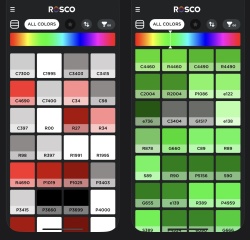
For the Lighting Department, the Rosco iGobo for iPhone and iPod Touch is the perfect tool for lighting designers, technicians and creative directors on the go. Containing the entire Rosco gobo library of more than 2300 images, iGobo makes it easy to browse, compare and select steel, glass or effects gobos, black and white or color, no matter where you are -- in your studio, at the tech table, in a design meeting or even in transit. iGobo uses the familiar look and feel found on the Rosco Gobo Website and printed catalog, with gobos sorted into helpful categories and shown along side similar, related images. The app defaults to the same order and layout found in the Rosco Gobo Catalog, but you can re sort by gobo code or name or by category
Your most recently browsed gobos are always available for review in case you want to go back to something you know you saw before. A comprehensive table of keywords helps you to zero in on the right gobo. Choose any 2 gobos to compare side by side, replacing one or both images quickly and easily. When you find something you like, add it to a Favorites list so you can recall it at another time. Make notes about how you might use it, or on what project. Finally the powerful search finds gobos by name, code, category, keyword, designer name or even the DHA gobo code familiar to many designers in Europe and Asia. And of course all of the iPhone’s magical gestures have been implemented allowing you to flick back and forth among gobos, rotate or reposition them with a simple twist of your finger and double tap into new screens.

FEATURES
More than 2300 gobo designs in steel and glass, b/w, full color and iPro images
Crisp clear thumbnails and brilliant full screen images
Arranged by category and easily sorted by code, name, category or catalog order
Search by name or code
Rotate or spin gobos with the flick of your finger
Compare any two designs
Store your selections as a Favorite’s list for easy recall later

Rosco iGobo for iPhone and iPod Touch is the perfect tool for lighting designers, technicians and creative directors on the go. Containing the entire Rosco gobo library of more than 2300 images, iGobo makes it easy to browse, compare and select steel, glass or effects gobos, black and white or color, no matter where you are -- in your studio, at the tech table, in a design meeting or even in transit. iGobo uses the familiar look and feel found on the Rosco Gobo Website and printed catalog, with gobos sorted into helpful categories and shown along side similar, related images.

The app defaults to the same order and layout found in the Rosco Gobo Catalog, but you can re sort by gobo code or name or by category Your most recently browsed gobos are always available for review in case you want to go back to something you know you saw before. A comprehensive table of keywords helps you to zero in on the right gobo. Choose any 2 gobos to compare side by side, replacing one or both images quickly and easily. When you find something you like, add it to a Favorites list so you can recall it at another time. Make notes about how you might use it, or on what project. Finally the powerful search finds gobos by name, code, category, keyword, designer name or even the DHA gobo code familiar to many designers in Europe and Asia. And of course all of the iPhone’s magical gestures have been implemented allowing you to flick back and forth among gobos, rotate or reposition them with a simple twist of your finger and double tap into new screens.

For other lighting control and lighting color changing applications for the iPhone and iPod read more "The Next Swiss Army Knife for the Cinematographer"
For more information about Rosco

OLD SCHOOL, NEW SCHOOL. MANY VISIONS, ONE VOICE.

A terrific documentary....with a cast of brilliant minds
Better than a $2,500 creativity workshop..


Steven Fischer, a two-time Emmy nominated documentary filmmaker, is traveling the United States in search of meaningful conversations with master storytellers.

OSNS collects intimate conversations between Fischer and master storytellers from all disciplines (dance, music, literature, cinema, etc.) into a cinematic study that explores how an artist can reach his full creative potential. The conversations center on three major themes: how to find your own voice, taking risks, and defining success in the arts. These accomplished artists offer engaging insights and generous wisdom, sharing a lifetime of real-life lessons learned about the essential matters every serious storyteller wants and needs to ponder.

The incisive on-screen questions by Steve Fischer and the revealing answers from the cast of brilliant minds participating in the documentary engage any viewer in a participatory way. The answers reveal an insight of their creativity process as individuals and they become the master advice to anybody who is searching their creative path and probably life purpose.

Although OLD SCHOOL, NEW SCHOOL is still a work in progress, the message becomes very personal to the audience and after the editing process is done, the sequential inter-cutting of questions & answers could become an anticipatory progression to a climax. There is a final answer to achieve your goals? There is a golden key or a template?. Or taking risks while you are trying to succeed is the answer?.

FEATURING:

WILLIAM FRAKER, ASC - six-time Oscar nominated cinematographer of "Rosemary's Baby", "Bullitt", "War Games", "The Freshman". Select ON-DEMAND to watch a portion of the interview with Mr. Fraker.

EMANUEL AZENBERG - Tony Award winning Broadway producer of "Rent", "Brighton Beach Memoirs", "Biloxi Blues", "Long Day's Journey Into Night".

BEN JONES - actor "The Wonderful World of Disney", "As the World Turns", "The Daily Show", most recognized as Cooter from "The Dukes of Hazzard".

KIRSTIE SIMSON - Britain's celebrated dance artist. Simson teaches and performs throughout Europe, Asia, and North America.

JOHN BAILEY, ASC - Legendary Hollywood cinematographer of "American Gigolo", "The Producers", "In the Line of Fire", and "He's Just Not That Into You". Select ON-DEMAND to watch a portion of the interview with Mr. Bailey.

JAMES RAGAN - acclaimed poet and former head of USC's Professional Writing Program.

SAM McCREADY - renowned Yeats scholar and playwright. Former teacher of Liam Neeson, Kenneth Branagh, Kevin Spacey.

OLD SCHOOL, NEW SCHOOL, marketing and distribution strategy for completion funds seems more altruistic than solely commercial. At key presentations, the original interviewees are invited for a Q&A talk and in their absence another brilliant guest panel is invited for the Q&A talk to dissect creativity and other issues from own their perspective. All panels are composed by high caliber creative people at the top of their totem pole providing fantastic inside vision of the creative process. The screening and the Q&A portion is a motivational and educational evening for personal enrichment. I would summarize it as better than any $2500 creative workshop offered often around Hollywood or New York City.

The last screening of OLD SCHOOL, NEW SCHOOL to which I was fortunate to attend was organized by Hollywood Shorts, Kimberley Browning. The Q& A panel was a chuck full of creative wisdom and experience composed by Brett Pasel (author Mommies who Drink), Mark Goffman (producer Law & Order: SVU), Steve Melendez (producer The Lion, the Witch & the Wardrobe; Peanuts, Garfield), Mike Polcino (director The Simpsons, Family Guy) and moderated by Steve Fischer.
Steven Fischer conferencing at
Bill Melendez Productions

KODAK EVENTS AT LOS ANGELES FILM FESTIVAL

Emmy®-winner Robbie Greenberg, ASC shared his experiences at the Los Angeles Film Festival (LAFF), which showcases new American and international cinema. Greenberg offered his insights into the artistry and technology of his craft as he showed and discusses his work from a career that spans over 30 years. The festival, now in its 15th year, ran June 18-28 at venues in and around Westwood Village.
Michael Houser, Kodak's Account Manger of Entertainment Imaging, moderated the presentation and Q&A. Houser serves as Kodak's liaison for the major studios and independent filmmakers acquiring film stock. Houser relationship with Hollywood top cinematographers and his awareness of their production needs made him the right choice for the conversation with Robbie Greenberg.

Robbie Greenberg has won two consecutive Emmy® Awards for his work on Introducing Dorothy Dandridge and Winchell, as well as three additional nominations for Warm Springs, Iron Jawed Angels and James Dean. His work on four of these telefilms also earned him American Society of Cinematographers (ASC) Awards. Greenberg's extensive credits include The Milagro Beanfield War, Free Willy, Fools Rush In, Save the Last Dance, and Wild Hogs.

After a brief introduction by Houser, Greenberg was received with a thundering applause by the audience. The attending audience consisted of a mixed bag of festival goers, film school students, camera department professionals and first time filmmakers.

The afternoon program consisted of a 10 minutes clip screening of some of his award winning films followed by a candid conversation with Houser and a Q & A with the audience. A note worth to mention was that the screening was projected on film stock. The quality condition of the three prints screened allowed the audience to evaluate the sharpness, color rendering and forgiving latitude of the Kodak negatives used by Greenberg in these three different genres.

The first clip presented was The Milagro Beanfield War, a compelling pastoral social rights issue drama directed by Robert Redford. The mesmerizing screening focused into the almost constant magic hour landscape photography captured by Greenberg, who highlighted the storyline with a surreal multicolor glow and a naturalistic mountain ambient light.

The audience was stunned by the emotive beauty of the framing, composition and photography of the film and made many questions ranging from the relationship between cinematographer and director, camera placement and actor blocking, choice of film stock, lenses and aspect ratio, production design as complementary to cinematography and, of course, Greenberg's working relationship with Robert Redford.

The second clip was Winchell, a made for TV biopic spanning several decades. In order to emphasize the different periods of Winchell's saga, Greenberg lit the many scenes with the proper elements of the different eras. As an example, to photograph Winchell's youth scenes in new York's lower East Side (at Paramount lot), he re-styled a textured lighting plot with deep shadows reminiscent of The Godfather's youth scenes. "The intent was to be able to span the many decades of Winchell's life and to keep each period unique". Greenberg also recreated and mixed stock footage with the actors, offering seamless black and white newsreel style photography.

At other moments, when Winchell is at the top of his game as the hottest journalist in town adulated by politicians and the stars of the moment, Greenberg uses a very sharp and glossy photography to show the decadence of the era.

The last clip presented was the feature crime story Even Money where the narrative describes the lives of three otherwise unconnected people and their destructive addiction to gambling. Here, Greenberg lit each people world's completely different to the other. Each character has it own "signature" lighting trough the storyline that is complementary to their personality, shortcomings and destructive behavior.

Other events organized by the festival also include Kodak Speed Dating, which offers session participants the opportunity to talk one on one with industry professionals, and Kodak Fast Track, an intensive film financing market that connects filmmakers seeking funding and financiers, production companies and other high-level industry professionals who can provide assistance.
Previous Fast Track projects include Amreeka, Frozen River, Kabluey, Four Sheets to the Wind, Ira and Abby and After Innocence. "We're thrilled that the innovative filmmakers who are exhibiting their work here at LAFF continue to create their vision on film," says Peter Boyce, Kodak's general manager of North and South America. "Our goal is to listen, and continue providing the highest-quality tools that filmmakers want. We are committed to bringing the best products and services to the creative community, so they don't have to make compromises at any stage of the filmmaking process." Kodak's Entertainment Imaging Division is the world-class leader in providing film, digital and hybrid motion imaging products, services and technology for the entertainment industry. For more information, visit www.kodak.com/go/motion.

HD EXPO - NEW YORK CITY

September 17, 2009-New York, NY
November 4-5, 2009-Los Angeles, CA

THE GREAT DAYLIGHT MONITOR SHOOTOUT

Camera Support a designer and provider of crane, rail and moving camera platforms for the film and high definition industry and a Stedicam rental house in Burbank hosted yesterday The Great Daylight Monitor Shootout.

The public at the event

A "rotisserie" was constructed with speed rails to hold 14 different new daylight monitors available for Steadicam and other flying rigs. There were 14 clips and a live camera feed. To demonstrate the features of the monitors the rotisserie could be rotate 90 degrees to position the monitors from horizontal to vertical. Several of the manufacturers were present to answer any questions about the features and price of the monitors.
The "rotisserie" with daylight viewing monitors for close evaluation

Steadicam operators checking features

Gaylen Nebeker of Nebtek answering questions

Some of the companies who participated in the Daylight Monitors Shootout were, Nebtek, Inc who showcased three monitors namely, the Blackbird Sunlight Viewable 6.5" Screen Monitor and the Solar 7" HD and HDS Sunlight Viewable TFT LCD Monitors. These monitors offered a superb color rendering and definition at a glance at different viewing anglers under the direct afternoon sun. Another practical accessory showcased in their booth was the CW-5HD HD Wireless Transmitter and Receiver along a with bracket to handheld the monitors. Pretty nifty!

Transvideo the premier state of the art electronic company for the film industry was showcasing couple of monitors of their flagship series, The Rainbow Series, a 5" daylight viewable monitor with a outstanding amount of features and the choice of many Steadicam operators. The monitors offered at glance easy viewing of the image and color at several angles, along with an array of many necessary adjustment and features such as underscan, overscan, vectorsope, waveform, histogram, blue check, gamma, zoom, 4.3, 16:9 and 2.35:1 ratios and much more. Also they had available many accessories necessary to the displays such as a 6" Night and Sun Hood, a Spirit level, a raincover and a wireless handheld bracket to name some.

Bernie Keach of Marshall Electronics

The largest company in the shootout was Marshall Electronics, a veteran manufacturer in the broadcasting industry. The quality of their outdoor viewing monitors is outstanding with an larger array of sizes to choose from the outdoor 6.5" TFT to the 15" TFT offering the technical characteristics and performance Marshall Electronics is known for. Their 6.5" and 7" portable camera-top field monitors are fully featured monitors with False Color and Peaking Filters with a variety of inputs and outputs, including 3G, HD and SDI and a variety of battery configurations.

Randy Gomez, CEO of Camera Support and
Tisha Matthews, camera operator

CINEGEAR EXPO 2009 WAS A BLOCKBUSTER!

CINEGEAR kicked off its 13th expo on Thursday June 4th with a big bang returning to its original stomping grounds, the Paramount Pictures Studio lot in Hollywood. The program started with the Film Series, a tribute to the Visual Art of Filmmaking which included the Student Short Film Competition, the Independent Short Film Competition, the Independent Feature Film Competition, and the new Documentary Film Competition.

CINEGEAR at Paramount, the place to network
and see the latest of the motion picture industry
(double click for detail)

An elliptical Airstar space lighting balloon
over a lower Manhattan street.
(double click for detail)

CINE GEAR opened its doors to the general public on Friday 5 at 4:00 pm and in matter of a few minutes the studio filled with attendees visiting the impressive exhibits on display. Among the companies exhibiting their products or services were: Creative Handbook, Pictorvision, Motion Picture Marine, Birns & Sawyer, Kodak, Airstar America, Nevada Film Office, Lensbaby, Carl Zeiss, Technocrane, Photo-Sonics , Mole Richardson, Society of Camera Operators, Schneider Optics, Fuji Film, Walter Klessen FX, Warner Bros, American Society of Cinematographers and many more.

The main venue for vendors exhibiting massive outdoor displays was the realistic exterior set of the lower Manhattan streets. The cavernous Stage 16 was the venue of choice for other companies like Panasonic, Filmtools, Rosco Labs, the UK Pavillion, Bron Kobold, Litepanel and Chimera to mention some of the participating companies.

Tom Hallman , Pictorvision and CINNERS President
along with Dave Arms, Aerial Operator and Technician showcasing
the new PictorFX 3D scanning and modeling system.


Creative Handbook, the # 1 entertainment resource
David Shapiro and team


PRESERVING THE FUTURE OF THE MOVING IMAGE, A PREMIERE SEMINAR AT CINEGEAR

The Premiere Seminars series started with Preserving the Future of the Moving Image held at the sold-out Sherry Lansing Theater and co-presented by the BSC, British Society of Cinematographers and the ASC, American Society of Cinematographers, moderated by Bob Fisher. The BSC panelists presented an evaluation comparing images produced with 18 different digital cameras and film stocks in Super 16 and Super 35 formats to provide an objective visual reference and factual information to help guide decisions about the choice of media for the production of narrative motion picture and television programs.
The evaluation included day and night, interior and exterior scenes and close-up shots that were produced at Pinewood Studios. The images are in the process of being taken through a state of the art post-production workflow for projection in both film and digital formats.

After an introduction of the members of panel by Bob Fisher, the President of the BSC, Sue Gibson presented the evaluation and workflow process supported by a video projection of several key images and footage taken in different settings and lighting situations by accredited members of the BSC. The evaluation presentation was followed by a Q&A with the participation of the inquisitive audience covering gray areas for some, such as format, image acquisition, proper workflow and global technical standardization.The BSC and ASC members of the panel responded with a unanimous voice about the proper way of utilizing the discussed cameras, being digital or film, as a unique tool for your specific job at hand. No digital camera supersedes a film stock reflex camera or vice-versa, they all just represent another tool in your cinematographer's bag . The immediacy and grain less images of the digital camera realm has brought the need of the comparison test implemented by the BSC and ASC members.

America, Europe and the world in general, looks up to the BSC and the ASC for their artistic, ethical and technical guidelines, thus creating the need of a coherent and bona fide technical reference to follow, rather than a subjective manufacturer sales sheet that provides marketing specs to their prospective clients as described by Michael Goi, ASC President.

Few moths ago, the ASC conducted a similar comparison test in conjunction with the Producers Guild Of America (PGA) spearheaded by Curtis Clark, ASC and Dave Stump, ASC, using the following cameras: Arri 435 (various Kodak film stocks, but primarily 5217), Arri D21, Panavision Genesis, Panasonic 3700, RED One, Sony F23 , Sony F35 and Thomson Viper and released its findings last Sunday, July 7 during Produced by Producers held at Sony Studios. (Upcoming posting)
Sue Gibson, BSC President and Michael Goi, ASC President

The BSC/ASC panel was integrated by Sue Gibson, BSC President, Joe Dunton BSC, John Daly BSC, Martin Hammond, ASC President Michael Goi, Steven Poster ASC, Richard Crudo ASC, and Nic Morris, BSC, Board of Governors. As a closing highlight, the panel discussed the preservation of the moving image for future generations, preceded by the presentation of a clip of a restored film and a Q&A.

Bob Fisher, Joe Dutton, BSC and Phil Meheux, BSC