SONY UNVEILED AI POWERED 33MP FX2 CINEMA CAMERA

Latest Sony compact Cinema Line camera

The FX2 improves the baseline for everyday filmmakers and content creators with a 33MP full-frame sensor, 4K shooting up to 60 fps and Full HD up to 120 fps, a 3.68m-Dot OLED viewfinder, Al-based subject recognition and framing, 15+ stops of dynamic range, and 4K live streaming. The FX2 features also advanced properties for shooting stills, including the ability to capture stills in S-Log3 mode with optional LUT application.


Sony FX2 AI POWERED 33MP CINEMA CAMERA

                     FX2 Cinema Camera w/ XLR Handle


FX2 Highlights:

  • 33MP Full-Frame CMOS Exmor R Sensor
  • 4K up to 60 fps | 1080p up to 120 fps
  • 33MP Stills in S-Log3 at 800/4000 ISO
  • Al-Powered Auto Focus & Framing
  • Dynamic Active Al-Based Stabilization
  • 10-Bit 4:2:2 XAVC S-I, 16-Bit Raw Output
  • S-Cinetone/S-Log3/HLG, 15+ Stops DR
  • 3.68m-Dot 0.7x OLED EVF with 90° Tilt
  • CFexpress Type A & SD Card Slots
  • 2.4/5 GHz Wi-Fi for 4K Live Streaming

Sony introduced its latest compact Cinema Line camera, the FX2, improving the baseline for everyday filmmakers and content creators with a 33MP full-frame sensor, 4K shooting up to 60 fps and Full HD up to 120 fps, a 3.68m-Dot OLED viewfinder, AI-based subject recognition and framing, 15+ stops of dynamic range, and 4K live streaming. 


Sony FX2 AI POWERED 33MP CINEMA CAMERA WITH LENS

The FX2 also features shooting stills, including the ability to capture stills in S-Log3 mode with optional LUT application. A natural successor to the popular FX3, if not a direct descendant, the FX2 is an uncompromising realignment of its forerunner’s hybrid ethos with the contemporary digital landscape.


Cinematic Video Meets Advanced Photo Capture

Equipped with a 33MP full-frame sensor, the AI-powered Sony FX2 combines the comprehensive video capabilities of the Cinema Line with enhanced still image capturing in a compact, travel-friendly form factor. Ideal for on-the-go filmmakers and content creators, the FX2 features an S-Log3 photo mode with optional LUT application, and it sports a 3.68m-dot OLED viewfinder that tilts from 0 to 90°. Its AI processing unit provides active image stabilization and real-time subject recognition, allowing for maximizing the accuracy of autofocus and framing.


Sony FX2 AI POWERED 33MP CINEMA CAMERA WITH LENS II

33MP Exmor R BSI CMOS Sensor

Matching its 33MP back-illuminated Exmor R sensor with a BIONZ XR processor, the FX2 captures vivid 4K video with natural gradations, realistic color, and low noise in both full-frame and Super 35 modes, providing wide lens compatibility without sacrificing resolution. In full-frame mode, the FX2 offers 7K oversampling with full pixel readout for exceptional sharpness and realism. Designed to tackle diverse lighting scenarios, the FX2 features a dynamic range greater than 15 stops, an ISO expandable up to 204800, and updated dual-base ISO technology for capturing footage in S-log3 at 800 or 4000 ISO.


DCI 4K Video Recording

Designed for flexibility, the FX2 shoots DCI 4K footage internally with 10-bit 4:2:2 sampling or outputs 16-bit raw video via an HDMI connection. Live streaming in 4K is also possible over the camera’s Wi-Fi or through a wired, USB connection in UVC/UAC, RTMP, and SRT protocols. 


Capture video in XAVS S, S-I, and HS recording formats in Long GOP, All-Intra, H.264, and H.265 codecs. Color and tone reproduction can be tailored with precision using up to 16 user-imported LUTs or S-Cinematone mode for matching VENICE, FX9, FX6, FX3, and other camera sources. The FX2 features an intuitive Variable FPS setting for creating time-lapses and slow-motion video, and it can de-squeeze 1.3 and 2.0x anamorphic footage, all in-camera.


Sony FX2 AI POWERED 33MP CINEMA CAMERA SHOOTS STILLS

Hybrid Still Image Capture

The FX2 brings the versatility of a hybrid camera to the Cinema Line, improving still-image capture and adding features such as Log shooting and user-LUT application. It features built-in toggle to switch from movie to still mode, shoot 33MP JPG or HEIF images in S-Log3 for streamlined color grading,  capture photos from shot marks during internal video recording or playback, apply previously imported user LUTs to captured still images, flex or base ISO settings and S-Gamut3 or S-Gamut3.Cine color spaces.


Sony FX2 AI POWERED 33MP CINEMA CAMERA SHOOTS STILLS LOG


AI Subject Recognition

One of latest features is the new AI processing unit that uses deep learning to deliver improvements in autofocus, auto framing, and stabilization. The phase- and contrast-detection AF is boosted with real-time subject recognition, identifying people, animals, and vehicles, along with Eye AF for humans, animals, and birds, seeing a 30% improvement over the FX3 and FX30. Auto framing automatically tracks and crops subjects, keeping them prominent in the frame, while also boosting stabilization. The new Dynamic Active Mode adds another layer of AI-powered stabilization for videos taken while walking.


Sony FX2 AI POWERED CINEMA CAMERA


Comprehensive Stabilization

The FX2 also retains the same five-axis, in-body optical stabilization as other Cinema Line and Alpha cameras. Combining in-body optical image stabilization with AI processing power and E-mount lens metadata for post-production, the FX2 offers an array of ways to eliminate camera shake during handheld shooting. It features 5-axis in-body optical image stabilization, Dynamic Active Mode for stable handheld shooting, Framing stabilizer uses advanced AI, Shake metadata is embedded into footage for post-production.


Unique Built-In Electronic Viewfinder 

Another unique addition to the FX2 is the new built-in electronic viewfinder. Tiltable between 0 and 90°, the EVF has a 3.68m-Dot OLED screen and a rubber cup for precise compositions in any lighting conditions. The 3”, tiltable, fold-out touchscreen offers further viewing options along with intuitive menu navigation and the BIG6 home screen found in high-end CineAlta cameras.


Improved Accessibility

Inheriting the BIG6 home screen from high-end CineAlta cameras such as the VENICE, the FX2 allows easy adjustments to FPS, ISO, shutter angle, aperture, look, and white balance when set in Movie Mode. The 3" fold-out touchscreen LCD provides intuitive menu navigation and sports a tiltable design and 1.03m-dot resolution. Unique to the FX2 is a built-in 3.68m-dot OLED electronic viewfinder with a 0.7x maximum magnification. Tilting from 0 to 90°, the EVF has a reversible rubber eyecup and 33mm eye point, allowing pinpoint framing in extreme lighting conditions.


Sony FX2 AI POWERED CINEMA CAMERA WITH GIMBAL

The improved handgrip holds an NP-FZ100 battery and sports one of the camera's five 1/4"-20 female threads—three for accessories and two for mounting plates. Several functions have dedicated controls, including the power switch, record button, movie/still switch, zoom lever, playback button, and control dials, while seven other buttons serve user-assignable functions.


Ergonomic Design

Built from lightweight, sturdy Magnesium alloy, the FX2 has an updated heat-dissipating structure and built-in cooling fan, ensuring uninterrupted 4K60 recording. The improved handgrip holds a single 16.4Wh NP-FZ100 battery and sports one of the camera's five 1/4"-20 female threads—three for accessories and two for mounting plates. Several functions have dedicated controls, including the power switch, record button, movie/still switch, zoom lever, playback button, and control dials, while seven other buttons serve user-assignable functions.


SONY FX2 CINEMA CAMERA


SONY FX2 CINEMA CAMERA IO PORTS
Connectivity & Compatibility

The camera has a broad selection of connectivity options, including HDMI output, USB-C, LAN, Wi-Fi, micro-USB, 3.5mm mic and headphone jacks, and a multi-interface hot shoe. Internal storage is supported by one CFexpress Type A/SDXC card slot and an SD card slot. The FX2 Digital Cinema Camera is also compatible with Sony’s XLR-H1 Handle Unit for expanded control and audio options. Sony is selling the camera bundled with the XLR-H1 Handle Unit in addition to the body only option. 


FX2 Cinema Camera (body only): $2,698.00. Visit B&H for purchase and hands-on demo.

REST IN PEACE, POLAROID FILM 1928-2009. REVISITED

 In Loving Memory of Polaroid: A Photographer’s Farewell to Instant Film. Originally published on August 22, 2009. Revisited and updated, celebrating the premiere of the three episodes of  Mr. Polaroid in American Experience/PBS on April 24 at 9PM/8PM central. 

This past month marked the quiet passing of yet another beloved tool in my professional photographic arsenal. Polaroid—the legendary instant camera company known for its iconic blue and rainbow-striped packaging—finally surrendered to the immediacy and ubiquity of digital photography. After ceasing consumer instant camera production in 2008, and halting commercial camera lines a year earlier, Polaroid announced that once it exhausted its final batch of instant film, it would end production entirely. The remaining three plants producing large-format instant film were slated to close by the end of that quarter, while two others responsible for consumer film packs were set to shut by year’s end.

Polaroid Speedliner Model 95. Vintage adv.

Polaroid®—a name synonymous with instant photography—is also the name of a synthetic plastic sheet used to polarize light. Patented in 1929 and refined by Edwin H. Land in 1932, this material uses embedded microscopic iodoquinine sulfate herapathite crystals within a nitrocellulose polymer base. When aligned by stretching or magnetic fields, these crystals absorb light polarized in one direction while allowing perpendicularly polarized light to pass through, making the sheet ideal for sunglasses, window coatings, LCDs, microscopes—and of course, Land’s revolutionary instant film.

Polaroid Camera Model 180

Polaroid Land 180 with a 114mm, f/3.8 4-element

Tominon lens. Separate-window range/viewfinder

assembly. Built-in mechanical development timer


Polaroid was more than a consumer brand—it was a vital part of professional image-making. It offered a tangible, immediate preview of lighting, exposure, and composition before committing to costly film. It gave photographers instant feedback, allowed clients on set to visualize the final image, and even served as bartering currency with agency models, stylists, and assistants. In many ways, it was the “proof of proofs.”


Polaroid Peel Off Film 57

Polaroid 57 4 x 5 Black and White Sheet film. 

A high speed, panchromatic general purpose 

black and white print film, ultra high-speed medium 

contrast with medium grain


But Polaroid wasn’t the only loss. Among my most mourned photographic casualties is the Agfa-Gevaert XT series of motion picture negative stocks. With their soft pastel hues and warm earthy tones, Agfa XTR250 and XTS400 were favorites of cinematographers worldwide. I was fortunate to shoot on these emulsions across various projects and compare them to Kodak and Fuji stocks during workshops hosted by a short-lived Manhattan cine club for professionals. These events, sponsored by the late Studio Film & Tape, presided by Carole Dean and with the participation of renowned cinematographers like Sol Negrin, ASC and other members of the old NABET/IATSE local 644 in New York City, were invaluable learning grounds. Until recently, I still had 1,200 feet of Agfa XT320 stored in my fridge—an homage to a bygone era.

Agfa XT 320. Motion Picture Film

Perhaps the saddest farewell of all is Kodachrome—Eastman Kodak’s legendary 35mm transparency film. With its durable polyester base and unmatched dye-coupler sharpness, Kodachrome was a masterpiece of photochemical engineering. Its proprietary K-14 process yielded deep contrast and rich, vibrant colors that simply couldn’t be replicated. I relied heavily on Kodachrome 25, 64, and 200 ASA films for fashion editorials and corporate portraits. The results were spectacular, especially when printed on Cibachrome paper, known for its glossy, metallic finish. Clone-a-Chrome and Duggal Photo Labs, once bustling hubs in Manhattan’s photo district, produced prints that felt like art objects.


Kodachrome film

In 1947, with WWII behind us and government contracts dwindling, Edwin Land fast-tracked his instant camera into production—and struck gold. Polaroid sold millions of units, and by the mid-90s employed over 15,000 people, with revenue peaking at $2.31 billion. Yet by 2000, the tide had turned. That year, Americans bought 4.2 million instant cameras—nearly all Polaroid—but they also purchased 4.5 million digital cameras. The writing was on the wall. Digital photography quickly became faster, cheaper, and easier to share. By the following year, only 240,000 instant cameras sold, while digital cameras surged past 28 million units. Polaroid had deeper troubles too. A costly battle to fend off a hostile takeover in the late ’80s left the company buried in debt. By 2001, it had filed for bankruptcy and was eventually acquired by Petters Group Worldwide, which pivoted the brand toward flat-panel TVs, DVD players, and digital cameras.

Limited edition 4x5 Alpenhause Polaroid

Limited edition of 4x5 Alpenhause Polaroid with a 127mm,

f/4.7, 4-element Rodenstock Ysarex and double-window

viewfinder/rangefinder on top of the camera and

automatic parallax compensation


Still, for working photographers, the loss of Polaroid film was devastating. In commercial studios and on location—from my Manhattan and Hoboken studios to outdoor fashion sets—I used Polaroid sheet and pack film religiously. Whether I was shooting 35mm with a Nikon, medium format with a Hasselblad or Mamiya RZ67, or large format with a Linhof or Sinar 4x5, I depended on Polaroid for test shots. The beautiful, tactile peel-apart prints were more than just tools—they were relics of a process, a moment, and a promise. Even the act of peeling a Polaroid was a performance. Only trusted assistants were allowed to handle the delicate operation. Get the timing or pressure wrong, and you’d ruin the proof. And that unmistakable chemical scent left on your fingers? It’s still etched in my memory.


Polaroid 4x5 back holder
Mamiya RZ6x7 Polaroid Back Holder

A Polaroid 4x5 sheet holder, standard

for every 4x5 view camera and a Polaroid 

holder for pack film for Mamiya RZ67


The SX-70, a favorite among artists, insurers, and even law enforcement, was Polaroid’s crown jewel—a compact SLR folding camera with integral film and immense creative potential. It symbolized everything innovative about the company’s approach.


Polaroid SX70

Polaroid SX-70 the first foldable "reflex" instant

camera with integral film and coated 4-element

116mm f/8 coated glass lens and electronic shutter.

The SX-70 film was the favorite of artists for

creative manipulation


Today, the industry moves at a digital sprint. Analog film, NTSC video, and tape-based workflows have been replaced by 4K, 6K, and 8K resolutions, SSD storage, and real-time streaming. High-speed cinematography is gone, replaced by ultra-fast digital sensors. Even flat, two-dimensional imaging has given way to 3D scanning, virtual production, and fully digitized postproduction. Films like Avatar and The Jungle Book were the harbingers of this new visual language.


Polaroid 669 Instant Film

Polaroid 669 film is balanced for average

daylight (5500K) at 1/125 of a second,

as well as for electronic flash units


Yet, despite all this progress, I still miss shooting with Polaroid. I miss my 180 and 185 Land cameras, modified with Copal leaf shutters. I miss my foldable SX-70, always ready for experimental film manipulation. I miss watching images slowly appear, framed by white borders, ghostly and delicate—before revealing their full glory.
8x10 Format Sheet Polaroid Film

I even miss the “gooey screw-ups”—when I’d mis-pull the protective tab on a pack of 667 or 669 film. And perhaps most of all, I miss the eccentric geography of my fridge: nestled between leftover takeout and glass soda bottles, stacks of Polaroid packs, shrink-wrapped “bricks” of Kodachrome, Ektachrome, Fujichrome, Agfachrome, Portra, Kodak T-Max, Ilford black-and-white rolls, and 400-foot cans of 16mm and 35mm motion picture film and short ends.


Hasselblad Camera with Polaroid Back Holder

Hasselblad 500C with Polaroid Back Holder


But what I miss most is the anticipation. That brief window of wonder as you waited for an image to emerge. That, to me, was magic. A magic that lasted more than seventy years—a longevity few technologies today can claim.


8x10 format Polaroid sheet film. Medium-contrast, 
medium-speed, daylight (5500°K), 
(electronic flash) balanced color print film 
with extended dynamic range.


“Mr. Polaroid is a must-see, like any other outstanding documentary on PBS produced by American  Experience. As a commercial photographer thriving during the final decades of the analog era, the use of Polaroid film and ‘Polaroid backs’ in all formats was paramount to a successful photo shoot. The proofs were valued not only for their technical merit, but also as artistic mementos—and even as a form of currency to reward crew and models for their participation in a given photo session.”


Edwin Land Showing a Polaroid Print

Mr. Polaroid Showing in PBS


That was, in short, my experience using Polaroid film. It feels like a long time ago—certainly years before AI’s advent on the scene. There were no computers, no internet, and no social media influencers. The photographer’s world was entirely analog and photo-chemical. And it most certainly, it was not about AI-driven ‘Instant Gratification.’ Above all, remember this: Support public libraries and the Public Broadcasting Service, they are AI’s analog ancestors.”


📸 MR. POLAROID  first of three episodes premiered Friday, April 24 at 9/8c on @PBS

#MrPolaroidPBS


Polaroid Corporate Logo

CREATING IMMERSIVE ENVIRONMENTS WITH LED VOLUME WALLS

Virtual Production environments encompassing LED volumes are an exciting, revolutionary addition to the background capture techniques used in video and motion picture production. A successor to established techniques like green screen and front and rear projection, this latest technology means that your surroundings are limited only by your background content. 

Orbital Studios LED Module for Virtual Production

WHAT IS VIRTUAL PRODUCTION? 

In basic terms, Virtual Production uses digital cinematography, LED volumes, game engines, and processing platforms to create an unlimited world of virtual environments.


Universal Studios LED Module for Virtual Production

LED Volume Walls

An LED volume wall is a system of linked high-end LED panels used to display video footage or 3D content to form a background behind your actors. In essence, it’s like shooting live action in front of a highly sophisticated, extremely large television screen. Used for productions ranging from streaming series to weekly episodic shows to sci-fi blockbusters, LED volume walls can consist of a mobile setup or a more permanent system (volume stage). Providers such as Orbital Virtual Studios can supply background content, production setup, and project management for your Virtual Production capture.


LED Module for Virtual Production

Universal Studios LED Module for Virtual Production

Game Engines

The integration of Game Engines like Unreal Engine (UE) from Epic Games is essential to the use of LED volumes in virtual production. Content created in CGI and rendered in real time via Unreal Engine is truly three dimensional and completely interactive with camera movement, creating a real sense of dimensionality through parallax motion.


Processing

Compositing software such as Assimilate LiveFX, processing platforms from Megapixel VR, camera tracking and CGI solutions from Ncam, and workstations from Silverdraft are popular choices for tying all the visual elements together. Ncam is a 3-dimensional camera tracking solution that sends camera and lens metadata in real time to a content platform such as Unreal Engine


LED Module for Virtual Production III
Universal Studios LED Module ROE for Virtual Production
The use of NVIDIA GPU computation is essential to the creation of virtual production content coming from CGI platforms such as Unreal Engine. Helping customers navigate the complex virtual production process is essential. B&H and its Studio division often partner with content and service providers such as Orbital Virtual Studios and Light Sail VR to offer real world solutions. Turn to Newtek for NDI, IP-based tech including virtual sets and editing.


Why You Should Use Virtual Production?

There are many reasons you should consider Virtual Production, including using an LED volume to increase your creative freedom and when dictated by budget considerations. Specific instances might be: When you can’t physically be there (Mars, or fictional worlds created using ICVFX); or when It is prohibitively expensive to bring the cast and entire crew; or when the location is in difficult-to-access, such as the middle of an ocean;  When you're faced with risky capture methods or settings like a car chase or a tornado. 


With its immersive Environment, LED volume walls make it easier for actors to maintain their concentration by surrounding your talent with the environment in which the action takes place. Long shoot days in front of a green screen will send most actors running for the hills, but with a volume wall, they get the next best thing to being there.


Image Based Lighting

Dynamic image-based lighting (IBL) and pixel mapping are key technologies that increase the sense of photo realistic immersion in a Virtual Production environment. Since light emanates directly from your footage playback, it accurately depicts any changes in intensity or hue levels striking or reflecting on your talent. If need be, your subject lighting can then be enhanced by adding on-set fixtures. With volume walls, you also are spared the time-consuming task of removing the annoying “spill” that is often reflected on your subjects when using green screens.


LED Volumes Wall
LED Volumes Wall IV
LED Volume Walls and Stages
LED volume walls can be flat, curved, or horseshoe-shaped and can even include ceiling panels for more enveloping coverage. The term "volume stage" is used for a larger, more encompassing LED volume rig set up on a sound stage. Top-of-the line LED panels such as the Roe Visual Black Pearl form the heart of an LED volume wall, while the rigging needed to build the actual wall can be sourced from leading suppliers like Area Four.

Background Environment is the content displayed using an LED volume wall can be as simple as a wide-open exterior shot of a weather event or as advanced as 3D-processed tracking shots, ultra-realistic car or maritime shots, or spacecraft travel.


The basis of your LED volume wall setup will often consist of a "plate," a film term which refers to the recording of a background landscape, minus any actors or other subjects. A pared-down crew captures this footage using anywhere from a single camera to eight or more synced and aligned cameras to get a simple wide shot or up to a 360˚ field of view.


Sony Venice 2 for Virtual Production


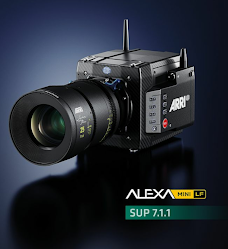
Large-format, high-resolution digital cinema cameras such as the Sony VENICE 2 and the ARRI Mini LF are popular for Virtual Production capture. Their resolution is beefy enough to handle ICVFX and their shallow depth of field helps to keep the volume wall in softer focus than the foreground, preventing moiré effects on the LED displays. High quality optical lenses such as the ZEISS Supreme Prime Radiance series are used to capture crisp, organic images with the option of controlled, customized flares. Based on Cooke i/Technology, the Supreme Primes' ZEISS eXtended Data Technology transmits lens data for frame accurate advanced


Camera Rig for Virtual Production

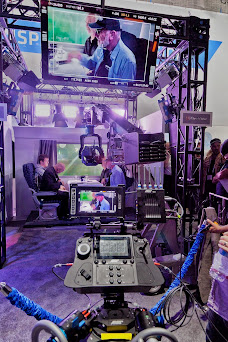
Dollies, cranes, and jib arms from providers such as J.L. Fisher and Kessler Crane enable you to position your camera exactly where you prefer and to create dynamic, engaging moves, making the most of volume stage's area. You may not be trekking from one exotic location to another, but stages can be quite large, so using equipment carts will save time and energy. Check out these Inovativ Voyager Carts for wheeling your camera rig around and supporting DIT setups, editing monitors, and other equipment.

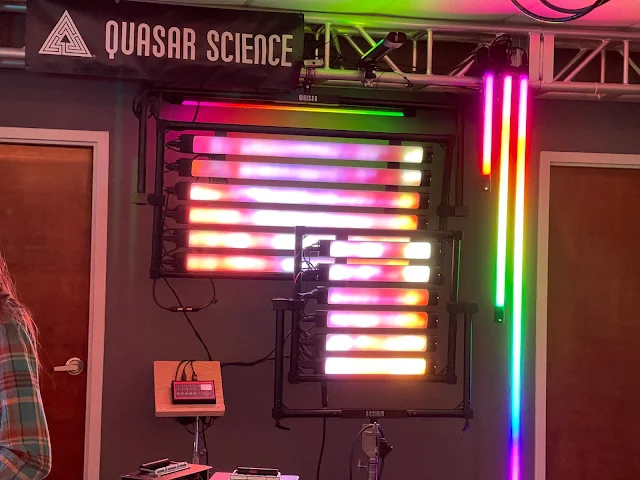
Quasar Science LED tube lighting

LED Tube lighting for Virtual Production

Augment the ambient light of your virtual background using LED panels like the Litepanels Gemini or ARRI SkyPanel series to cover large areas with more diffuse lighting. Turn to the Litepanels Studio X LED Fresnel lights for more shaped light output or use the ARRI Orbiter series or Quasar Science Rainbow series of LED tube lights for programmable, image-based lighting with pixel mapping.


Courtesy of Mary Latvis at B&H Photo Video & Pro Audio. All products described above are available for purchase at B&H Photo Video & Pro Audio.


Coming Soon, How to Build an LED Volume wall for Virtual Production