NAB SHOW 2013. METAMORPHOSIS

 By George Leon
KZ755AEW429R

Metamorphosis, the changing face of media and entertainment was the theme for this year and the NABShow has maintained once more its rank as the world's largest electronic media event covering filmed entertainment and the development, management and delivery of content across all mediums. "the NAB Show serves as the premiere event for content and communications professionals from around the globe," said NAB Executive Vice President Dennis Wharton. "We're thrilled by the continued support from our exhibitors and attendees, and delighted that NAB Show's brand remains a powerful enabling force for technological advancement in media and entertainment."

No reproduction, copying or download permitted. ©georgeleon/filmcastlive 2013. All rights reservedNo reproduction, copying or download permitted. ©georgeleon/filmcastlive 2013. All rights reserved
 The registered attendance this year rose to 92,414 with 24,461 international attendees and 1,703 news media attendees from all over the globe covering the daily activities and latest products and services.  Here are  some of the highlights of NAB Show 2013.

No reproduction, copying or download permitted. ©georgeleon/filmcastlive 2013. All rights reserved

No reproduction, copying or download permitted. ©georgeleon/filmcastlive 2013. All rights reserved
 At the North Hall showcasing Digital Asset Management, Storage, IT/Network Infrastructure and Security, 3G B/S, Signal Management, Systems Integration, Cloud Computing, Routers, Master Control, Newsroom Automation, Video/Content Servers, Multicast, Workflow Solutions.

No reproduction, copying or download permitted. ©georgeleon/filmcastlive 2013. All rights reserved
Q&A series with SPROCKIT participants by highlighting the founders and CEOs of featured organizations specializing in content management – Collective[i], Localytics and Standard Media Index. They’ve given us their thoughts on the SPROCKIT program, the media industry at-large, some interesting facts about themselves, and their plans for company growth.  

No reproduction, copying or download permited. ©georgeleon/filmcastlive 2013. All rights reserved
No reproduction, copying or download permitted. ©georgeleon/filmcastlive 2013. All rights reserved
At the South Lower Hall showcasing post-production including, Animation and VFX, Digital Intermediate, Editing Software/Hardware, 3D Technologies, Motion Graphics, Mastering and Duplication, Character Generation, Music and Sound Libraries, Subtitling and Closed Captioning, Encoding, Format Conversion, Workflow Solutions. 

No reproduction, copying or download permitted. ©georgeleon/filmcastlive 2013. All rights reserved
 At the Central Hall featuring Acquisition & Production, 3D, Cameras, Lenses, Capture Accessories, Lighting & Grip, Motion Capture, 4K, Virtual Production, Set Design, Motion Picture/Film, ENG Vehicles, Workflow Solutions.

Sony Presented a Concept 4K DSLR Camera
Alec Shapiro President of Professional Solutions America and  Toshihiko Ohnishi Deputy President of Sony’s Professional Services Group in Japan, presented what  the Sony  brass called “Our vision for the future.” introducing to attendees and journalists  2 concept  cameras  and a variety of lenses. Toshihiko described the showcase as the embodiment of Sony’s future development.

 Sony DSRL 4K concept camera. Courtesy of engadget

One of the cameras  is a DSLR that is destined to close the gap between  high definition  motion pictures and still photography with easiness of a DSLR.  Described as “the embodiment of Sony's future development,” the concept camera and complementary lenses were  not be previewed on the NAB show floor, and no other details were given, not even what resolution it would capture. Sony emphasized its 4K prowess at the event. “We're not bragging when we say Sony owns 4K just like we did with SD and HD,” said Phil Molyneux, president of Sony Electronics.

Academy Award winner Claudio Miranda, ASC, and DIT  Alex Carr will discussed their experiences shooting Universal Pictures "Oblivion," starring Tom Cruise.  They shared  insights into their use of the F65 on Oblivion, from which a clip was shown.and digital workflow and cinematography techniques used to create this major motion picture. Claudio discussed how he was able to shoot this futuristic thriller by candlelight, against front-screen projection and in high-contrast scenes.


No reproduction, copying or download permitted. ©georgeleon/filmcastlive 2013. All rights reserved
 An unlikely match, at least for now. Claudio Miranda, ASC and 
Tim Smith,  PPMD Manager at Canon USA. 

The shoot took place in a lot of different locations including in Iceland, where we had mostly overcast skies,” the cinematographer said. “The extra color gamut helped us capture some challenging dynamic range shots.”Alex talked about working with RAW files, multiple deliverables and the challenges of an international production. The panel discussion Q&A was moderated by Jon Fauer, ASC  of Film and Digital Times.

Blackmagic Introduces Two New Cameras
Blackmagic biggest news at the show was the introduction of two new models in their Blackmagic camera family: the Blackmagic Pocket Cinema Camera and the Blackmagic Production Camera 4K. The Blackmagic Pocket Cinema Camera will retail for $995 featuring  a magnesium alloy chassis, 13 stops of dynamic range, Super 16 sensor size, high quality Apple ProRes 422 (HQ) and lossless compressed Cinema DNG RAW recording, as well as interchangeable optics with an active Micro Four Thirds lens mount, all packed into an incredibly tiny size. 

 Shipping in July, the Pocket Cinema Camera is a highly compact and portable shooter compatible with MFT lenses from the likes of Olympus, Panasonic, Sigma, and Tamron, as well as pro cinema lenses via an MFT adapter. Other camera’s features include a 3.5-inch LCD, Micro HDMI out, external mic input, and SD card storage. Blackmagic says the camera contains most of the features of the larger Cinema Camera that was announced at last year’s NAB.

No reproduction, copying or download permitted. ©georgeleon/filmcastlive 2013. All rights reserved

The Blackmagic Production Camera retails at $3995 and is a new high resolution 4K digital film camera with an innovative large Super 35 size sensor with professional global shutter, combined with precision EF mount optics and high quality Apple ProRes 422 (HQ) file recording.

No reproduction, copying or download permited. ©georgeleon/filmcastlive 2013. All rights reserved

Also, Blackmagic Design announced the immediate availability of HyperDeck software update 3.6, a new update to its revolutionary solid state disk (SSD) recorder which adds support for Apple ProRes 422 (HQ) into HyperDeck Shuttle 2, plus new closed caption support for all HyperDeck models. At a retail cost of US$345, the HyperDeck Shuttle 2 with the new ProRes compression feature significantly reduces the size of uncompressed HD video files while preserving full frame 10-bit 4:2:2 quality, allowing customers to record up to six times longer.

With the addition of the new ProRes recording and playback, as well as full closed caption support, the HyperDeck Shuttle 2 provides customers with a small, affordable and battery powered solution that is the perfect field recorder. For direct camera mounting, HyperDeck Shuttle Mounting plate can be added to provide multiple pre drilled 1/4” and 3/8” mounting holes.

Angénieux Introduces its Optimo Anamorphic 56-152mm 2S Series Zoom Lens 
Angénieux  unveiled the first in its new anamorphic lens series represents an important step in Angénieux’s ongoing industry leadership in designing new optical technologies that enhance technique and creativity for Cinemascope production. The new lightweight Optimo Anamorphic56-152mm 2S (2x squeeze) Zoom Lens lends a film-like, dimensional character to images with lower distortion compared to typical anamorphic lenses.


“As an industry leader in zoom lens technology for film and digital production, we strive to develop optical innovations that enable cinematographers to bring their vision to the screen,” said Dominique Rouchon, Sales and Marketing Director, Thales Angénieux. “Our new Optimo Anamorphic56-152mm 2S Zoom Lens invites freedom of movement into the creative process with superior results, whether used in hand-held mode or on a Steadicam.”

Jean-Yves Le Poulain of Angénieux, showing the new anamorphic lens
and an Optimo DP 3D ready kit

With 2x squeeze, a fast aperture of T:4 and no ramping or breathing, the Optimo Anamorphic56-152mm 2S Zoom Lens delivers exceptional optical performance not previously achieved with an anamorphic lens. Based on the optical design of the world renowned Optimo 28-76mm (SOC award 2012, Academy of Motion Picture award 2009), the new Optimo Anamorphic56-152mm 2S Zoom Lens features all of the remarkable characteristics shared by the Optimo series, including pristine optics, high precision mechanical zoom system and 320° focus rotation with over 50 focus marks. 

No reproduction, copying or download permitted. ©georgeleon/filmcastlive 2013. All rights reserved
The unique optical design combines spherical and cylindrical elements in the same group, giving the 56-152mm lens exceptional sharpness and low distortion for an anamorphic zoom.Furthermore, the flexibility of a 2.7x zoom range is perfect for framing without the need to move the camera forward or backwards. The lens is extremely compact, weighing only 4.8lb or 2.2kg.The Optimo Anamorphic 56-152mm 2S is a PL mount lens with a PV mount available on request.

A New Camera Stabilizer 
 MoVi  is a new camera stabilization gear by Freefly, the maker of camera-drone equipment and stabilizers and since its release MoVi has created  a buzz  around the internet for the users of DSRL's and other  lighter digital video cameras.

No reproduction, copying or download permitted. ©georgeleon/filmcastlive 2013. All rights reserved

MoVI consists of a gimbal and 3-axis gyroscope that stabilizes the camera. The heart of the gimbal is Freefly’s proprietary high performance IMU and brush-less direct drive system. The gimbal is 100% custom designed in-house by Freefly engineering team.Freefly declares, no compromises were made to accommodate off-the-shelf brushless motors, motor drives or IMUs. Creating the gimbal from scratch has allow Freefly to precisely execute their vision for the next generation of stabilized camera gimbals and it is currently priced at $15,000, with a $7500 option coming in the near future. 

VectorMount,  A Vehicular Mounting Device
 VectorMount for GoPro is a vehicular mounting device for your GoPro designed to dynamically rotate the camera(s) and create a richer, more stunning composition of video. A dynamic, smooth, rotating camera mount that uses the natural motions of the vehicle and airflow to sweep the camera view across a horizontal plane.As the vehicle moves forward in a straight line the camera mount points the camera view forward.


No reproduction, copying or download permitted. ©georgeleon/filmcastlive 2013. All rights reserved

As the vehicle turns, a slide-weight assembly is affected by centrifugal force and causes the camera mount to swing, pointing the camera view into the direction of the turn, just as a driver would look into the direction of a turn. This creates an added dynamic to the video not captured by traditional static mounts.


You can use a single camera, or with the included silver 2X Conversion Kit, use two GoPro cameras and  to grab the view behind your vehicle as well as the one in front. Following  the action - and leading  it too. This is the package highly preferred by drift & track racers to improve technique, study the competition, and capture the moment.

Flightcopter,  A Sturdy Flying Drone
Flightcopter, is a company has been developing and manufacturing multi-rotor platform systems since 2007. Practical experience and individual user requirements has been the inspiration for these multi-use camera and video platform systems. All parts being manufactured, tested and assembled in Germany, ensuring the highest level of quality control in the industry. By using light weight carbon and aircraft aluminum materials Flightcopter produces platforms and frames, based on specific user specifications

No reproduction, copying or download permited. ©georgeleon/filmcastlive 2013. All rights reserved

 The Quadrocopter, Hexacopter and Octocopter frames are manufactured with the highest priority on functionality and reliability. We achieve this through rigorous flight t testing by our R&D team. All the frame systems can be easily assembled and disassembled using an unique "Plug-in-System"TM, which allows for easy and secure transportation. Within minutes the motor arms can be inserted, automatically aligned and secured. The "Plug-in-System"TM for the cantilever framework was invented and first  used in 2009. It has been continuously improved upon upon for all practical and specif c flight  situations.

No reproduction, copying or  download permited. ©georgeleon/filmcastlive 2013. All rights reserved

The center  plates are the centerpiece for various frame assembly options.  The  Hexacenterplates allow for the construction of a Y-Copter, Quadrocopter or Hexacopter. When using Octocenterplates a Quadro-, Hexa-, Octocopter can be assembled. During ordering you can choose a center plate, which will be securely mounted with either six or eight cantilever brackets. The motor mounts and the center plates are made of 2 mm carbon ber reinforced plastic (CFRP) . The controller cables are routed inside a 25 mm diameter carbon boom. For a safe and controlled flight, Flightcopter  recommends Hacker and Kontronik engines.

The Atomos Ninja 2
The Atomos Ninja 2 is a 10-bit HDMI video recorder that uses 2.5" removable drives for capture. The Ninja-2 is a portable, intuitive touchscreen-operated HD recorder, monitor and playback device for professional media producers. It captures pristine 10-bit 4:2:2 video and audio direct from any HDMI source: DSLRs, decks, switchers, PC, Mac, iPad and iPhone. The Ninja-2 consumes very little power, ensuring long recording times (up to 16.5 hours on a 750GB disk) and the efficient use of batteries.
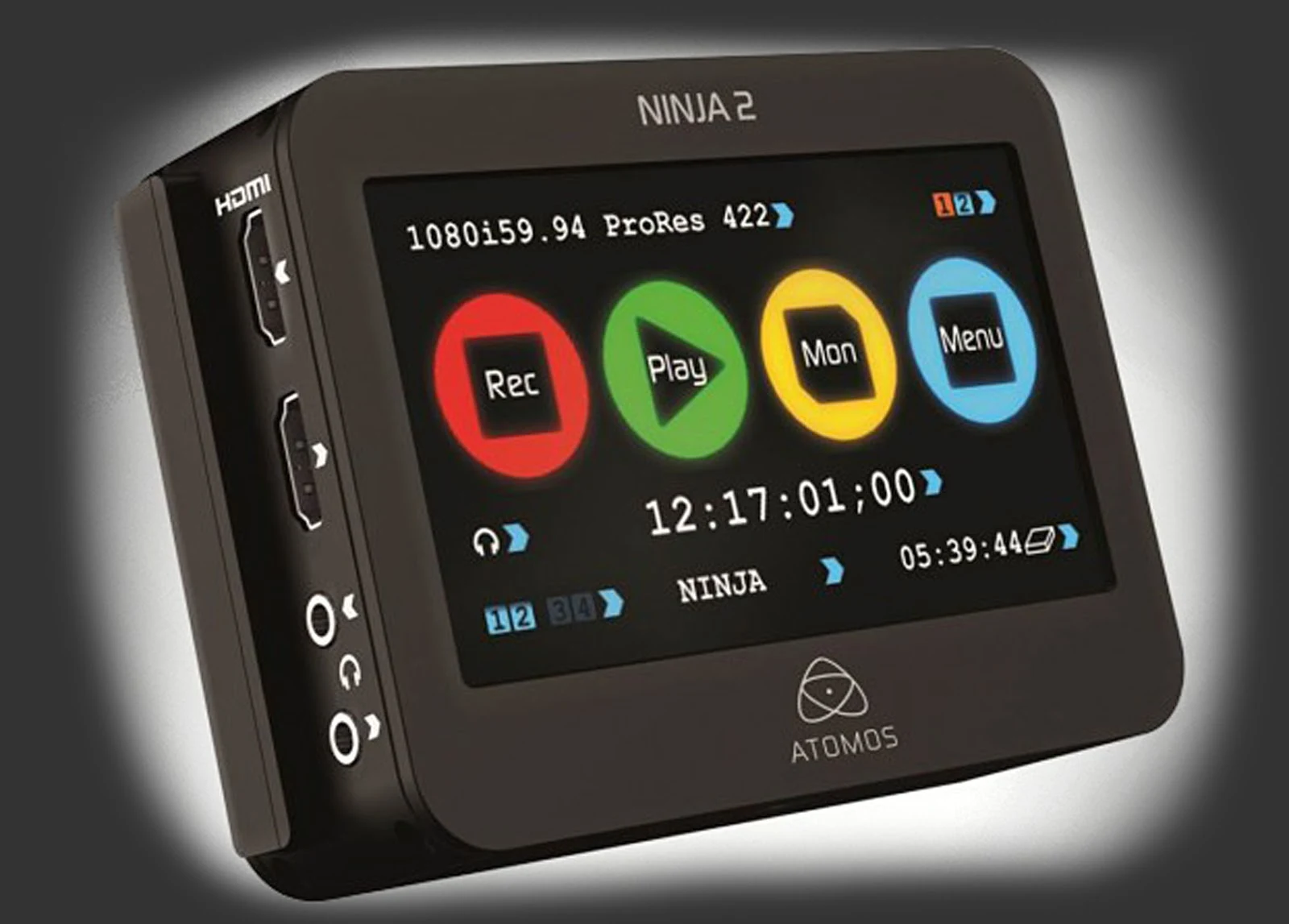

Capture content in real-time directly from the camera sensor and encode it to Apple ProRes or Avid DNxHD formats, eliminating the lossy, time consuming capture-to-edit process. Bypass the image-degrading compression of in-camera flash storage and use limitless and cheap storage on removable 2.5 inch hard disks.
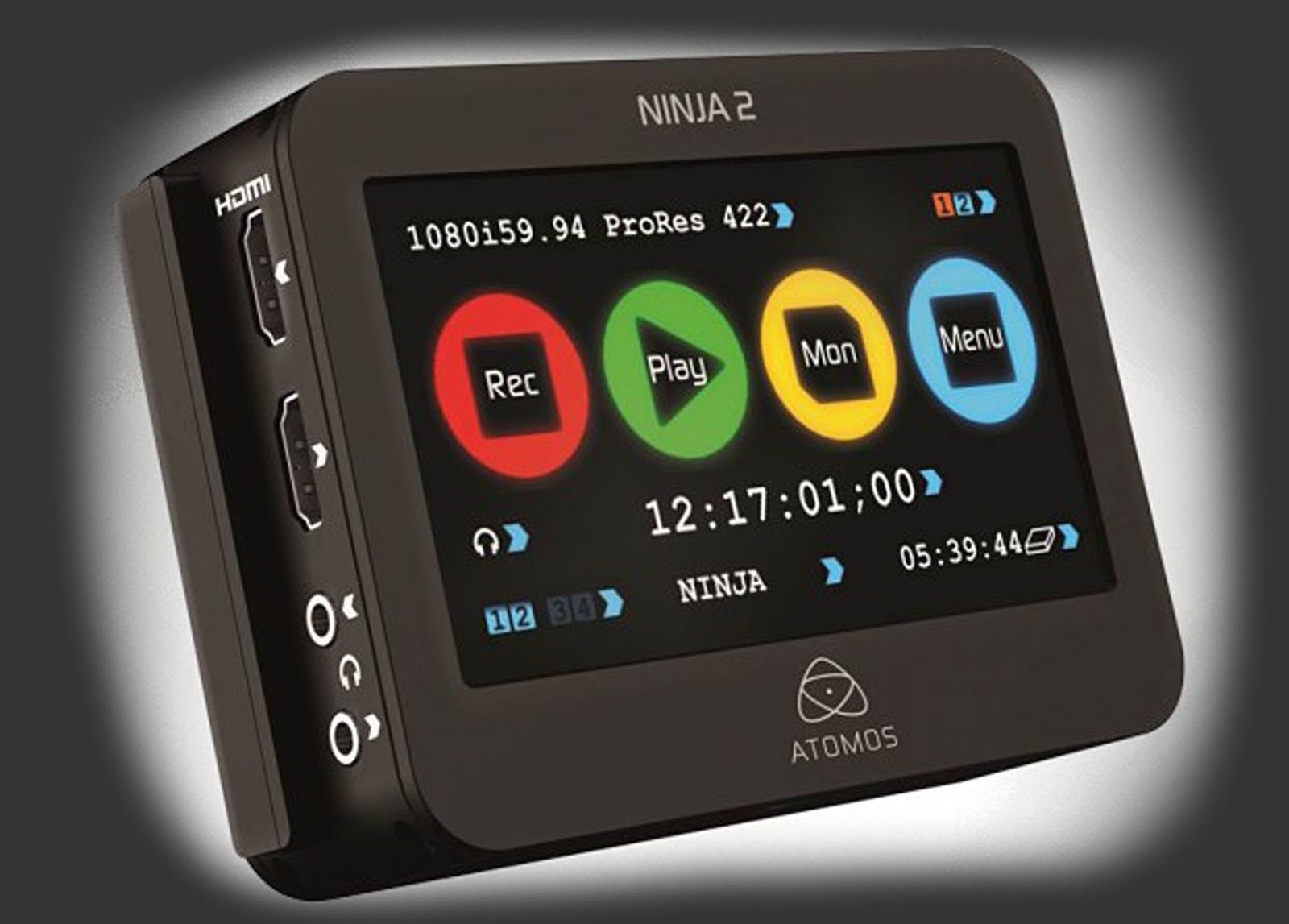
The Atom OS operating system driving the Ninja-2 allows access to all functions through a fast and responsive touch-screen interface. SmartMonitor helps you accurately assess focus and exposure with focus peaking, adjustable zebra, false color twin mode, blue-only exposure check and adjustments for individual filters. SmartLog allows you to get started on post-production in the field by logging and pre-editing your footage on the fly. The Ninja-2 is built from aircraft-grade aluminium. It’s light and can be mounted almost anywhere. All accessories come in a rugged case: batteries, chargers, disk caddies and a PC/Mac docking station.
Continuous Power allows you to unplug the depleted battery and replace it with a fully charged one without interrupting recording. The Ninja-2 comes with an AC power adapter and two Lithium Ion camera batteries, which offer up to 10 hours battery life for continuous power on location and on the road.  Most camcorders with an HDMI output will work with the Ninja-2 (and the original Ninja). DSLRs are a little different however, as it is only comparatively recently that they have output what we call a ‘clean’ HDMI video signal, without the viewfinder information embedded in it. The good news is that more and more DSLRs coming on to the market have this feature.
(photos©georgeleon/filmcastlive 2013. All rights reserved) 
CXNAPQKPFSXR

ASC AND BAFTA AWARDS 2013 CINEMATOGRAPHY NOMINEES

ASC Award Nominations/Feature Film
Seamus McGarvey, ASC, BSC (Anna Karenina), Danny Cohen, BSC (Les Miserables), Claudio Miranda, ASC (Life of Pi), Janusz Kaminski (Lincoln) and Roger Deakins, ASC, BSC (Skyfall) have been nominated in the feature film category of the 27th Annual American Society of Cinematographers (ASC) Awards for Outstanding Achievement. The winner will be announced at the ASC Awards celebration on February 10 at the Hollywood & Highland Grand Ballroom.


 “The films our members have nominated are visually distinctive, and very diverse: a theatrical epic, a grand musical, an imaginative 3-D fable, a sweeping biographical drama, and a stylish spy thriller,” notes ASC President Stephen Lighthill. “What they all have in common is that each project’s cinematographer contributed captivating visuals that enhanced and elevated the storytelling.”

This year’s nod brings Deakins’ total to 11. He won ASC Awards for The Shawshank Redemption (1995) and The Man Who Wasn’t There (2002). His other nominations were for Fargo (1997), Kundun (1998), O Brother, Where Art Thou? (2001), No Country for Old Men (2008), The Assassination of Jesse James by the Coward Robert Ford (2008), Revolutionary Road (2009), The Reader (2009) and True Grit (2011). He was also the recipient of the organization’s Lifetime Achievement Award in 2011.

This is Kaminski’s fifth nomination. His prior nominations were for Schindler’s List (1994), Amistad (1998), Saving Private Ryan (1999) and The Diving Bell and the Butterfly (2008).

Cohen, McGarvey and Miranda have all been recognized once previously – Cohen for The King’s Speech (2011); McGarvey for Atonement (2008); and Miranda for The Curious Case of Benjamin Button (2009).

For more information regarding the ASC Awards, visit the ASC website at www.theasc.com


 BAFTA Nominations for Best Cinematography 2013
Seamus McGarvey, ASC BSC  - Anna Karenina
Danny Cohen  BSC - Les Miserables
Roger Deakins ASC BSC - Skyfall


 For more information regarding the BAFTA Awards visit , www.bafta.org
For more information regarding the BSC visit,  www.bscine.com/

CANON EOS-1DC AVAILABLE ON DECEMBER 26

By George Leon

 Canon’s 4K DSLR EOS-1D C available on December 26, 2012. $11,999 on pre-order at B & H.

Designed specifically for the unique demands of the motion picture industry, the EOS-1D C Camera from Canon is a breakthrough in hybrid HDSLR technology--able to record stills, 4K and Full HD video, to either two on-board CF cards or uncompressed Full HD to outboard recorders.


 One of the largest benefits of having 4K video technology in a DSLR body is that it will be able to go places that other larger 4K cameras cannot, providing new ways of composing and capturing scenes. It is also compatible with the entire fleet of Canon EOS lenses already available, and perhaps already in your arsenal. If you're looking for a powerful yet versatile rig that knows what a cinematographer wants and needs, then Canon answers the call with this impressive offering.

The EOS-1D C was built to shoot cinematic quality, in a compact and versatile EOS body. It is able to capture 4K (4096 x 2160), 24p (23.976) content directly to its on-board CF memory cards. It does this by using an 8-bit 4:2:2, high bit rate Motion JPEG compression scheme--allowing 4K content to be acquired in virtually any shooting environment, without an off-board external recorder. Coupled with the camera's small form factor, the EOS-1D C allows 4K recording in environments that would normally be impossible or that would require much larger cameras, crews and permits. It also allows filmmakers to be discreet in crowded or hostile shooting environments, on and in vehicles, or even in underwater housings.


 In addition to its large pixel size--for outstanding still images and 4096 x 2160 video--the camera provides the serious photographer with a generous ergonomic design, along with a smart layout of the controls. Dual CF card slots ensure that every shot can be captured, while the magnesium alloy body is dust and weather resistant, allowing you to get the job done without hesitation, or worry. Producing the selective focus and field of view that made filmmakers fall in love with the EOS 5D Mark II, the standard Full-Frame HD setting on the EOS-1D C takes advantage of the camera's 36mm sensor width. This setting is ideal when filmmakers want to take full advantage of Canon's EF and EF Cinema prime lenses to capture that unique and distinct full-frame look--though Canon's EF Cinema zoom lenses require the Super 35mm Cropping setting, fixed focal length EF Cinema lenses will cover the area of a full-frame sensor As a new category of hybrid HDSLR cameras is created, capable of shooting 4K video--the motion picture industry standard--Canon and the EOS-1D C enter previously uncharted territory. Now cinematographers can shoot feature films from inside cars and planes, or documentaries using underwater housings--allowing a whole new perspective to be captured for the big screen.

Cinematic 4K Video
Putting the industry standard of 4K (4096 x 2160), 24p (23.976) video into an EOS-1D camera body revolutionizes the way feature films, documentaries, and television studios can record. Now instead of teams of workers, heavy and complicated equipment, and even permits just to use it all, you can get an enormous amount of versatility, mobility, and creative control without losing cinematic quality.

 The 1D C can also simultaneously output a time code stamped, uncompressed 8-bit 4:2:2 Full HD signal for off-board recording--Clean HD video via HDMI. While recording in this high quality, however, roughly each minute of recorded content occupies 4GB of storage space. Therefore, a 64GB CF card can record approximately 16 minutes of 4K content so you will likely come to rely on the dual CF card slots as they fill up faster than HD video on previous DSLR cameras.

Full HD Recording
The EOS-1D C is capable of recording Full HD (1920 x 1080) content to on-board CF cards with a choice of frame rates (24p, 25p, 30p, 50p and 60p), in two distinct fields of view (Full-Frame HD and Super 35mm Crop). Both are recorded as 8-bit 4:2:0 H.264 based Full HD video, and can be recorded at a number of frame rates all the way up to 60 progressive frames per second (which requires no up scaling in post when dropped into a 1920 x 1080 timeline).The 1D C's Super 35mm Cropping setting matches the motion picture industry's standard imaging format and angle of view when in a commercial or feature film env ironment. Using this setting will match the depth of field and angle of view used in virtually all digital cinema cameras on the market today (including the Canon EOS C500 and C300).
 Note: Canon's EF Cinema zoom lenses require the Super 35mm Cropping setting, since they do not cover the area of a full-frame D-SLR imaging sensor. Canon's fixed focal length EF Cinema lenses, however, will cover the area of a full-frame sensor.


 18.1Mp Full-Frame CMOS Sensor
 The EOS-1D C features Canon's full-frame 18.1 megapixel CMOS sensor that's designed from the ground up to create high resolution, perfectly detailed images with unprecedented speed and clarity. A full 24 x 36mm, the sensor captures 5184 x 3456 large individual 6.95 µm pixels and has a much-improved S/N ratio resulting in better images from the start. A photodiode structure with an increased photoelectric conversion rate increases the sensor's sensitivity by approximately 2 stops over previous models, meaning higher ISOs with the lowest noise of any EOS digital camera. And a 2-line 16-channel simultaneous signal readout means speeds of up to 12 fps (RAW + JPEG) and even 14 fps (Super High Speed Mode) are possible.

HD Compression Modes: IPB and ALL-I
 When recording 1920 x 1080 HD video with the 1D C to its on-board CF cards, the file type changes from that of the 4K Motion JPEG to the more familiar MPEG4, AVC, H.264 file types used in previous EOS HDSLRs. The two compression schemes that can be chosen during Full HD recording are "IPB" and "ALL-I." The "IPB" compression scheme (Interframe, Predicted Frame, and Bidirectional Predicted Frame), allows for good image quality and a significant reduction in overall file size compared to first generation HDSLR cameras such as the 5D Mark II, 7D and 60D. It is well suited for recording long, continuous clips where lots of tight editing and cuts are not as likely to occur in post-production. When using IPB compression, approximately 15 minutes of Full HD recording produces a 4GB file (though continuous recording file sizes are not limited to 4GB in the 1D C).
The second "ALL-I" compression scheme (All Intraframe), processes each individual frame as a complete image, and each frame can be edited with its quality still intact. This is ideal for situations where editors expect to make many precise edits to original video files. However the trade-off with ALL-I is that file sizes will be about 3x larger than those using the IPB method.  Therefore, a 4GB video file (Full HD 1920 x 1080) will contain roughly 4.5 to 5 minutes of video when recorded using the ALL-I compression method. That said, it still produces relatively small files and is the best choice for projects that will be widely distributed in a variety of formats.

Internal Audio Recording and Silent Volume control
Recording audio on the EOS-1D C can be done internally--using either the built-in microphone, or via an external microphones and a standard stereo mic jack. Automatically, or manually control sound levels over a 64-step, user-adjusted range. Like the EOS-1D X and EOS 5D Mark III, the EOS-1D C offers silent adjustment of audio (or exposure) settings with its touch-sensitive Quick Control Dial.

 Noteworthy on the EOS-1D C is a built-in headphone jack, simplifying greatly the task of monitoring audio during recording or playback. This is especially useful when combined with the silent control feature for adjusting audio levels during actual recording. However it is still recommended that when doing documentary, commercial, television or feature film production that the camera's audio be used only as a reference to sync with.

14-bit A/D Conversion, Wide Range ISO Setting 100-51200
The EOS-1D C not only offers 14-bit signal processing for excellent image gradation, it delivers higher standard and expanded ISOs, and a score of new options to enhance shooting in varied and fast-changing lighting situations. With a standard range of ISO 100-51200, the EOS-1D C represents a 2-stop increase in sensitivity over previous cameras. Thanks to the improved signal-to-noise ratio of the new sensor and powerful noise reduction, the EOS-1D C can shoot at expanded sensitivities down to ISO 50 (L) and up to 102400 (H1), and even 204800 (H2)! Beyond the obvious advantages of its wide ISO range, the EOS-1D C has automatic ISO settings, found on the dedicated ISO menu. Minimum and maximum ISO settings can be specified, as can a user-defined range, plus full auto and manual.

Dual DIGIC 5+ Image Processors for Enhanced Noise Reduction and Blazing Processing Speed
 For a whole new level of performance, the EOS-1D C uses Dual DIGIC 5+ Image Processors that include four 4-channel A/D converter front-end processing circuits and deliver speeds of up to 12 fps (RAW + JPEG) and 14 fps (JPEG). Compared with the predecessor, Canon's DIGIC 4 Image Processor, the Dual DIGIC 5+ Image Processor offers approximately 17x faster processing speed, and feature new algorithms that promote greater noise reduction at higher ISOs. In addition to conventional image processing functions the Dual DIGIC 5+ Image Processors offer real-time compensation for Chromatic Aberration in both still and motion images. With the power of these two processors, speed improvements are noticeable from the instant the camera is turned on and the stunning results speak for themselves.

61-Point High Density Reticular AF
The newly designed 61-Point High Density Reticular AF features an Offset Array Sensor (with staggering AF point arrangement) to deliver greater accuracy, no matter the situation. It offers multi-zone wide-area AF for better tracking, has 5 central dual cross-type points (f/2.8 diagonal), 21 central cross-type points (f/5.6 horizontal and vertical) and 20 outer cross-type points (f/4.0 horizontal), and is sensitive in extremely low-light situations (EV-2 for a central point with a f/2.8 lens).

 The EOS-1D C has a dedicated AF menu tab, so AF can be controlled without having to go through custom function menus. It also has 6 AF point selection methods (Spot, Single Point, Single + Adjacent 4 Points, Single + Adjacent 8 Points, Zone Selection, and Automatic AF Point Selection), plus a dedicated AF configuration tool for control of AI Servo AF III tracking parameters (tracking sensitivity, acceleration/deceleration tracking, and AF point auto switching).

The EOS-1D C uses the 100,000-pixel RGB Metering Sensor to aid the AF system in Automatic Point Selection. This dramatically increases the tracking performance for subjects that were previously unpredictable to follow, such as fast-moving or flying subjects. EOS iTR (Intelligent Tracking and Recognition) AF recognizes the subject based on face and color detection from the AE system, and tracks it using AF points. The EOS iSA (Intelligent Subject Analysis) System incorporates color recognition and Face Detection for proper exposure. Specific parameters can be adjusted and refined and saved in the AF menu for later use.

Magnesium Alloy Body with Shutter Durability and Dust and Weather-Resistance
For professionals who demand nothing less than the best, the EOS-1D C is designed to perform superbly, even in the most treacherous environments, every time. The body is constructed of rigid, high-strength magnesium alloy for rugged performance and features a new grip design for easier finger placement and reduced hand fatigue. Its newly redesigned shutter has lightweight and carbon-fiber blades, and is rated to maintain up to 14 fps performance without compromise, for up to 400,000 cycles.

Ultrasonic Wave Motion Cleaning (UWMC)
The EOS-1D C's integrated cleaning dust removal cleaning uses a carrier wave type self-cleaning sensor unit. While previous dust removal systems removed dust adhered to the surface of the infrared absorbing/ultraviolet-blocking glass in a frontward direction by vibrating the glass with ultrasound, the new system effectively rolls rather than shakes the dust particles off, removing an even greater amount of dust, especially smaller particles.  As with previous cameras, the IR/UV absorbing glass in front of the EOS-1D C's sensor is treated with an anti-dust fluorine coating making it easier to remove damp or sticky dust particles. As part of Canon's Integrated Cleaning System dust missed by the camera can be identified and removed using the Dust Delete Data feature of Canon's Digital Professional Pro software, bundled with every EOS digital SLR.

Intelligent Viewfinder with Superimposed LCD
The EOS-1D C's Intelligent Viewfinder offers a sharp, bright approximately 100% field of view with an approximate magnification of .76x, a viewing angle of 35° and a 20mm eye-point. With a new construction featuring aspherical lens elements, the viewfinder displays less distortions and color aberrations than previous models. It uses a transparent LCD to superimpose a customizable combination of focus points and gridlines directly over the image. The AF status indicator can even be directed to display within or outside of the viewfinders image area. With the intelligent viewfinder, unlike with other cameras, the photographer has the choice of seeing shooting information or looking only at the scene in front of the camera. The ability to effectively erase all shooting data and turn it back on with the touch of a button gives the photographer the opportunity to concentrate simply on looking and composing the photograph without distraction, a great advantage in numerous shooting situations.

ARRI KITS FOR THE BLACKMAGIC CINEMA CAMERA

Blackmagic Design announced today that ARRI, the world’s largest manufacturer and distributor of professional motion picture equipment, has introduced Ready to Shoot Kits for Blackmagic Cinema Camera.

Kits from the ARRI Pro Camera Accessories (PCA) line are built for a wide variety of users, situations and environments. Stable and reliable support systems, sturdy connections and quality engineering allow DPs to stay prepared and tackle a range of workflows in dynamic shooting environments. Starting at $1200, all Blackmagic Cinema Camera kits include ARRI’s Mini Base Plate MBP-3 and Camera Cage System, offering a non obstructive solution for the mounting of accessories through industry standard 3/8-16" and 1/4-20" interfaces, as well as a Universal Cable Safe System CCS-1, which protects internal electronics against accidental stress when using HDMI, USB or audio cables.

ARRI’s MBP-3 was designed to fit small form factor cameras, such as Blackmagic Cinema Camera, through dedicated adapter plates. Attaching the strong yet lightweight cage support system to the MBP-3 provides numerous 3/8-16” and 1Ž4-20” mounting points for arms and accessories and an ergonomic design allows for efficient set up and operation.
Because no two workflows are the same, the ARRI PCA set for the Blackmagic Cinema Camera come in several different configurations. The basic configuration adds an aluminum left side Support Arm CSL-1, providing solid support for handles and accessories, while still allowing for the use of handgrip and controls. The top of the line professional configuration comes with a Hot Shoe Bracket CHS-1 to prevent camera body flex.

Stephan Schenk, General Manager of ARRI’s Camera and DI Business Unit, comments, “All motion picture cameras need reliable and well-designed accessories to deliver the best results. The idea behind our Pro Camera Accessories range is to make film-style functionality available to users of all professional cameras that are real players in the market, which the new Blackmagic camera clearly is. Both Blackmagic and ARRI have responded quickly to customer demand, working together to create an accessory kit that improves the interface between camera and operator.”

“Seeing the addition of ARRI accessories for our Blackmagic Cinema Camera is incredibly exciting,” said Grant Petty, CEO, Blackmagic Design. “When we designed the Blackmagic Cinema Camera, it was vital that it could work with the best accessories possible to ensure quality, reliability and the ability to work in any production situation or location. ARRI’s PCA kits absolutely provide that.”

for more information visit Blackmagic Design

MORE ABOUT 3D. PINA BY WIM WENDERS

Pina 3D film by Wim Wenders
PINA is a feature-length dance film in 3D with the ensemble of the Tanztheater Wuppertal Pina Bausch, featuring the unique and inspiring art of the great German choreographer, who died in the summer of 2009. PINA is a film for Pina Bausch by Wim Wenders. He takes the audience on a sensual, visually stunning journey of discovery into a new dimension: straight onto the stage with the legendary Tanztheater Wuppertal Pina Bausch ensemble, he follows the dancers out of the theatre into the city and the surrounding areas of Wuppertal - the place, which for 35 years was the home and centre for Pina Bausch's creativity.
 PINA was filmed in Wuppertal in three stages: in autumn of 2009, in spring and in summer of 2010. In the first stage "Café Müller", "Le Sacre du printemps" and "Vollmond" were performed live on stage at the Wuppertal Opera House, some in front of an audience, and recorded in their entire lengths. The tight global tour schedule of the Tanztheater allowed only this window for the filming. In addition to the complex 3D recording, the challenge increased significantly with the live situation, because the recordings could not be interrupted or repeated. The complexity of a 3D live recording required intensive preparation and planning.
 

For the 3D image composition Wim Wenders convinced one of the most experienced 3D pioneers in stereography, Alain Derobe, to join his team. For the unique requirements of the shoot of PINA, Derobe developed a special 3D camera rig mounted on a crane. To create the depth of the room it is very important to stay close to the dancers and to follow them: "Normally, with a dance film, we would erect cameras in front of the stage, far away from the action on stage," says Alain Derobe, "for PINA we positioned the cameras between the dancers. The camera literally dances with them. Therefore, each crew member had to deal with the choreography. Everyone had to know exactly where the dancers would move so the camera could follow them and not be in their way."


3D PRODUCER ERWIN M. SCHMIDT TALKS ABOUT THE PRODUCTION PROCESS.
New possibilities with digital 3D technology.
Digital technology allows complete control of the image for the entire production process of a film: from the filming, to the post-production, to the screening in theaters. Thus digital technology has been instrumental in the recent 3D boom, overcoming the difficulties of analog 3D format that plagued the previous waves in the 50's and 80's. Digital cameras run synchronized and, like digital projectors, offer an absolutely stable image; both are crucial for the perception of 3D. When we began preparing PINA, the availability of complex equipment and experienced professionals was still limited. Luckily, we met the experienced stereographer Alain Derobe, who not only familiarized us with the mirror-rigs he had developed, but also enriched us with his knowledge and enthusiasm.

Preparation of the 3-D shoot
We prepared for the filming with a series of elaborate tests. In the summer of 2009, two months before the scheduled filming, we carried out a test shoot in Wuppertal, involving the film crew and the Tanztheater´s dancers and team, employing the same equipment we would then use for the main shooting. The aim was to simulate the shooting process and to test the reliability of the technical systems. These test shots were then post-produced and screened in a cinema. We carried out smaller tests right up to the main shoot, painstakingly acquiring the complex knowledge of 3D. The Tanztheater´s tight schedule restricted the shooting schedule; we simply could not afford errors and re-shoots.
 A complex 3D live system
Wim Wenders and the 3D Supervisor François Garnier developed a sophisticated system to control the telescopic crane, which was set up in the audience. For this purpose they divided the floor plan of the theater space into a virtual checkerboard and used a protractor, which corresponded exactly with the viewing angle of the camera lens. Using video recordings of previous performances, Wenders and Garnier could write a detailed schedule noting precisely where on the quadrant the camera should be positioned, at any given moment during the performance. During rehearsals and shootings, the director related these instructions via radio link to the team members.
  Wim Wenders talks about PINA stereographic process at Studio Q with Jian Ghomeshi

 The 3D technology used
To shoot in 3D you need two cameras mounted either side-by-side or in a so-called mirror-rig. In the latter, cameras are positioned at an angle of 90°. A one-way mirror is installed in between them, at a 45° angle to the two lines of sight. One camera films through the mirror, the other films its reflection. The various rigs used on PINA´s set were all prototypes, optimized by Alain Derobe for our shoot. The two camera systems we used were both made by Sony: large studio cameras (HDC-1500) for use on the telescopic crane, and smaller mobile units (HDC-P1) for the Steadicam. 
 3D limits the choice of focal length; wide-angle lenses cause distortion, while long focal lenses creates a silhouette effect. Extensive tests led us to three lenses: DigiPrimes with focal lengths of 10mm, 14mm and 20mm. Since changing the lenses in a 3D rig is time-consuming - and we had little time to spare - the focal length for each scene needed to be clearly established before shooting began.
 On set we used a special 3D Transvideo monitor to calibrate the rigs and to control the 3D effect. The monitor depicts the output of both left and right cameras as superimposed anaglyph images, so that the pixel offset between the two images is visible. In addition to the experience and creativity of our stereography team, this monitor was the most important tool.
 Challenges of live recording and 3D outdoor shooting 
We recorded the four dance pieces live, during sold-out performances. Therefore, we could not interfere with or disturb the dancers on stage. Yet we wanted the 3D rig as close as possible to them. The use of a long, telescopic crane gave us this possibility. Of course, the dancers had some initial qualms about a giant eye dancing with them on the stage, but this soon evaporated. We could thus capture incredibly close and dynamic images, giving the viewer the sense of being onstage with the dancers.
3D loves depth - that's why the solos of the dancers outside the theatre space are a perfect complement to the dance performances on stage. These spectacular scenes were shot in striking locations throughout Wuppertal and its surrounding areas: streets, forests, mountain slopes, industrial landscapes, and of course on the Wuppertal Suspended Monorail.
Excerpt text, pics, and trailer courtesy of HanWay Films
Video interview courtesy of Studio Q.

CANON LAUNCHES FILMMAKER AWARD PROGRAM

Canon U.S.A., Inc., launched the new Canon Filmmaker Award Program in partnership with Film Independent, the non-profit arts organization that produces the Spirit Awards and the Los Angeles Film Festival.  Open to eligible Film Independent Fellows, Los Angeles Film Festival alumni, and Spirit Awards Nominees and Winners, the program is designed to help emerging filmmakers ‘leave no story untold.’

 Tim Smith announcing Canon Filmmaker Award Program

Winners of the Canon Filmmaker Award Program will be lent a Canon Cinema EOS C300 camera package to create their next feature length narrative or documentary film, or in special cases, short films. Announced quarterly over the next year, the application process for the Fall Period opens today and will accept submissions until August 1, 2012.  

 Josh Welsh, Co-President Film Independent

“We are thrilled to be partnering with Canon, a company that shares our vision of supporting cinema as art, on this new Canon Filmmaker Award Program,” said Josh Welsh, co-president, Film Independent. “So many of our Fellows are already working with Canon's existing equipment, so to be able to shoot their films with these new cameras will truly elevate their production experience and bring their films to life.”


 Canon U.S.A. announced the new program at the 2012 Los Angeles Film Festival, a preeminent cinematic event presented annually by Film Independent at L.A. LIVE in Downtown Los Angeles.  From June 14-24, 2012, the Festival will screen nearly 200 feature films, shorts, and music videos, including Virgin airlines’ “Departure Date,” shot with the Cinema EOS C300 at 35,000 feet.  Just a few of the other projects on the Festival’s diverse roster that were filmed with Canon imaging equipment include “A Band Called Death,” “About Face,” “Beauty is Embarrassing,” “An Oversimplification of Her Beauty,” “Red Flag,” “Remote Area Medical,” and “Reportero.”


As one of this year’s Platinum Sponsors, Canon partnered with Film Independent to bring an exciting new slate of programming for filmmakers and festivalgoers, and on Saturday, June 16, 2012, Canon invited Los Angeles Film Festival attendees to explore the company's line of Cinema EOS products at the Filmmaker Lounge, including touch-and-try demonstrations of the acclaimed Cinema EOS C300, EOS 5D Mark III, and new 4K Cinema EOS C500 and EOS-1D C cameras.

  Shane Hurlbut, ASC, Nancy Schrieber, ASC and Richard Crudo, ASC

The experience culminated in the much-anticipated event “Canon Celebrates Cinematographers,” hosted by Shane Hurlbut, ASC, and Richard Crudo, ASC, where established and emerging industry professionals convened to honor the art of cinematography.  Canon, along with co-sponsor HBO, also hosted the annual Fellows and Industry Mixer at Katsuya at L.A. LIVE on Sunday, June 17, 2012. 

Jeff Cronenweth, ASC

On Saturday, June 23, 2012, Canon will screen “when you find me”—a short film produced by two-time Academy Award® winner Ron Howard and directed by his daughter Bryce Dallas Howard, as part of Canon’s Project Imagin8ion.  Immediately following the screening, Canon will host a unique panel discussion with some of the key creative and technical minds behind the production, including Kevin Chinoy, producer, Freestyle Picture Company; Andre Lascaris, director of photography; and Evan Pesses, chief lighting technician.  

 The event will close out with a screening of Dante Ariola and Jeff Cronenweth’s short “Man and Beast,” filmed with the new 4K Cinema EOS C500.  The screenings and panel, moderated by Canon film and television production advisor Tim Smith, begin at 10:00 am at Regal Cinemas L.A. LIVE 12.

All applications are to be submitted via the Film Independent website, 
http://www.filmindependent.org/labs-and-programs/grants-and-awards/canon-filmmaker-award-program/

FESTIVAL DE CANNES 2012. PALME D'OR WINNNER


 By George Leon

 Michael Haneke’s  ‘Amour’ wins Palme d'Or and Matteo Garrone’s Italian satire 'Reality' takes Grand Prix.The Cannes Film Festival rewarded one of its favorite directors Sunday, as Michael Haneke won the top prize for a second time with his stark film about love and death, “Amour, following his triumph in 2009 with The White Ribbon. The film is the tenderest in a career defined by unflinching brutality, as well as arguably the least cinematic: a two-hander set in a Paris flat. Haneke joined just five others to have won the Palme d'Or twice, including Francis Ford Coppola and Emir Kusturica.

Amour, which stars Jean-Louis Trintignant and Emmanuelle Riva as an elderly couple struggling to cope after one of them suffers a series of strokes, won universal praise on its premiere at the 65th annual festival last week, and its win was widely thought to be something of a certainty.

Some viewers were surprised by the movie’s frank humanity, coming from a master of tightly controlled cinema whose movies often contain sudden bursts of violence. The director said his reputation for delivering shocks was unjust. “Journalists always try to stick a label on directors,” he said. “For a long time I’ve been the expert in violence.” But he said a film’s style should match its subject matter, not its director, and “this film is about love.”
 Haneke has brought 10 films to Cannes over the years, including “Funny Games” and “Hidden.” He previously won the Palme in 2009 for “The White Ribbon,” and is only the seventh director to take the top prize twice.

 The Grand Prix (widely perceived as the runners-up award) went to Reality, Matteo Garrone's satire on reality TV, which met with a far more muted reception from critics than Gomorrah, his mafia hit from 2008. But there was much applause for Ken Loach, another surprise victor, this year of the Jury Prize (which ranks just below the Palme d'Or and the Grand Prix). Loach, whose The Wind that Shakes the Barley won the Palme in 2006, used his speech to send out a message of solidarity to those adversely affected by austerity and privatization.

His film, The Angels' Share, a larky whiskey heist, was screened with English as well as French subtitles at the festival, lest the Glaswegian accents prove a barrier for non-Scots. The film made headlines after revelations about its newcomer lead's stint in prison, and after Loach berated the British Board of Film Classification over what he considered their squeamishness over the use of the c-word. Mexican auteur Carlos Reygadas picked up the coveted best director award for Post Tenebras Lux, an experimental drama about a couple on a high-end sex holiday, whose children experience strange dreams. The Camera D'Or went to Benh Zeitli’s “Beasts of the Southern Wild,”  for best first film.

Filmcastlive
The best actor prize went to Mads Mikkelsen as a man ostracized by his small-town community when he is accused of child abuse in “The Hunt.” Jury member Ewan McGregor said Mikkelsen had given a beautiful performance whose “wonder is in the subtlety ... but with complete conviction with his character.”

 Best actress was won jointly by Cristina Flutur and Cosmina Stratan, as friends separated by faith in Romanian movie “Beyond the Hills.” Cristian Mungiu’s drama of love and faith in a remote Romanian monastery also won the award for best screenplay.


 The Paperboy

 There was little love for other English language cinema at the festival, including The Paperboy, Lee Daniels's noirish follow-up to Precious, starring an oft nude Nicole Kidman as an unstable woman who has an affair with Zac Efron. On the Road, Walter Salles's adaptation of the Jack Kerouac novel starring Kristen Stewart, walked away empty-handed, as did Cosmopolis, the David Cronenberg film featuring Stewart's Twilight co-star Robert Pattinson. 

  Hiam Abbass, Diane Kruger and Jury president Nanni Moretti 
arrive at "Amour" Premiere at the Palais des Festivals.

 The prize winners were chosen from among 22 contenders by a jury, led by Italian director Nanni Moretti, that included actors Ewan McGregor and Diane Kruger, director Alexander Payne and fashion designer Jean-Paul Gaultier.


COZUMEL CELEBRITY GOLF TOURNAMENT 2012

From May 31st to June 3rd the Cozumel Country Club will play host to the 2012 Cozumel Celebrity Golf Tournament, A promotional tourism event for the Island of Cozumel, Quintana Roo with the participation of 18 well known celebrities within the sports and entertainment industry from the USA and Mexico.

 Some of celebrity golfers participating on the charity driven event include NFL stars, Bob Beamon, Jorge Campos, Antonio Freeman, Eddie George, Andrew McCarthy, Ed Marinaro, Dave Parker, Bruce Smith, James Scott, Dave Stewart, Daryl Talley, Thurman Thomas, Billy Saint and more.


 The Celebrity Golf Tournament was announced last week to the press at L'Ermitage in Beverly Hills by a roster of organizers, celebrities and state representative. Juan Carlos Gonzalez, Secretary of Tourism for the State of Quintana Roo, Rodrigo Navarro, CEO Fanatiks,  Alex Vega-Biestro, Director QR Celebrity Golf, and Hill Street Blues star and golfer Ed Marinaro, were among of the participants making the announcement. the tournament will be a competition between groups of three and FOX Sports will cover the event and air an hour special of the tournament sometime in late June or early July.  

 First Cozumel Celebrity Golf Tournament press conference. 
Cesar G. Canavati, CEO Oveshion,  Alex Vega-Biestro, Director QR Celebrity Golf, 
Ed Marinaro,Actor and Celebrity Golfer, Rodrigo Navarro, CEO Fanatiks, 
 Luigi Mira, CEO Oveshion

 The golf tournament is sponsored by the state government of Quntana Roo, the local government of Cozumel, Fox Sports, Señor Froggs, Avis and other sponsors. Portions of the revenue gained from the tournament will be donated to two charities namely,  International Children and Dr. Smiles Foundation.

Since 1936, Children International, a top rated charity, has been providing assistance to children and families struggling in terrible poverty.Today, through the Children International® Sponsorship Program, we help children in 11 countries – Chile, Colombia, the Dominican Republic, Ecuador, Guatemala, Honduras, India, Mexico, the Philippines, the United States and Zambia. Dr. SMILES is a civil association dedicated to work for children with chronic and terminal diseases. The major diseases we work with are: AIDS, cancer, cystic fibrosis, and renal failure, among others.

 Hole 4 at the Cozumel Country Club

The Tournament will be  hosted at the Sabor Cozumel Resort and Spa and  it will be played at the Cozumel Country Club, a Jack Nicklaus designed 18-hole championship course. This 6,734 yard 72 par course extends itself around a  tree line surrounded by mangroves, swamps and the rest of the natural habitat of this beautiful Island. The  golf course is located only 15 minutes from the international port and 10 minutes from the Cozumel airport, making it accessible to all new visitors. There won't be any entry fee for spectators and locals to attend and spend the day at the Cozumel Country Club.

For more information visit http://www.fanatiks.com/cozumelgolf