AT THE SHOWBIZ EXPO 2010 LOS ANGELES
The past weekend I visited the ShowBiz Expo in downtown Los Angeles and I was bit surprised that they were sharing the Convention Center with the Cannabis Expo...it shows we are in Lalaland...and I do not have anything against it.. just that the landscape was bit "exotic" to me.
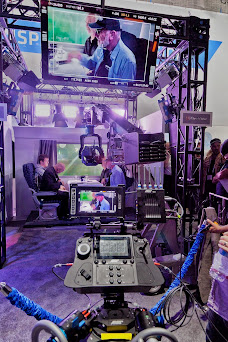
The CinePed, a panoramic 360° camera
support system, with a dolly hydraulic pedestal
Syd Wilder operates the rig
A couple years ago, I visited the ShowBiz Expo in New York City and I found there a very busy floor, but it was mostly geared to the acting, performance and theatrical industries. Here in Los Angeles, I was anticipating for the expo to be rather a meeting place for the production and post industries, but then again I found here a mixed bag of vendors mostly addressing the acting, modeling and performance industry and other few production related companies
.
The American Cinematographer booth offered their
flagship magazine and other educational publications.
It was a crowded stop for the attendees at the ShowBiz Expo.
The American Society of Cinematographers also conducted a
morning session focusing in the relationship between the
cinematographer and the performer. Pictured above is
publisher Martha Winterhalter and staff.
But nonetheless, it became evident that the attending public was also a mixed bag, a crowd of non-production , actors, performers and production people eager for information from the different vendors and workshops. The only session I was able to visit was the RED workshop "All want you want to know about the RED" and the panel provided a comprehensive session about the RED camera as they related their experience about production and work-flow to the attending public.
Michelle Danner, Executive Artistic Director of
EdgeMar Center for the Arts on Main, Santa Monica
Overall, The ShowBiz Expo it is a potential networking place not just for the uninitiated, but also for the professional looking for information, connections and orientation about the in-and-outs of acting, the performing arts and the different aspects of production, serving thus a good purpose to the industry as a whole in a town where these type of shows are commonplace.
Kenny Davis, COO of THE WRAP, one of leading online
news outlet and blog about everything Hollywood
RED Session "All what you want to know about the RED"
Jay Hoben, Technical Editor of Digital Video,
Christopher Proby, Brad Wilson, Raphael Smadja,
Jon Sagud of RED Cinema and Al Satterwitte
all cinematographers experienced with RED production
and workflow.
Scott Smith, production coordinator,
Craig O'Brien, cinematographer
Mary Tortomasi, operations manager
Skydive Perry Outdoor/Indoor Skydiving
Production Skydiving Specialists
Megahn Shriver, Maury Donnelly & Parr,
Production Insurance
A NEW ERA IN SPORTS: LIVE 3D BROADCASTING
by George Leon
ESPN To Launch First 3D Television Network. ESPN presented at the NABShow 2010 Content Theater, the super session ESPN: Scoring a Field Goal in S3D Sports to a pack house audience emphasizing on the creative and technical lessons that ESPN has learned producing sports in stereoscopic 3D -S3D-, how S3D impacts broadcast direction, workflows, graphics, camera placement and other key components of sports capture and exhibition. "The worldwide leader in sports" featured dynamic, never-before-seen S3D sports footage and addressed the network's vision for making a dedicated S3D channel a reality.
The panelists were Anthony Bailey, vice president emerging technologies, ESPN; Phil Orlins, coordinating producer, ESPN X Games; Vince Pace, CEO and Cinematographer, PACE; and Bob Toms, vice president, production enhancements & interactive TV, ESPN.
Earlier this year, "The industry’s first 3D television network" was announced by George Bodenheimer, Co-chairman, Disney Media Networks, and President, ESPN and ABC Sports. ESPN 3D will showcase a minimum of 85 live sporting events during its first year, beginning with the first 2010 FIFA World Cup match on June 11 featuring South Africa vs. Mexico. Other events to be produced in 3D include up to 25 2010 FIFA World Cup matches, NBA, X Games , college basketball, and college football, which will include the BCS National Championship game in Glendale, Ariz., January 10, 2011. Additional events will be announced at a later date."ESPN’s commitment to 3D is a win for fans and our business partners,” said Bodenheimer. "ESPN 3D marries great content with new technology to enhance the fan’s viewing experience and puts ESPN at the forefront of the next big advance for TV viewing.”
Sony HDC-1500 cameras, side by side dual lenses
Pace’s Fusion 3D technology
“This will be a meaningful step to drive adoption of 3D television sets and afford opportunities for our affiliates to create value through new product offerings, and our advertisers, who want fresh sponsorship opportunities,” said Sean Bratches, executive vice president, sales and marketing.
ESPN has been testing ESPN 3D for more than two years. Last fall, ESPN produced the USC vs. OSU college football game which was shown in select theaters as well as to 6,000 fans at the Galen Center on USC’s campus. ESPN has developed best practices for utilizing the technology in live game applications which have provided ESPN the ability to streamline workflow operations, adjust 3D camera positioning, test transmission and gauge fan reaction to a 3D telecast versus a traditional telecast.
Fusion calibration charts
ESPN relied on NEP's SS 3D truck, a 53-foot unit that ESPN first used to produce the Ohio State-USC college football game in 3D last September. The truck, which NEP built in partnership with 3D production specialist PACE, features a 3D viewing area where the production team can watch the action on 3D LCD monitors while wearing passive 3D glasses; a "convergence station" where operators can dynamically adjust the depth of field from multiple cameras; and 3D-capable tape, video and engineering rooms.
High Definition 2D and 3D Fusion Pace rigged cameras
covering the game
Key gear includes PACE’s FUSION 3D technology, which relies on stereoscopic camera rigs that use two Sony HDC-1500 cameras. SS3D is wired for eight 3D camera systems and houses a Sony MVS-8000A 4ME switcher, an NVision Envoy digital video router, NVision AES digital audio router, and SSL Aysis Air PLUS! digital audio console. One Chyron Hyper X3 graphics unit is on board, provided by PACE, and the truck is wired for two six-channel EVS XT[2] servers (the tape complement is à la carte, per client request).. SS3D features a 3D production viewing area (monitor wall provided by PACE), a convergence station, and 3D-capable tape, video, and engineering rooms.
3D Master Control and stereographers controlling
intrerocular and convergence
The production team, includes a director for both the 2D and 3D productions-with the exception of a stereo-grapher dedicated to the 3D pictures, and a separate tape producer who had the freedom to select different shots for the pre-recorded ESPN2 telecast.
Smaller High Definition cameras with
splitter lens for hand held EFP coverage
PACE's Fusion 3D camera system was used to shoot the sci-fi epic 'Avatar' - The film is a revolutionary blend of CG and live-action, all coming together in stunning digital 3D. PACE is the world's leading innovator in advanced 3D and Digital Cinema Systems.
Trusted by many of the top producers in the industry, the team at PACE, in collaboration with Director James Cameron, has designed and developed the FUSION camera system, capable of creating content in some of the planet's most extreme locations. The Pace Fusion 3D digital camera has two lenses side by side; the dual signals from the camera are sent by cable to a remote storage system. The camera's lenses can be positioned a variable distance apart for different shooting circumstances (convergence).
Watch a video clip about the Pace Fusion camera in our ON-DEMAND video playlist above
Trusted by many of the top producers in the industry, the team at PACE, in collaboration with Director James Cameron, has designed and developed the FUSION camera system, capable of creating content in some of the planet's most extreme locations. The Pace Fusion 3D digital camera has two lenses side by side; the dual signals from the camera are sent by cable to a remote storage system. The camera's lenses can be positioned a variable distance apart for different shooting circumstances (convergence).
Watch a video clip about the Pace Fusion camera in our ON-DEMAND video playlist above
QUASAR 3D / PANAVISION AT THE SOC
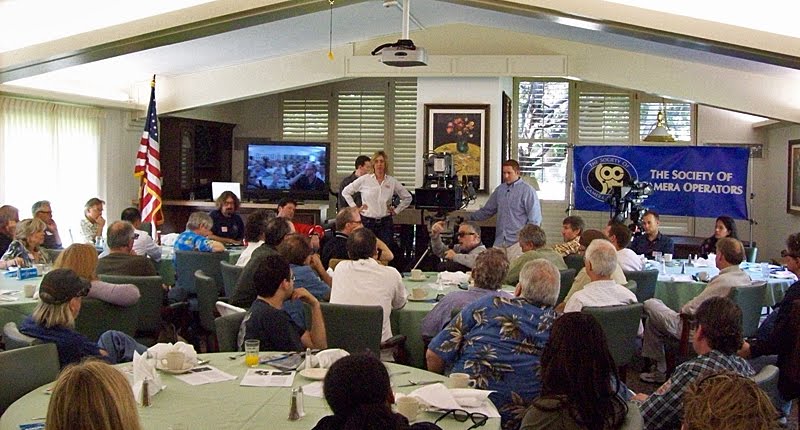
Panavision has added to its rental inventory the Element Technica Quasar 3D Rig fitted with Panavision Genesis cameras and Primo prime lenses. The modular rig was reviewed in a mini workshop Q& A presented by the the Society of Camera Operators (SOC) and held at The Motion Picture & Television Fund Country Home in Woodland Hills. Sharon Walker from Panavision and Chris Burket from Element Technica, explained the features of the stereoscopic rig and answered questions from the attending cinematographers and camera operators about the many technical and aesthetics details of acquiring 3D footage using the Quasar 3D rig. Other smaller 3D rig was presented, the Neutron, designed for 1/3 or 2/3 inches cameras such as Iconix or SI2K-mini.
Attending SOC members and guests
Panavision's Director of Service & Technical Standards,
Sharon Walker shared details about the Quasar/Panavision rig
Among other features explained is that the Quasar is a 3D tool that has been designed to be as simple to use as most modern 2D camera systems, making it possible for any filmmaker to create 3D content using their regular 2D crew and the Quasar is designed to accommodate full-size digital cinema cameras like the Sony F23 and F35, RED ONE, Panavision Genesis as well as full-body and box-type digital broadcast cameras like the Sony F950 and 1500, Grass Valley LDK cameras and others. The Quasar is a platform for matching zoom or prime lenses to accommodate any shooting style or format.
The Quasar 3D rig showing the two Genesis
cameras, stereo assist (zoom, focus, intrerocular
and convergence) and a Transvideo 3D
monitor on a Vinten head
Beamsplitter for 15mm to 250mm lenses
The Quasar’s modularity allows it to be configured as either a beamsplitter system for work with lenses from 15mm to 250mm or alternately set up as a converging side by-side system for use at with focal lengths of up to 2200mm or when close focus is not an issue. For the first time the precision and refinement of a beamsplitter system is offered in a side-by-side rig utilizing the same electro-mechanical components and same user interface.
Both beamsplitter and parallel configured camera platforms to accommodate cameras from the small sensor Iconix or S1-2K to fullsized digital imagers like the Genesis and Sony F35. These systems represent the first of a new generation of 3D imaging tools with fully embedded control electronics. Most systems will accommodate zoom lenses and offer synchronous control of focus, iris and zoom with the embedded electronics. The beamsplitter and parallel systems share the same basic mechanism and electronics for Intraocular and Convergence as well as the same user interface.
The Quasar 3D rig seen here shooting “Larger Than Life in 3D,”
a live concert featuring Dave Matthews Band.
Chris Burket, Technical Rep from Elements Technica explains
the Neutron 3D Rig for 1/3 or 2/3 inches cameras such
as Iconix or SI2K-mini. Here with Sony cameras
Quasar Rig Specifications: Camera and lens agnostic, designed for full body digital imagers: Genesis, Sony F23/35 & 1500 & RED. Beam Splitter: Compatible with prime lenses and small zoom lenses.
Focal length range (S35 format) 15mm to 250mm. Side-by-side: Compatible with all primes and most ENG/Cine zooms. Focal length tested to 2200mm (S35 equivalent). Rig weight without cameras: 36.6lbs. [16.6 kilos]
Isolated mirror box provides exceptional rigidity and precise alignment. Integrated motors and electronics for Inter Ocular and Convergence control Wired/wireless remote hand unit for Inter Ocular and Convergence control.
Click here for more technical and rental information about the Quasar3D/Panavision Rig.
About the Society of Camera Operators
The principal purpose of the SOC is to recognize and nurture excellence in the field of camera operation and, secondarily, in the allied camera crafts, and to encourage development of both technology and production methods which will help our members achieve that excellence.The Society sponsors an annual Lifetime Achievement Awards banquet honoring outstanding camera personages and their accomplishments in, and contributions to, the cinematic media. Also given are Technical Achievement Awards which are presented to the Corporate Community for technological advancements, honoring innovations benefiting the art and craft of camera operating.
Because the members of the SOC make their living with their eyesight, they take pride in supporting the Vision Center at Childrens Hospital Los Angeles with annual donations which helps underwrite contact lenses for infants with serious sight problems.
Active Membership in the Society is open to Camera Operators. Associate Membership is open to Directors of Photography, Camera Assistants and Still Photographers. Corporate Affiliate Membership is extended to participating corporations. Membership is open to qualified persons of any nationality.
Click here for more information about the SOC
by George Leon
NAB 2010 AT A GLANCE Part 1
The National Association of Broadcasters Show in Las Vegas is certainly the most important "global industry destination" if you want keep yourself abreast and informed of new broadcast technology, including education and services, and this year was no different. The registration to the NAB Show 2010 soared to over 88.000 plus registered attendees making a very crowded convention floor. This year, I met new manufacturing vendors offering the latest technology in equipment in all levels of the industry from production to post.
Las Vegas Convention Center at dusk
Gordon Smith, new President/CEO of NAB and two term Senator from Oregon opened the show on Monday addressing attendees and presenting the NAB Service Distinguished Award to Michael J. Fox for his commitment to raising awareness and money for Parkinson's disease research through the Michael J. Fox Foundation for Parkinson's Research.
Gordon Smith
Michael J. Fox receiving the NAB Service Distinguished Award
NAB from NAB president/CEO Gordon Smith
The Keynote speaker was Hiroshi Yoshioka, executive deputy president of Sony Corp. and president of Sony Consumer Products & Devices Group. Yoshioka's address focused on global and U.S. consumer demand for 3D technology and its mainstream adoption.
Hiroshi Yoshioka, executive deputy president of Sony Corp.
3D technologies are stronger and redefined this year. Mostly every digital video camera manufacturer is showcasing a 3D camera, such as Panasonic or have partnered with others manufacturers to offer 3D acquisition and workflow. In the second year of the popular 3D Pavilion, many of the vendors showcased digital 3D cinema products, consumer eye wear and 2D-to-3D conversion technologies.
Sony cameras coupled in a Element Technica 3D rig
(D.Malhmann photo)
(D.Malhmann photo)
Panasonic AG-3DA1 is the world’s
first professional quality, fully-integrated Full HD 3D
camcorder that records to SD card media.
(D.Malhmann photo)
3D was the topic at Sunday’s Panasonic press conference, which included a screening of material captured with the AG-3DA1 HD 3D camcorder and projected on a 152-inch Panasonic plasma display. Joe Taylor, chairman and CEO of Panasonic Corp. of North America, reviewed the range of products designed to bring 3D assets “from the camera to the couch.” The 3D Pavilion has doubled in size since its introduction last year. Also the attendees were able to see the latest developments on 3D production and content development from Hollywood at the Content Theatre. The Discovery Channel and ESPN presented Super Sessions such as Wednesday's "The Business and Technology of Sports Broadcasting: From Mobile Devices to 3D," sponsored by Level 3 Communications.
3D presentation at the Content Theater
Among new camera prototypes to be release in a future date is Sony's MPE-200 3D Processor, which provides a variety of digital adjustments to the stereo imaging HD cameras, allowing a similar control experience to mechanical servos. The MPE-200 digitally simulates several of the adjustments that are currently performed mechanically on higher-end rigs. The 3D Processor provides stereographic engineers a means to manage camera and rig parameters in order to deliver high-quality 3D images. MPE-controlled systems can also augment higher-end rigs in complicated 3D-live productions. Also purpose-designed for 3D production is the company's new HDC-P1 full HD compact multipurpose camera, which combines 2/3-inch CCD technology and a two-disc filter servo in a small and lightweight design.
The MPE-200 Sony 3D camera
Silicon Imaging unveiled the SI-3D camera at the NABShow . The new SI-3D stereo camera utilizes dual SI-2K Mini heads integrated with a single processor, which mixes and synchs the left- and right-eye images into a single 3D QuickTime file. These can be recorded with the new SI-3D Minideck Recorder, or fed into the new SI-3D Live system for stereoscopic SMPTE HD-SDI broadcast or 2K Cinema playback and projection.
SI-3D camera
Silicon Imaging unveiled the SI-3D camera at the NABShow . The new SI-3D stereo camera utilizes dual SI-2K Mini heads integrated with a single processor, which mixes and synchs the left- and right-eye images into a single 3D QuickTime file. These can be recorded with the new SI-3D Minideck Recorder, or fed into the new SI-3D Live system for stereoscopic SMPTE HD-SDI broadcast or 2K Cinema playback and projection.
The SI-3D offers filmmakers built-in tools for checking and adjusting camera alignment and parallax shift between the two views. All of the controls are accessible through a simple touch-screen interface. The stereo data is processed in one system, eliminating the need for a separate stereo processor to mix the two signals for a stereo display.
Currently, 3D content is captured from two independent left and right cameras, each with its own settings, color controls, record start, timecode, content management and monitoring outputs. A variety of complex “workarounds” are used to synchronize the recordings or combine the outputs for viewing. Other systems use a fixed optical system with highly compressed H.264 or J2K codecs to record, which either limit 3D depth for close-ups or large scenic views “When you shoot with two separate cameras, you have to do everything twice, and you need all these other boxes to mix the signal together,” said Ari Presler, CEO of Silicon Imaging. “With the SI-3D, all you do is point the camera, shoot, edit, and then do your 3D grading. This camera makes it all one streamlined process.”
A road attraction for the consumer crowd at the NABShow floor are the manufacturers of support equipment for the new digital VDSRL-HD cameras such as Red Rock Micro and Zacuto, both companies producing rods, matte boxes, follow focus, support brackets, and lens converters for consumer HD video cameras. The increment of use by filmmakers of the Canon D5/D7, Nikon D90/300 and the Panasonic Lumix have made these aftermarket products a must to have if you want to operate your digital VDSRL-HD and achieve maximum performance
Canon EOS with Matte Box and Follow Focus
(D.Malhmann photo)
Lighting changes or updates come to market in a slow pace but Mole Richardson, one of the oldest lighting company’s has stepped into the LED world this year at NAB with the announcement of their latest fixture, the MoleLED. Mole Richardson is a trusted name in the motion picture industry.
New LED fixture, the MoleLED
(D.Malhmann photo)
Mole worked with OSRAM Sylvania to develop the MoleLED using the OSRAM Sylvania proprietary Phosphor Dome Technology to offer a Tungsten and Daylight LED fixture. The MoleLED fixture consists of 12 OSRAM KREIOS LED circuit board, each containing 20 high output LEDs for a total of 240 individual LEDs, each topped with a remote phosphor dome. The phosphor domes are an OSRAM proprietary design, which are blue light activated to produce light in two exact color temperatures, Tungsten and Daylight. Measuring in at 15″ high by 3.5″ deep and just 18.25″ wide and a total weight of only 13 lbs with the yoke, the MoleLED is perfect for location lighting were lightweight and small compact design is required. There is local or DMX controlled dimming from 100% to 10% with auto sensing power supply from 100-240 volts and uses just 0.6 amps max draw on a 110 volt AC power input.
Twenty-First Century Camera Crew Panel
From Left to Right: Lewis Rothenberg, TNS Productions, Inc.;
Andy Romanoff, Panavision; Steven Poster, Int. Cinematographers
Guild; Jason Clark, Ways & Means Productions; Rodney Charters
Andy Romanoff, Panavision; Steven Poster, Int. Cinematographers
Guild; Jason Clark, Ways & Means Productions; Rodney Charters
Transvideo CineMonitor HD 3D View 12"
The first HD SDI monitor in the world for 3D D-Cinema field use.
The CineMonitorHD 3D View includes several mode to help
the operator to correlate cameras and to preview the
image in anaglyph mode. (D.Malhmann photo)
the operator to correlate cameras and to preview the
image in anaglyph mode. (D.Malhmann photo)
A view of the NABshow floor. JL Fisher
Manufacturer of motion picture and television
equipment. Dollies, pedestals and heads.
Jib Arms and Cross arms.
Audio Booms and Bases.
(D.Malhmann photo)
NewTek, manufacturer of industry-leading video and 3D animation products, today has launched TriCaster™ model TCXD850, the latest addition to the TriCaster line of high definition (HD) portable live production systems. This new TriCaster offers a 22-channel switcher, with eight HD or standard definition (SD) digital or analog inputs, two DDRs, titles, stills, two network inputs and eight virtual/mix channels.
“TriCaster TCXD850 takes the TriCaster product line to a new level of performance, introducing a rack mount system with significant new capabilities, at all levels of production,” said Andrew Cross, executive vice president, engineering, NewTek. “This latest TriCaster continues to change expectations about what is possible in HD live production, enabling producers to deliver compelling live events, successfully engage their audience and create new revenue streams.
more to come, part 2
“TriCaster TCXD850 takes the TriCaster product line to a new level of performance, introducing a rack mount system with significant new capabilities, at all levels of production,” said Andrew Cross, executive vice president, engineering, NewTek. “This latest TriCaster continues to change expectations about what is possible in HD live production, enabling producers to deliver compelling live events, successfully engage their audience and create new revenue streams.
more to come, part 2
George Leon
AATON PENELOPE DELTA AT NABSHOW 2010: C'EST MAGNIFIQUE
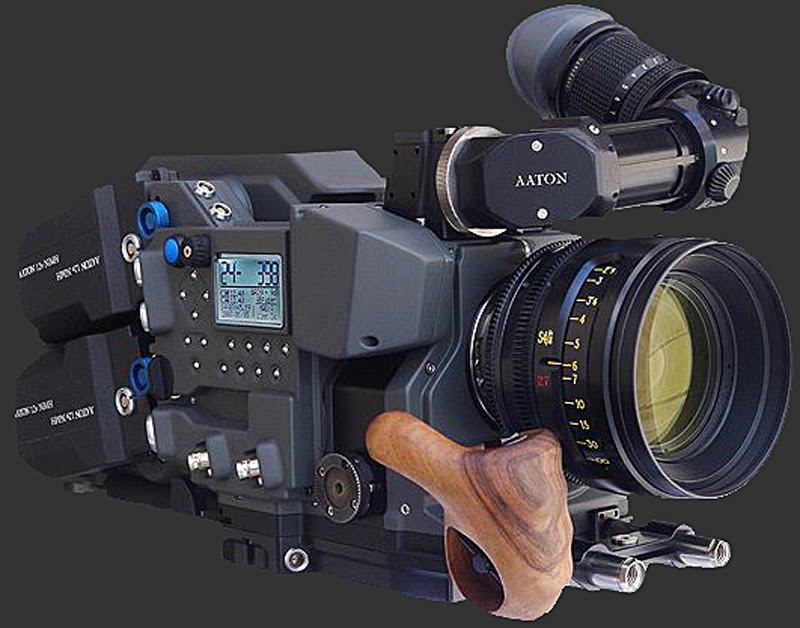
Among the many new or improved digital cinematography cameras showcased at the NABShow 2010 in Las Vegas, I have to bring your attention to the Aaton Penelope Delta, a 35mm film camera and a RAW uncompressed DPX/compressed DNxHD digital cinematography camera all rolled into one camera body. (The only camera in the motion picture industry switchable from Super35mm/2-3 perfs to DPX recording digiback in less than half an hour).
The camera was announced earlier this year by veteran camera maker and Aaton's founder Jean Beuviala at the AFC Micro Salon 2010 in Paris and since then I was waiting to see the camera up close and personal and I have to say that Aaton has done it again (Aaton die-hards agreed with me).
Aaton has created with the Penelope Delta, the first digital cinematography camera with the best ergonomic design for hand held operation to date. In the past, I have chose to work with Aaton cameras, from the original LTR/Origin C to the 35III, due in part to the same reason, ergonomics and much more, such as overall easiness of operation, specially for an one-man-band documentary camera crew.
With more of 40 years of groundbreaking camera making, since the implementation of coaxial magazines in the Eclair NPR and ACL, Beuviala and his team have combined the best features of an already superb 35mm film camera to develop a top of the line digital cinematography camera without sacrificing the sleek original design, Aaton cameras are known for. It is not a boxy awkward looking camera with hard edges, and it new digital untethered features are rather imperceptible to the untrained eye.
The slide-in lightweight (360 gr) 2.5" SSD Aaton DeltaPack® (compressed dailies -on SD cards- are simultaneously recorded) and electronic innards are housed in the "digital coaxial magazine" and it is capable to ingest uncompressed RAW DPX files of 4K+(plus) at up to 800MB/sec.(actual resolution of the image is not yet disclosed). The DNxHD format (10 bit hi rez)compressed dailies are a work-flow time saver, ready for edit, just import the files to your Avid or Premiere CS4 (with Adobe Media Encoder) system.
In the gate of the body of the camera sits the Aaton specific, Dalsa® CCD sensor with 13 stops dynamic range. One interesting feature is the that the 800 ISO basic sensitivity can be reduced to 100 ISO to virtually eliminate the use of ND filters (obscuring picture in the viewfinder) with close to 100% pixel-fill allowing for lenses with short exit-pupil distance, complemented with the original large and bright optical viewfinder from the Penelope camera.
Other features are, 4second boot time from zero power to REC-ready with three to six hour autonomy from 2 on-board Li-Ion batteries. Main selector accessible from both Operator’s and Assistant’s side for simple access to digiback commands, without sub-menus. The Assistant’s side screen displays essential shooting parameters: timecode, ISO, battery voltage, fps and remaining ‘footage’ (also visible on Operator’s side). 19dBA noise level in REC and PAUSE thanks to low power electronics and low speed air flow through large vents. HD422 (with view outside frame), and power socket for on-board HDSDI monitors. 19dBA noise level in REC and PAUSE thanks to low power electronics and low speed air flow through large vents located in the "coaxial digital magazine". Two outputs: HD422 (1.5GHz), HD444 (3GHz). One input: sync for 3D twins.
It is an Aaton switchable 2/3 perf. 35mm Penelope
or an Aaton Delta? The new design and digital features are
so integrated into the camera body that are almost imperceptible
to see from this angle.Answer: It is a 35mm Penelope
or an Aaton Delta? The new design and digital features are
so integrated into the camera body that are almost imperceptible
to see from this angle.Answer: It is a 35mm Penelope
In conclusion and a at first look, the Aaton Penelope Delta gives the impression to be as good as the French gastronomic cuisine... C'est Magnifique!. But let's wait for the development and follow through of all its features into the production model to market to test it in a real environment and to compete with the existent HD digital cinematography cameras out there.
The camera will be available next summer at a competitive industry price. For more info, visit Aaton or Abel CineTech. Also, learn more by watching Mitch Gross from Abel Cine Tech giving you the run down at NABShow 2010 of the Aaton Penelope Delta in our VOD video window. Click in our playlist and choose Penelope Delta.
by George Leon
MEETING ALEXA IN HOLLYWOOD
By George Leon
On Tuesday April 6, I was invited to the DGA theater complex in Hollywood for the ARRI pre-NAB Showcase featuring the newest addition to their digital camera line, the anticipated ALEXA. Following their motto "it's not just another digital camera, it's an ARRI", Volk Banehmann, CEO of ARRI USA presented the camera to an sold-out audience, emphasizing the technological advances integrated into the camera and gave warm thanks to the audience after announcing he is steeping down as CEO of ARRI USA and CSC and passing the torch to Glen Kennel who holds the post of Chief Technology Officer.
James Mather, Volk Bahnemann, Jon Fauer, ASC
As a highlight of the evening Fujinon also announced the introduction of two news lenses made specially for the ALEXA camera, the Arri-Fujinon Alura Zooms, a 18-80 T2.6 and a 45-250 T2.6. The evening went along with a presentation of the ALEXA specs and several video clips shot in different lighting conditions demonstrating ALEXA's picture perfect quality and extended latitude range.
David Darby, ASC, Bill Bennett, ASC and Chauncy Cummings,
FotoKem. Bill used the ALEXA camera and ARRI
lenses to shot a comparison test in an actual Honda TV spot
shoot.The clip was shot downtown Los Angeles and it was of
superb quality and excellent color reproduction.
FotoKem. Bill used the ALEXA camera and ARRI
lenses to shot a comparison test in an actual Honda TV spot
shoot.The clip was shot downtown Los Angeles and it was of
superb quality and excellent color reproduction.
ALEXA's Super 35 format CMOS Bayer sensor exhibits a cinematic, shallow depth of field with a base sensitivity of EI 800, low noise and an unsurpassed dynamic range of 13.5 stops and allows the use of all 35mm PL mount lenses. The sensor's 3.5K pixel count delivers an optimum in image sharpness, sensitivity and latitude for HD (1920 X 1080) and 2K DI workflows.
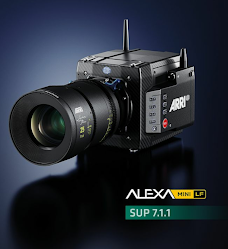
The ALEXA camera with the 45-50 T 2.6 ARRI Fujinon Alura lens
The camera touted as " the most advanced digital camera system with the highest dynamic range and sensitivy on the market" can simultaneously record Apple QuickTime/ProRes files, output uncompressed HD video and uncompressed ARRIRAW data onto on-board SxS memory cards. Also, ALEXA internal recorder encodes ProRes 422 (HQ) or ProRes 444 images, along with audio, metadata and Final Cut Pro (FCP) XML files. These files load directly into FCP for editing, coloring and finishing work.
An advantage to other systems is ALEXA' s easy upgrade to the module that holds the memory cards, which is removable and the camera electronics module which comprise the whole right side of the camera and can also be removed and replaced by upgraded electronics with advanced features.
The public milling around around the ALEXA and
discussing it's features
Although the camera weights 15 lbs. with bracket and
viewfinder - excluding the lens, it felt balanced and
comfortable on my shoulder.
viewfinder - excluding the lens, it felt balanced and
comfortable on my shoulder.
Chuck Lee, Fujinon Inc, Technology Manager
Bill Russel, ARRI V.P Camera Products.
Nancy Schreiber ASC, George Leon SOC, Douglas Knapp, SOC
Alexa 3D rig
For more information about ALEXA, read these past postings in FILMCASTLive! or experience the camera and other ARRI products at the NABShow in Las Vegas or visit the ARRI website.