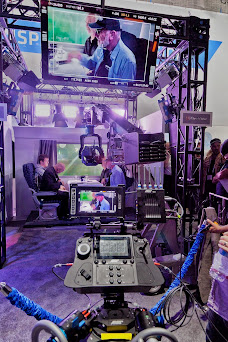
SONY PMW-F3

Sony’s new PMW-F3 is Sony’s third 35mm Cinealta Digital Camcorder and is based on the XDCAM EX platform. Specs of the F35 and SRW-9000PL still exceed the F3, we’re told, but this camera is no slouch, and footage shot with all 3 cameras should intercut. The F3, above all, is still a handheld camcorder. It doesn’t sit on your shoulder. It weighs about 5 pounds, which is lighter than many of the lenses you’ll be using. There’s a tilting viewfinder at the rear of the top handle. It looks similar to the HVR-Z7U finder: about 1.2 million pixels. An LCD monitor pivots out from the camera left side.  The new F3 camcorder is based on Sony’s XDCAM EX technology. There are 2 Sony’s SxS ExpressCard slots in back. The Super 35mm CMOS imager promises high sensitivity and low noise levels. The ballpark sensitivity rating is approximately ISO 800 and unconfirmed reports hint at an exposure range greater than 13 stops. 

There are HD-SDI dual-link outputs at the rear of the F3 for external recording (4:2:2 1080 50/59.94P normal; and RGB 1080 23.98/25/29.97PsF as an option). You’ll be able to select S-Log and Hyper Gamma to seriously increase the dynamic range. S-Log is Sony’s take on RAW “Digital Negatives.” The image, uncorrected, looks pale and washed out (like a negative), but when a Look-Up Table (LUT) is applied, shows the full dynamic range of the image, giving you greater flexibility for color and contrast correction in post.

The F3 records natively onto SxS Cards at 35 Mbps at 4:2:0 8-bit in XDCAM EX format. The SxS Cards are formatted in standard FAT file format; a 32 GB Card will record 100 minutes in highest quality. Many users will be happy with this. But, like Oliver Twist, many will want more. And they can have more–with the ability to use the onboard SxS Cards as immediately editable proxies, while simultaneously recording to a higher standard. That might include 4:4:4 10-bit S-Log HD-SDI dual link to an SRW-1 /SRPC-1 SRW tape recorder at visually lossless 440 and 880 Mbps or (next year) 1 TB Solid State Memory Cards at 220 and 440 Mbps.

Recording formats include 1920 x 1080, 1440 x 1080, and 1280 x 720 at 23.98/25/29.97p, 50/59.94i and, in DVCAM mode, 25/29.97PsF and 50/59.94i. Under- and overcranking is called S & Q for “slow” and “quick” recording, from 1 to 30 fps at 1920 x 1080 (17 to 30 fps in dual-link mode) and 1 to 60 fps at 1280 x 720 (17 to 60 fps in dual-link mode).

Who’s going to shoot with Sony’s F3–and how? If you’re a student or independent, you’ll probably take the simplest package possible: a zoom or primes, record to SxS onboard cards, and go direct to edit. Of course, you’ll be sure to diligently back up those SxS cards using Sony’s PXU-MS240 Mobile Storage Device, which not only backs up the cards, but also carefully checks the data to be sure it’s all there (parity). Next, you’ll copy the SxS card onto your Avid or Final Cut Pro system.  Go to www.sony.com/cinemon to download the Sony Cinemon plug-in: it enables MPEG-4 to be transparent to FCP Quicktime. You’ll be able to edit natively in FCP, with drag and drop, and all files instantly viewable on a Mac. Avid’s AMA (Avid Media Access) plug-in mounts the XDCAM EX files directly into Avid Media Composer.

If you’re shooting documentaries, commercials or TV, you might follow a similar path. Of course, you will not reformat your SxS Cards until the job is safely completed and many archives and copies have been cloned. Cards are relatively cheap. The dreaded word “Oops” is very expensive when a once-in-a-lifetime scene is re-formatted.

High end productions, recording to SR tape or memory, should soon have native support of SR codec on Avid and Final Cut Pro. The HD-SDI outputs of the Sony F3 will be eyed with great interest by the high-end after-market storage gurus at Codex, Cinedeck and elsewhere. At the rear of the camera: 12 VDC 4-pin XLR, dual SxS Card slots, HD-SDI dual link Out, HDMI Out, Composite Video Out, 2x USB ports, 700 Remote Control Port, and 3D Link. 3D Link is a future option that connects 2 F3 cameras in sync for stereo shooting. When connected, both cameras can be managed by one remote control. Genlock in and Timecode out are handled, along with Metadata. You’ll be able to record the left and right cameras onto one memory card, if you like.

The right side of the camera has a familiar Sony camcorder handgrip with zoom rocker control–a clear indication of commitment to an upcoming zoom lens specific to the F3. There are two 3-pin XLR audio connectors (Line/Mic/+48v). On November 17, the FILMCASTLive! team  will participate in a full hands-on demonstration presented by Sony  and after that presentation,  we will give you an assessment again, that it is not from a brochure or a press release.

CARLOS. A FILM BY OLIVIER ASSAYAS

by John Philip Jones,
Vancouver Editor 

Carlos impresses me on any number of levels. First and foremost by making a five and a half hour film, riveting. Carlos is a tour de force and is the crowning achievement for French director Oliver Assayas. 

Shown in three parts for theatrical release, the first part is ninety eight minutes long and not a second seems wasted. With the film moving from one international locale after another, at such a pace and without one slow moment it seems inconceivable to produce a two and a half hour version of the film for a television format.

Carlos was shot in 9 countries, spanning three continents and using the 11 languages of the playing characters, including Japanese, Russian, Hungarian, French, English, Arabic and Carlos’s native Caraqueño (Caracas accent) sounding Spanish sprinkled with conspiratorial whispering, audacious gunplay and Marxist dialectics.


One is left with the impression that one could sit forever holding on as the plot careens ahead. Edgar Ramirez the versatile Venezuelan born actor plays the part of Carlos, the Venezuelan-born terrorist Ilich Ramirez Sánchez, who became a member of the leftist Popular Front for the Liberation of Palestine (PFLP) and whose nom de guerre gives the movie its title. Edgar Ramirez plays Carlos with such “revolutionary internationalist” conviction that the critics compare him with Brando since the film was premiered at Cannes early this year.


 The film was entered in competition in Cannes but it was relegated by the jurors to the official program due to it cross platform. ”A made for TV Movie” and it’s financing by Studio Canal+, and conceived as a three-part television mini-series could not be counted as cinema, but by shooting the film in 35 millimeter negative stock and framing it with 2.35:1 aspect ratio (Cinemascope), Olivier Assayas ensures that the film does not resemble a just a “made for TV movie”. The use of hand held camera and other well placed camera movement as well as the intermingled editing provides a sense of time and landscape as well a sense of scale and depth that are all very cinematic.


 The first part (98 minutes) sets up the characters and events starting with the infamous "Carlos the Jackal".(Carlos was called The Jackal by The Guardian when Frederick Forsyth's novel The Day of the Jackal was reportedly found among his belongings). A younger looking Ilich Ramirez Sanchez comes off as an arrogant young bomb-thrower, an underground revolutionary playboy and womanizer, an international man of mayhem. Never a dull moment and it is full of unforgettable moments and potent gallows humor.


The second part  (106 minutes) shows Carlos as a seasoned leader of an internationalist organization that sees itself as the vanguard of a struggle against imperialism, Zionism, and whatever evil–ism catches its fancy. Their revolution, of course, never happened, but what was sometimes called “the Carlos Network” or “the Carlos Group” was nonetheless in the vanguard of future developments. Most of it centers on the unbelievably daring kidnapping of the oil ministers attending an OPEC meeting in Vienna in 1975 and the gunning down of two French officers in an apartment on the Rue Touillier in Paris and of a former colleague of his from the Popular Front for the Liberation of Palestine (P.F.L.P.) which serves as dramatic centerpieces in Assayas’s movie.


The last part (115 minutes) focuses on an anticlimactic finale with an overweight, bloated, yet still narcissistic Carlos who wanders errant looking for a place to call home, hindered by both, his past mistakes and a radically different world accentuated by the fall of the Berlin Wall and the abandonment of his backers to be finally captured by the French DST in Sudan.


The oddest thing about the film is the music. Totally anachronistic, at first it feels like an empty device. Suddenly, to the tune of Missing Boys and New Order, the world of international terror takes on the appearance of an MTV behind-the-scenes moment. One of Assayas’s better tongue in cheek moments, we are left with the impression that perhaps our boy wonder sees himself as a gun wielding rock star and this is his soundtrack.


Carlos's widescreen dexterity and aesthetic vision by Assayas are crafted for viewing in a theater. The cinematography by Denis Lenoir, AFC ASC and Dan Franck are both powerful and agile with a few stylistic flares such as retro 70’s production design and lighting. Assayas relies heavily on close-ups, probably on account of the film's mini-series origins. These enhance the closeness and accentuate the small size of the terrorist cells in comparison to their global enemies. Also, the proximity to the characters offers close-ups to their behavior and intimacy which adds to the feeling of being present.

 Illich Ramirez Sanchez at his trial in France. Though he has not
seen either version, he did issue vaguely menacing
challenges to its accuracy in the weeks leading up
to its big-screen debut at the Cannes Film Festival in May.


Carlos is definitely an epic worth watching in all of its five and a half hour glory. From the variety of filming locales to the extensive historical references, not a moment seems superfluous. Most films mercifully end after ninety minutes; Carlos could have been a little longer.

DV EXPO 2010


 The Digital Video Expo held last September 28-30 at the Pasadena Convention Center is an exciting place to visit and keep up with the latest technological advances presented by the participating vendors and manufacturers of the digital video industry.

At the Panavision booth

The Digital Video Expo is produced by the editors of DV and Videography magazines and the Creative Planet Community web sites. The Expo is targeted at the independent film industry and consists of two days of trade show exhibits with hands-on demonstration and many in-depth conference tracks on different industry topics such as, digital cinematography, lighting workshop, tapeless production, 3D production and post, web video and content production and delivery, HDSRL filmmaking bootcamp, tapeless post production workflow and more.

The Profit Formula conference by the Stimson Group

The exhibit floor of the DV Expo was evenly distributed with different vendors and manufacturers such as Tiffen, Azden Sound, JVC USA, Grass Valley, Lite Panels, Marshall Electronics, Panasonic, NewTek, Shutterstock, Christie and Schneider Optics among others.

At the Karl Zeis booth, Richard Schleuning explains the finer points

The most popular exhibits I found during my visit to the expo were Canon USA, were the Canon team was giving a hands-on presentation of their line of hyper popular HDSRL cameras,the EOS 5D Mark II, EOS 7D, EOS 60D and EOS 50D, Karl Zeiss, who was presenting their line of fast Cine Lenses, the Compact Prime CP.2 lenses now also with F-mount for the HDSRL cameras and Panasonic USA who was introducing the 3/4" Sensor AVCAM Solid State Camcorder AG-AF100 with interchangeable cine or photo lenses. Another popular stop was the Panasonic AG-3DA1 a fully-integrated HD 3D solid-state camcorder.

Tom Hallman from Pictor Vision and 
Bob Zupcka from Schneider Optics

Other popular exhibits were the aftermarket manufacturers for everything HDSRL such as Zacuto and JAG35 offering an array of brackets, rods, matte boxes, follow focus and viewfinders that allows you to shoot your HDSRL camera in an stable, over the shoulder ENG fashion and IDC photovideo with their IDC Run and Gun follow focus that allows to use you existent photo lenses for rack focus with a gear-less mechanism.

Varavon's ProFinder

The two most innovative products I found at the DV expo this year, were  Grass Valley's Edius 6 NLE software  and Varavon's Pro Finder. The ProFinder features  a convertible viewfinder  attachable to the Canon 5D and 7D. The ProFinder is  fashioned from the  typical medium format SRL 120 cameras waist level viewfinder  (Hasselblad, Rollei, Yashica, Mamiya) so you can view the image from the top at waist level. Also, with a flip of a switch, it converts to an eye-cup  viewfinder with diopter measurements included.  The view from above is clear and bright and it is reflected into a polished non-ghosting mirror allowing the operator to focus from a considerable distance. The ProFinder fit the two cameras and it comes with a specific mounting bracket for each camera.  I give kudos to this product due to the solid light construction, simple mechanism, sharpness of the waist view mirror, large eye cup, selective diopter and sealing gasket that protects any stray light out of the camera back screen.  I have many years of experience shooting with medium format still cameras (Hasselblad, Mamiya, Rollei) with a waist viewfinder and I know the advantages of being able to shoot your composition  with a convertible viewfinder. My only recommendation to Varavon would be the possibility  of  a protective etched glass (maybe a fresnel glass) to cover the mirror from spit and other debris from above and a proprietary mirror cleaning kit.

 Grass Valley's Edius 6 NLE software

In the area of post-production, I won't hesitate to integrate to my workflow the Grass Valley Edius 6, featuring a basic, entry-level range of tools. The EDIUS® 6 software works natively real time in 4K/2K to  proxy  24x 24, with many different video formats, such as Sony XDCAM, Panasonic P2 cards, Ikegami's GFCanon XF and EOS movie formats at different rates , such as 60p/50p, 60i/50i, and 24p. It is GPU accelerated for 3D transitions, with real-time effects, keyers, and titles and it operates on a Windows XP and Vista platform. It supports multicamera editing up 16 sources  simultaneously. Writes Blu-Ray and DVD from the time-line export. It export in AVCHD format to media card. All these features for below $800.  I am going to download a full operational trial version to install it on my Intel® Core™2 Quad Processor Q8400 (2.66 GHz, 4 MB L2 cache, 1333 MHz FSB) and edit a promo to evaluate what it seems very promising as a superior NLE than Adobe Premier and Final Cut.

 Martha Winterhalter, Publisher of American Cinematographer 
and crew

The conferences were outlined for the needs of the new digital filmmaker and experienced alike such as the Digital Cinematography training conducted by Gary Adcock, a comprehensive study on the next generation of cameras designed for digital filmmaking. Discussed cameras included the ARRI Alexa, Panasonic AG-3DA1, RED Epic and the RED One MX update.


Other interesting conferences were "HDSLR Camera and Lens Selection"  by Richard Harrington, CEO and Founder, RHED Pixel, Inc.,  "An Introduction to 3D for Producers and Directors" by Gary Adcock, Principal, Studio 37. and  "Live Streaming Production" by Ned Soltz, Contributing Editor, DV Magazine among many more.
In conclusion, the DV Expo in Pasadena is a must to attend if you are interested to keep up with the fast changing pace of the digital video technology and also if you want to purchase equipment or accessories at discounted prices during the expo.

ROGER DEAKINS WILL RECEIVE ASC LIFETIME ACHIEVEMENT AWARD

ASC LOGO AMERICAN SOCIETY OF CINEMATOGRAPHERS

Roger Deakins, ASC, BSC will receive the 2011 American Society of Cinematographers (ASC) Lifetime Achievement Award. The presentation will be made during the 25th Annual ASC Outstanding Achievement Awards celebration here at the Hyatt Regency Century Plaza Hotel on February 13, 2011.

Roger Deakins ASC BSC


 "The Lifetime Achievement Award is a reflection of the impact that a cinematographer has made on the art of film-making rather than the capping of a career," says ASC President Michael Goi. "It is our way of acknowledging a true artist in his prime. Roger Deakins raises the artistic profile of our profession with every movie and he will continue to do so for many years." Deakins has earned Oscar® nominations for The Shawshank Redemption (1994), Fargo (1996), Kundun (1997), O Brother, Where Art Thou? (2000), The Man Who Wasn't There (2001), The Assassination of Jesse James and the Coward Robert Ford (2007), No Country for Old Men (2007) and The Reader (shared with Chris Menges, ASC, BSC, 2008).


 His peers nominated all eight of those films and Revolutionary Road (2008) for ASC Outstanding Achievement Awards for feature film cinematography. Deakins claimed top ASC honors for The Shawshank Redemption and The Man Who Wasn't There."I had mixed emotions when I was told about this recognition," Deakins says. "To be honest, I am flattered, but I also feel like I am only just getting started. I'm enjoying what I do more than I ever have and there seems to be so much more I want to do. I feel like I'm getting this award about halfway through my career. It is great to realize that my colleagues watch my work and get something out of it."

 
ASC Awards Committee Chairman Richard Crudo observes, "Roger Deakins overcame formidable obstacles during the dawn of his career and went on to help create some of the most memorable films of our times. Roger has inspired young and older filmmakers to pursue what sometimes seems like impossible dreams." Deakins blazed a non-traditional career path. He was born and raised in the seaside town of Torquay in Devon, England. As a boy,  Deakin's passion was for painting but when he enrolled in the Bath Academy of Art his interest shifted to photography. When Deakins wasn't taking pictures, he was in the darkroom processing film and making prints.

 
After a brief stint as a professional photographer Deakins continued his education at the National Film School in London. Deakins estimates that over three years he shot more than 15 films for student directors, both dramatic films and documentaries ranging from 30 to 90 minutes each.

 
After graduation, he primarily spent the first seven years of his career shooting documentaries, the first of which required him to play the role of crew member as well as director/cameraman during a nine-month yacht race around the world. Deakins went on to work on many documentaries for British television, which included films on the liberation wars in Rhodesia (now Zimbabwe) and Eritrea, a study of mental patients within the UK National Health Service, and the life of the Nuba people of Southern Sudan. His first of some 50 narrative film credits was in 1983 for Another Time, Another Place, which aired on Channel 4 in England.

 
 "I've always chosen to work on films that are more than entertainment," he says. "I believe film can also be provocative and send audiences home thinking." Deakins has collaborated with an impressive array of directors, including Sam Mendes, Martin Scorsese, Ron Howard, Norman Jewison, Ed Zwick, Andrew Dominik and Michael Apted. True Grit, which is slated for release in December, is his 11th co-venture with brothers Ethan and Joel Coen at the helm.

INCENDIES WON BEST FEATURE FILM VANCOUVER FILM FEST 2010


Quebec director Denis Villeneuve's film Incendies has won the ET Canada Best Canadian Feature Film award at the Vancouver  International Film Festival. It is the second time Villeneuve has won the top Canadian film at VIFF; he also won in 2000 for Maelstrom. Incendies is adapted from a stage play by Wajdi Mouawad about twins who receive some shocking news in their mother's will: the father they thought was dead is alive, and they have a brother they never knew existed. The cinematographer is Andre Turpin. Sony Pictures Classics picked Incendies for distribution in Toronto TIFF 2010. Incendies is also the entry for Canada's Oscar Award Foreign Film Category.

Another Quebec film, Curling, by Denis Cote, was singled out by the jury, which included actor Deborah Kara Unger, director Sandy Wilson, Frank Samson of ET Canada and Andrea Henning, executive director of Arts and Culture for British Columbia. Halima Ouardiri, won most promising director of a Canadian Short Film for her 15-minute film Mokhtar.The U.K./Brazilian co-production Waste Land won the Rogers People's Choice Award, the top award voted on by VIFF audiences. It was directed by Lucy Walker.

A German movie set in the Congo, Kinshasa Symphony, won another audience award, most popular nonfiction film. It was directed by Claus Wischmann and Martin Baer. Director Sara McIntyre's Two Indians Talking won most popular Canadian film, as voted on by the audience, while Leave Them Laughing (directed by John Zaritsky) won most popular Canadian documentary. The environmental film audience award went to Force of Nature: The David Suzuki Movie, directed by Sturla Gunnarsson. The awards were handed out Friday night at the Granville 7 before VIFF's closing gala.

by jmackie@vancouversun.com

DIGITAL 16SR MAGAZINE BY P+S TECHNIK

The digital coaxial magazine has a 2/3″ Thomson sensor and records full 1920×1080 resolution in a visually lossless compressed RAW format on SSD cartridges or HD with a Cineform codec. Soon, selected customers will be able to buy a digital magazine, which will be limited to 30 fps, but later on up to 75 fps will be possible. The digital coaxial magazine is compatible with 16SR-1, 2 and 3 cameras up. Adaption to the camera is simple: just the film gate has to be switched to allow proper alignment of the sensor.
The magazine can be configured via a web interface, which allows the use of any device capable of displaying a website for configuration. It has internal WIFI, so basically any iphone or ipad can be used to control the mag. P+S also offers a reader for the memory cartridges and a dedicated post-production work-flow software, based on Silverstack by Pomfort.

The 16Digital SR Mag CMOS sensor produces cinema quality with a 2/3” image sensor in full HD resolution. Choose from CineForm 10bit RAW or 4:2:2 High Definition recording - exceptional pictures meet flexible workflow simplicity !
 This 16Digital SR Mag camera for Film & TV provides uniqueness due to Digital image capturing onto the opto-mechanical movie camera ARRI SRIII. Onset operation is close to film camera operation. 16mm lenses and accessories. Original optical viewfinder system. HD-SDI video assist (flicker-free) Magazine configuration via standard laptop/PC, iPhone or through existing 16SR camera interface.Standard removable SSD storage. Direct access to digital post production work-flow.

THE PRINCESS OF MONTPENSIER AT VIFF 2010


By John Phillip Jones

“Dealing with history teaches you to be analytical and teaches you to find out what's important. Not conventional history, but the history told by the new breed of historians that show that history is linked with fact, flesh, blood, passion. It's not just about remembering dates, but it's about making the history alive.” Bertrand Tavernier.

Although Bertrand Tavernier’s early work was dominated by mysteries, he has never shied away from social commentary as can be observed in “Ça commence aujourd'hui” (1998) and “Histoires de vies brisées” (2001). His advocacy of pacifism is evident in films such as “Life and Nothing But” (1989), “Capitaine Conan” (1998).Tavernier’s awards include a BAFTA for best film in a language other than English in 1990 for “Life and Nothing But” and four César Awards. “The Princess of Montpensier” competed for the Palme d'Or at the 2010 Cannes Film Festival.


“The Princess of Montpensier” is a costume drama set during the French Wars of Religion (1562-1598). The story, loosely adapted from Mme. De La Fayette’s eponymous novel, takes place between 1568 and 1571. The plot centers around the beautiful Marie de Mezieres (Mélanie Thierry), who in spite of being in love with her cousin Henri de Guise (Gaspard Ulliel), is forced into a more advantageous marriage by her father. Her husband to be is Philippe de Montpensier (Grégoire Leprince-Ringuet) who she has never met. The consummation of their marriage, with all the public in attendance, has more the character of a business transaction than romance.However Montpensier is unable to get acquainted with his new bride as he is called to the front. His young bride is left under the protection of Count de Chabannes (Lambert Wilson), an impoverished noble who had served as her husband’s tutor some time ago.


Marie cannot forget her first love, but finds a friend in Chabannes, her tutor. Chabannes unfortunately for him soon falls under her spell. The Duke of Anjou (Raphaël Personnaz) becomes the fourth in the list admirers. An imbroglio of epic proportions ensues as the couple is called to Court in Paris. Her husband becomes jealous on account of de Guise’s pursuit of Marie, who is initially hesitant, but soon gives in to his advances. The droll Duke d’Anjou, who is to inherit the throne from his soon to be departed brother Charles IX, pulls rank to put a stop to the affair. Chabannes, caring more for her happiness than his, nobly aids the Princess to spend a night with her forbidden love.

The film’s production is spectacular with sumptuous costumes and luxurious sets. The locations go from the rustic Château de Messilhac to the majestic Château de Blois. Tavernier possesses a painter’s eye for depicting both nature and architecture. Cinematographer Bruno de Keyzer’s mastery of light and shadow is worthy of a renaissance master. His camera work is nothing short of brilliant, depicting with equal talent the luxurious interiors of Blois or the wild beauty of Auvergne. Keyzer is able to capture the essence of diverse moments such as slaughter of battle or the intimacy of the bedroom with equal skill.

This is not his first collaboration with Tavernier, both having worked together in “In the Electric Mist”(2009), “Life and Nothing But” (2009), and “La Passion de Béatrice” (1987). De Keyzer won a César for best cinematography for his work in Tavernier’s “Life and Nothing But” . This is most certainly an art house film, especially since the history may be unfamiliar outside Francophone sphere. It does however serve as a useful antidote to Ridley Scott’s forgettable “Robin Hood”.

PLUS CAMERAIMAGE. MICHAEL BALLHAUS TOP HONORS

This year’s PLUS CAMERIMAGE Lifetime Achievement Award will be granted to Michael Ballhaus. A special retrospective review of his films will present some of his greatest achievements and the cinematographer himself will be a guest of the Festival. 18th edition of the International Film Festival of the Art of Cinematography Plus Camerimage will be held in the city of Bydgoszcz, Poland from the 27th November through 4th December 2010. 
 During the fifty-year career Michael Ballhaus worked on almost 120 movies (both feature films and documentaries). He was tree times nominated to the Oscar.Michael Ballhaus has worked for over nine years with Rainer Werner Fassbinder’s and worked steadily with Martin Scorsese on seven movies. He also collaborated with many other well-known directors such as Francis Ford Coppola, Mike Nichols, Volker Schlöndorff and Robert Redford.Michael Ballhaus was Born on 5th August 1935 into a German family actors. Max Ophüls was a friends to the family. He started his profession in television and by the late 1960´s he began to shoot feature films. From 1970 to 1979 he worked on 16 films directed by Rainer Werner Fassbinder including The Marriage of Maria Braun and Martha.

Ballhaus arrived in Hollywood in 1982 and his first American film was Baby It’s You, directed by John Sayles. Two years later his long-lasting cooperation with Martin Scorsese began. Together they made such films as After Hours, The Color of Money, The Last Temptation of Christ, Age of Innocence, Goodfellas, Gangs of New York and The Departed.

Ballhaus also worked on many other well-known movies, for example Working Girl, Postcards from the Edge, and Primary Colors by Mike Nichols, Bram Stoker’s Dracula by Francis Ford Coppola, Quiz Show and The Legend of Bagger Vance by Robert Redford, Death of a Salesman by Volker Schlöndorff, The Glass Menagerie by Paul Newman, Air Force One Wolfgang Petersen, and Sleepers by Barry Levinson. He was director of photography on music videos for example with Madonna and Bruce Springsteen.

Three times Michael Ballhaus was nominated to an Oscar: Broadcast News directed by James L.Brooks, The Fabulous Baker Boys directed by Steven Kloves, and Scorsese’s Gangs of New York. In 2007 M.Ballhaus received the International Achievement Award by the ASC, American Society of Cinematographers. It was the first time that a German Director of Photography was granted such an honor.

Plus Camerimage Festival Office
www.pluscamerimage.

THE ALEXA PLUS AT IBC 2010

The Alexa Plus  is the newest addition to ARRI’s line of (digital) cameras. The PLUS provides built-in lens control and lens data, familiar to Arriflex 416 Plus users. Owners of “regular” Alexa EV models are offered an upgrade path to the Plus at a reduced rate.
An Alexa Plus with Codex On-board digital recorder, 
 with ARRI Fujinon  Allura 45-250mm zoom, OConnor 2575D head S.
ARRI also introduced the RCU-4 remote control panel, which is capable of controlling everything that can be controlled via the camera display. In addition, a new wireless network adapter WNA-1 can be attached to the camera to control the Alexa via an external device such as computers or smartphones.

The Alexa is also 3D ready. ARRI showed (background in this picture) two Alexas on a Tango rig equipped with wireless lens, interaxial and convergence control, as well as an UDM distance meter.

Scroll up and visit  our Main Video Window and choose ON-DEMAND to see Product Manager Marc Shipman-Mueller talking  through the latest developments to the ALEXA digital camera system, including the new ALEXA Plus model, which incorporates wireless remote control, improved connectivity and the ARRI Lens Data System.

VANCOUVER INT. FILM FESTIVAL 2010 REPORT


Vancouver International Film Festival 2010 Report
by John Phillip Jones 
 
Rodrigo Prieto is one of the most sought after cinematographers in the industry today. Nominated for an Academy Award for his work in Ang Lee’s “Brokeback Mountain” (2005), he was also the cinematographer in Ang Lee’s 2007 film, “Lust, Caution”. He has also collaborated with Alejandro Inarritu on “Babel” (2006), “21 Grams” (2003), and “Amores Perros” (2000). He has also worked with Oliver Stone and for Spike Lee as the Director of Photography on “Alexander” (2004) and “25th Hour” (2002), respectively. He has collaborated with Julie Taymor in “Frida” (2002) and with Curtis Hanson on “8 Mile” (2002). “Original Sin” with Director Michael Cristofer (2001) was Rodrigo’s first big, American film, however he boasts an extensive list of credits in his native Mexico.
 Alejandro Inarritu and Rodrigo Prieto, AMC ASC

In “Biutiful” Prieto, who possesses a connoisseur’s eye for the rough quality of urban squalor, composes a dynamic vision of street life.  "Biutiful" means to offer a grimy antidote to the ubiquitous hedonistic representations of Barcelona. Seldom has the city been portrayed as a pit of crime and exploitation. Rodrigo Prieto's outstanding handheld camerawork enhances the tiny cramped interior spaces, and narrow streets of the Santa Coloma neighborhood to bring the viewer to an almost unbearable proximity with the characters and their surroundings.

Prieto offers a potent vision of street life with an eye for the textures of urban grime. The almost promiscuous closeness of the African immigrant’s digs, the prison barracks feel of the Chinese laborer’s accommodations and especially toilets are shot in heart breaking detail. The kinetic tour de force of the police crackdown of immigrant street vendors, provides a welcome respite to the to the film’s heaviness.  The film’s feel is overwhelmingly dark; the garish and libidinous nightclub scene only further accentuates the air of despair.


 Alejandro Inarritu setting up a shot using Rodrigo's Panavision
camera and lenses as a director's viewfinder.

 Javier Bardem under a gritty fluorescent illumination

 "Biutiful" resolves around Uxbal, played by Bardem in a performance worthy of at least an Oscar nomination. Uxbal, an underworld entrepreneur, seems to carry the weight of the world on his shoulders. He dabbles in many illicit activities, from importing illegal Chinese labor to supplying counterfeit goods to street vendors. He is also called upon by grieving relatives to communicate with their recently deceased loved ones to ease their way into the next world. He is a caring father who has custody of his two young children, as his estranged wife Marambra (Maricel Alvarez) is manic-depressive and promiscuous to the point of sleeping with his nightclub owner brother Tito (Eduard Fernandez). Apart from all the other hats he wears he also feels responsible for the welfare of his illegal wards. 


When Uxbal is told he has cancer and only months to live, he rushes to set his affairs in order. With the exception of Ige, a Senegalese woman (Diaryatou Daff) whom he hires to watch his children, the adults he deals with prove to be unreliable to an extreme. Even Uxbal's best intentions have fatal consequences. Bardem's physical and controlled performance makes clear it that first and foremost he is a loving parent.


 “Biutiful” is definitely destined for the art-film crowd; it is by no means fare for suburban multiplexes. It is far too emotional and raw. The hand that life deals Uxbal is far too harsh, and the downward spiral has almost no uplifting moments save his daughter’s birthday and Ige’s almost imperceptible return. Hopefully, Prieto will manage and/or allowed to work his magic in Oliver Stone’s sequel “Wall Street”.


The film is one of five productions in a $100 million deal between Gonzalez Inarritu, Alfonso Cuaron, Guillermo del Toro, and the film companies Cha Cha Cha, Universal Pictures, and Focus Features International. Soundtrack by Gustavo Santoalla.